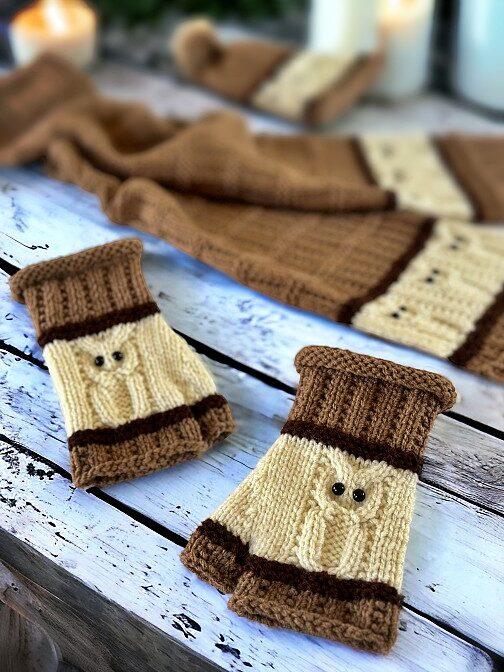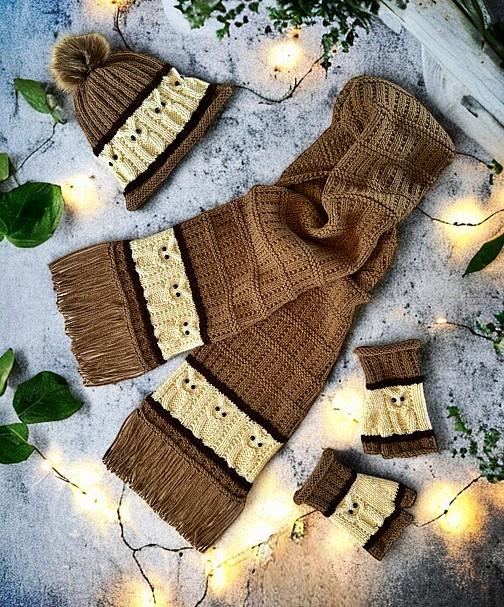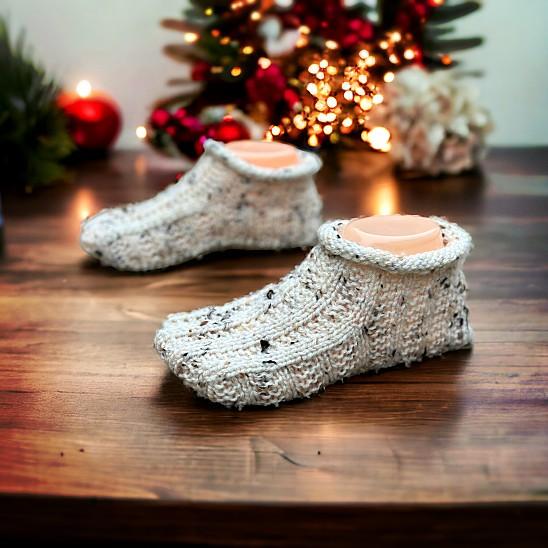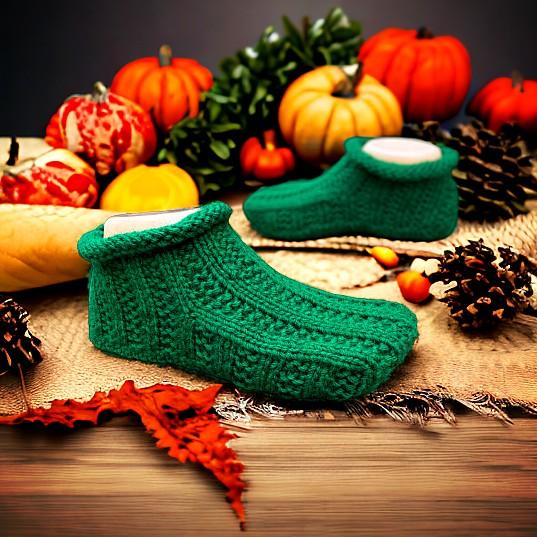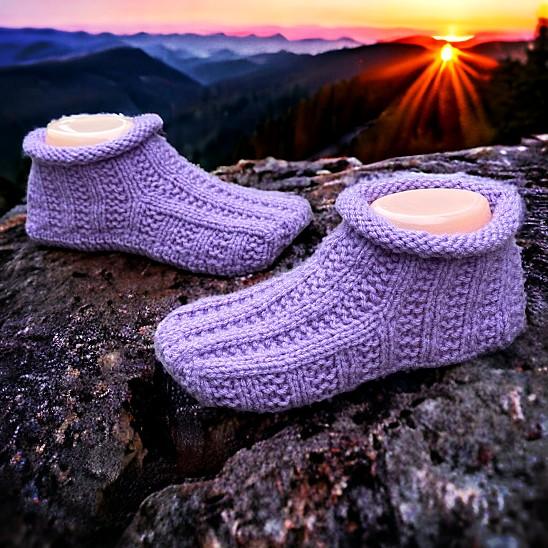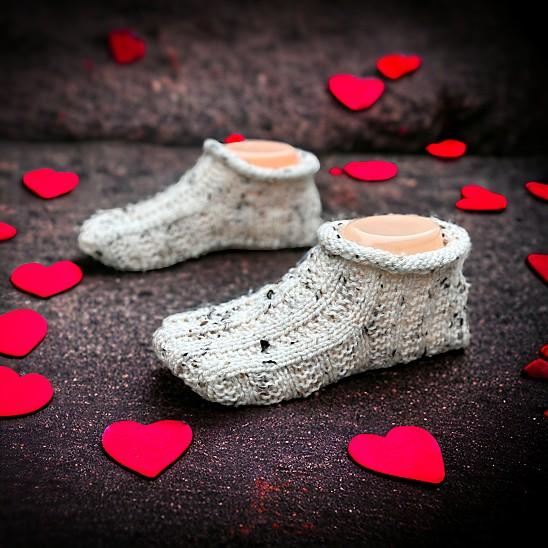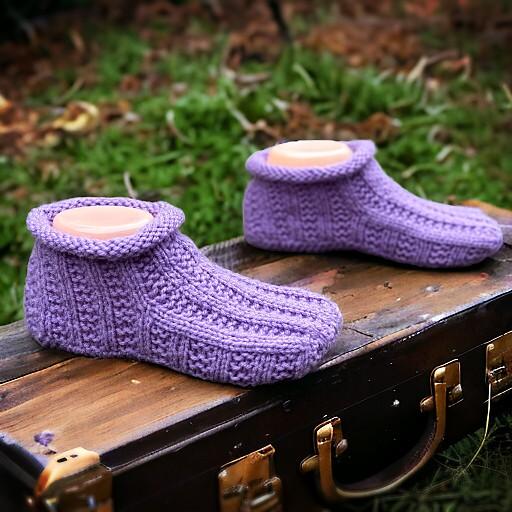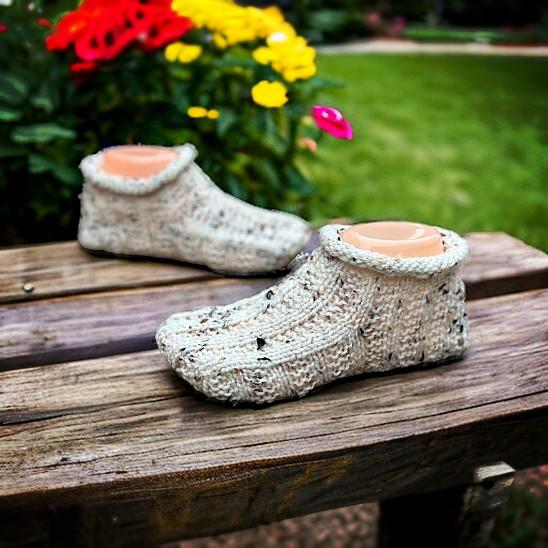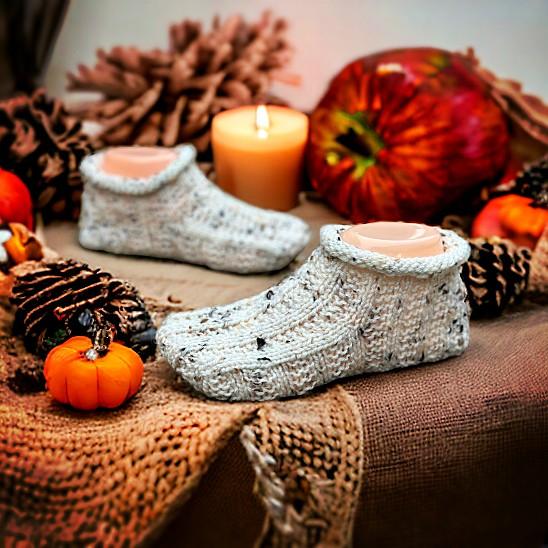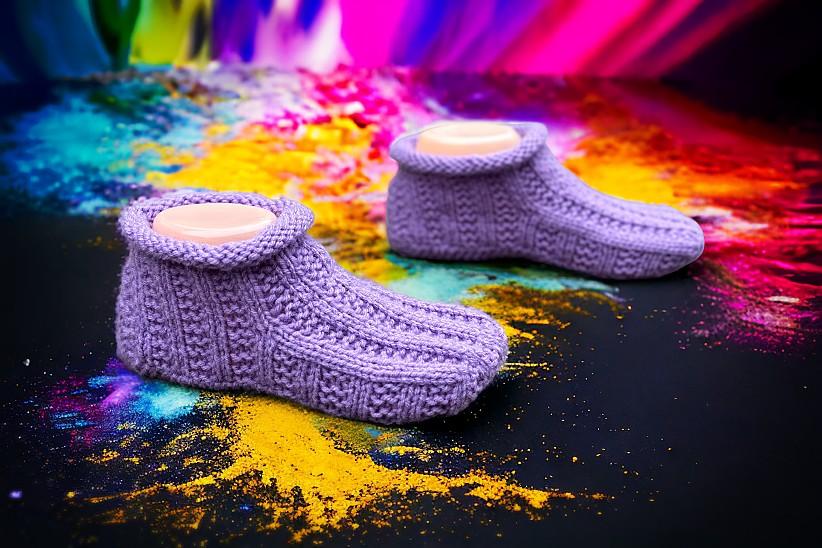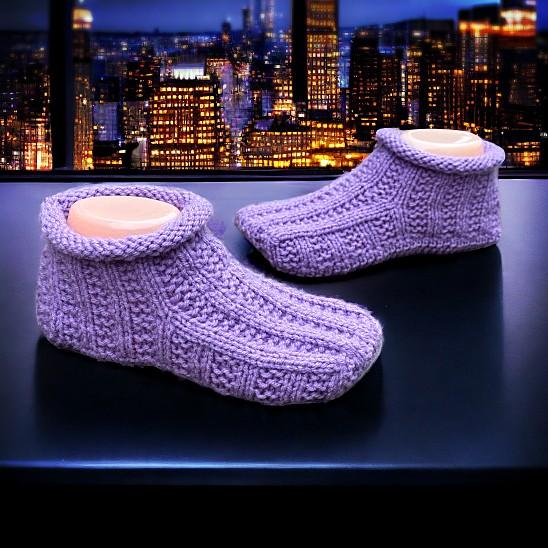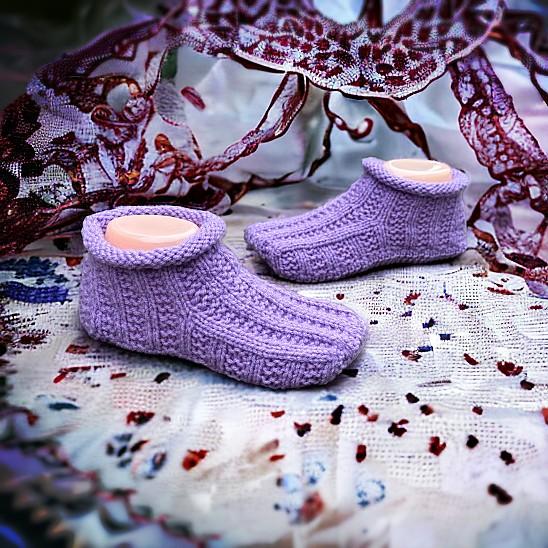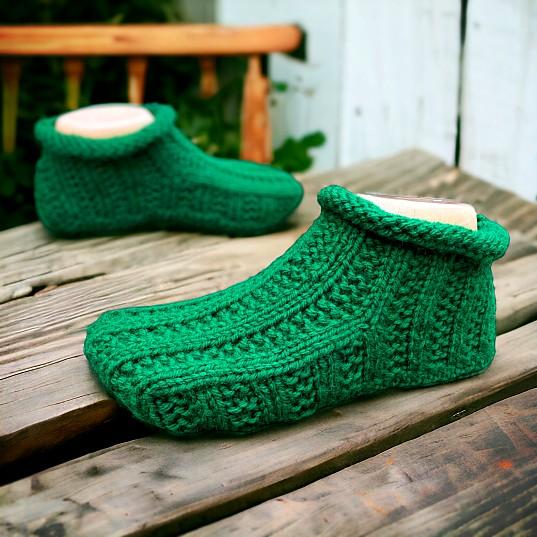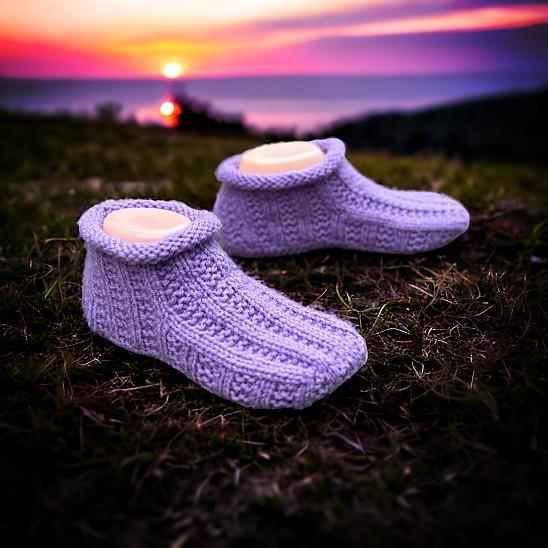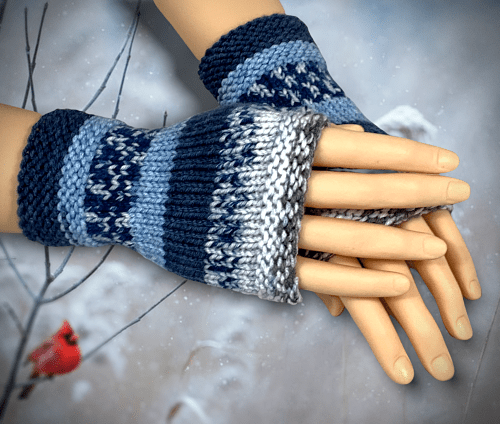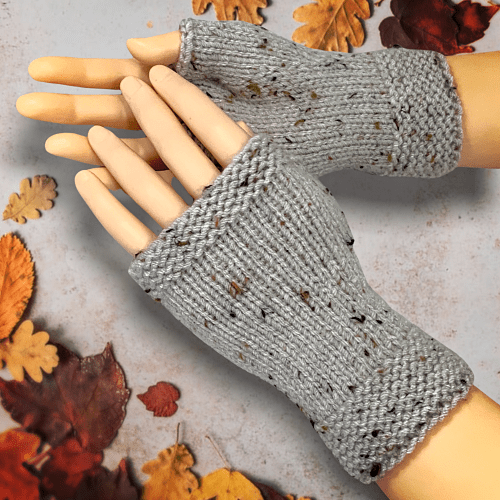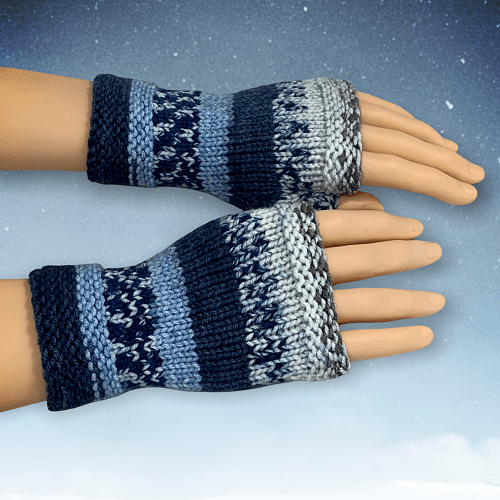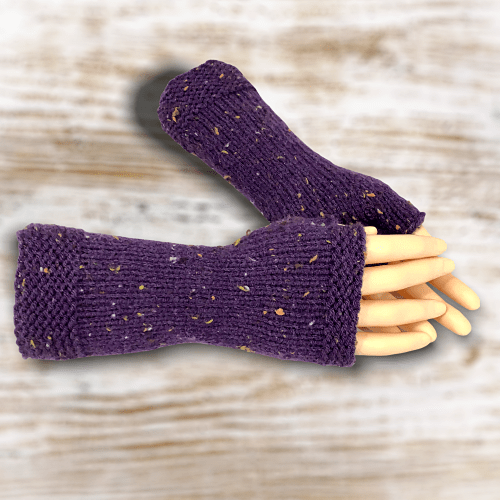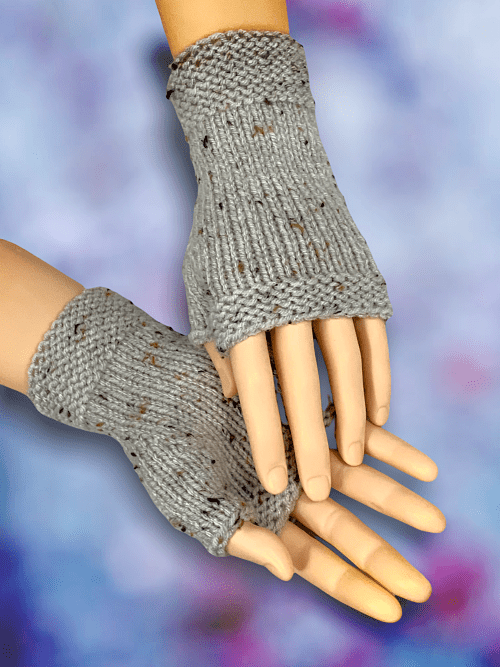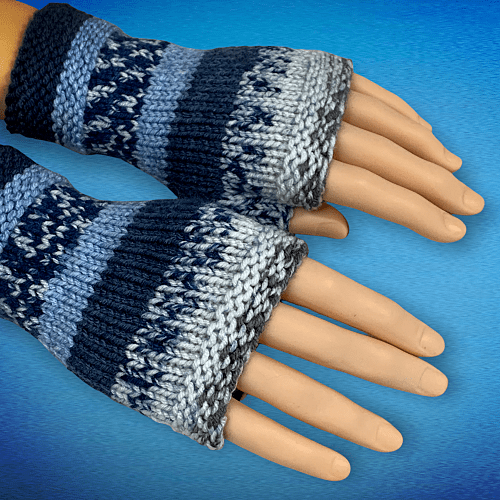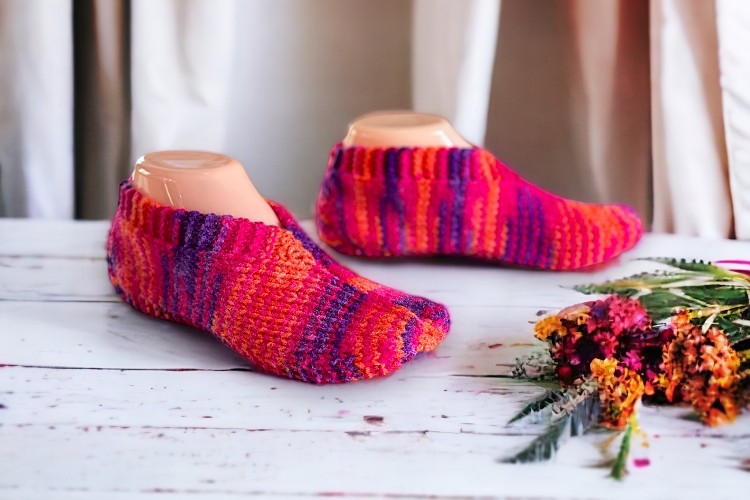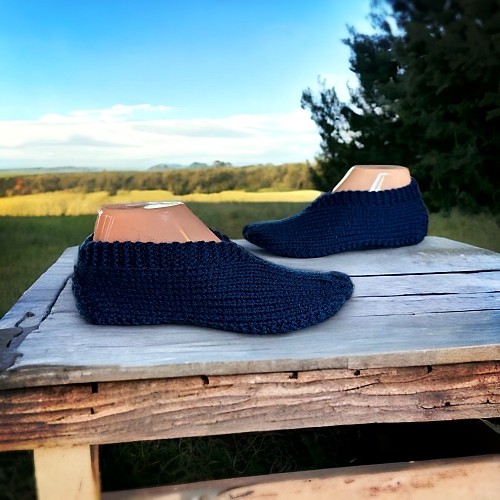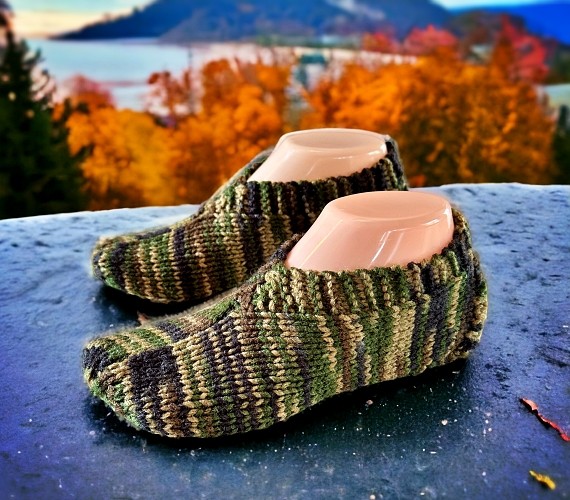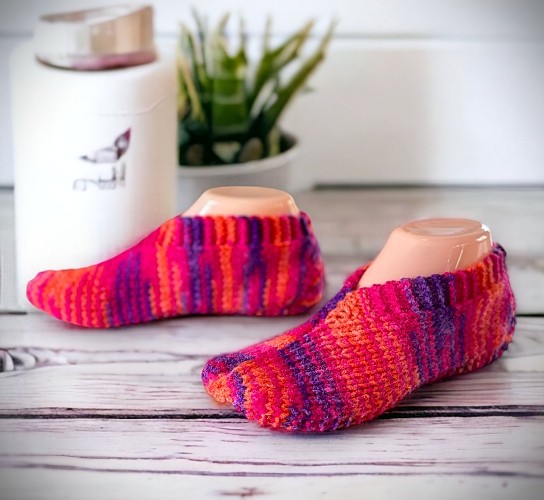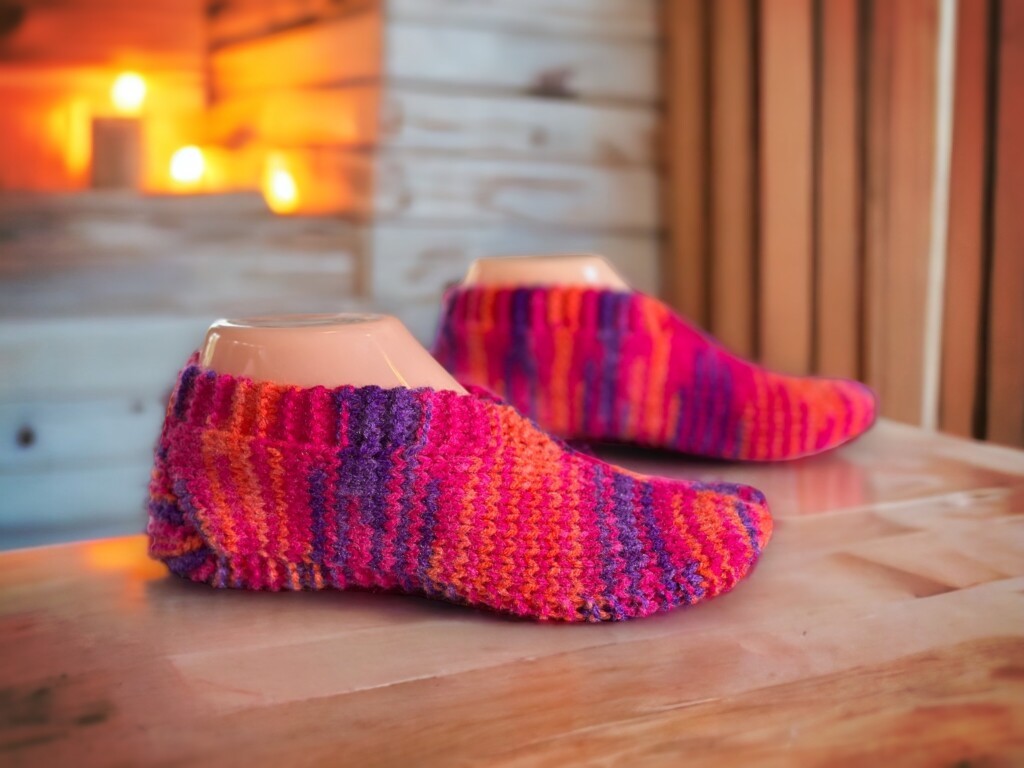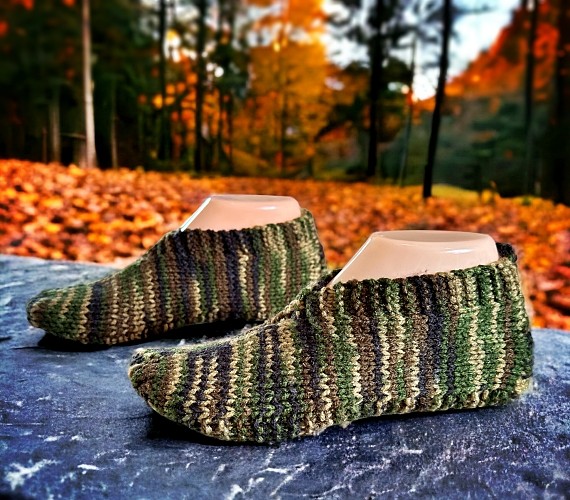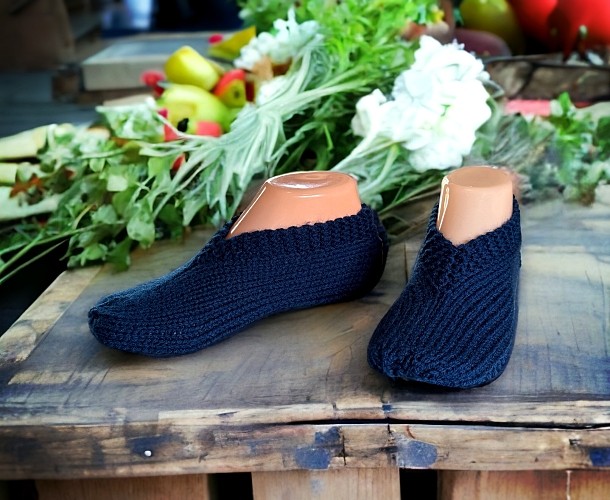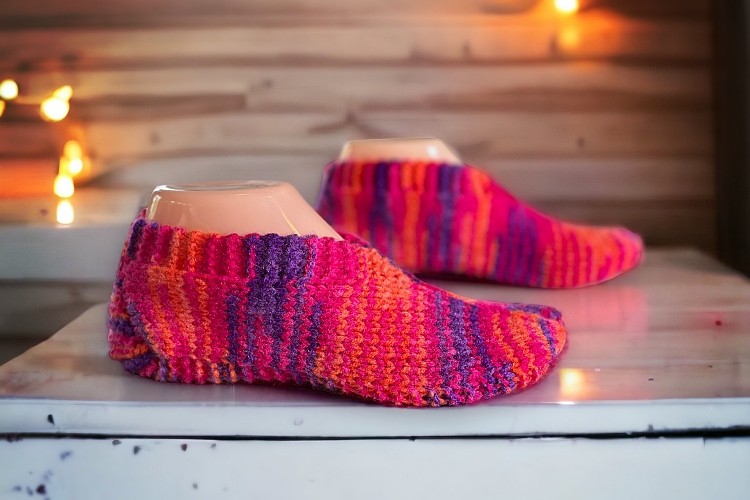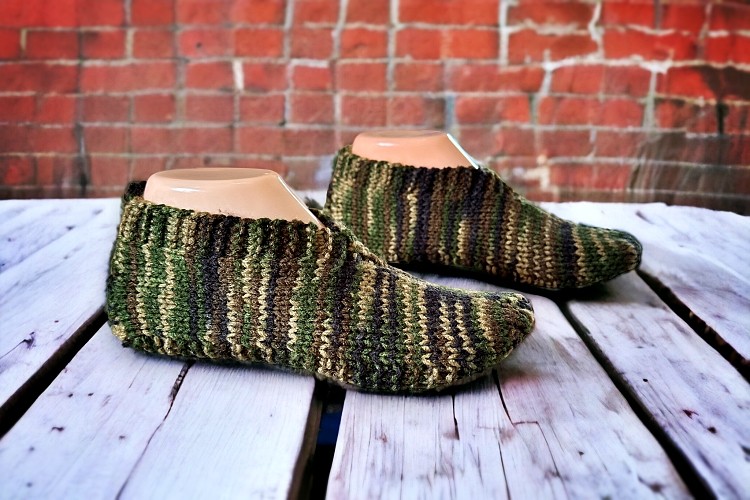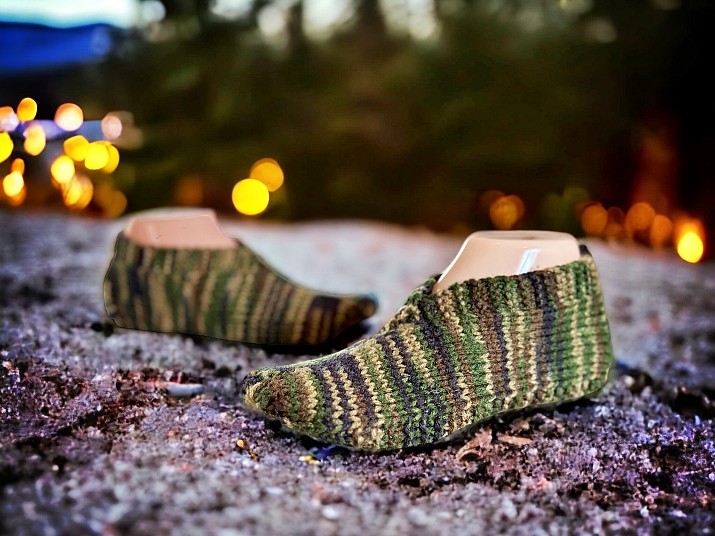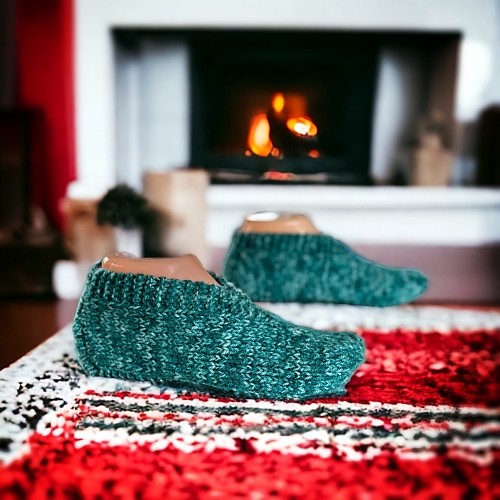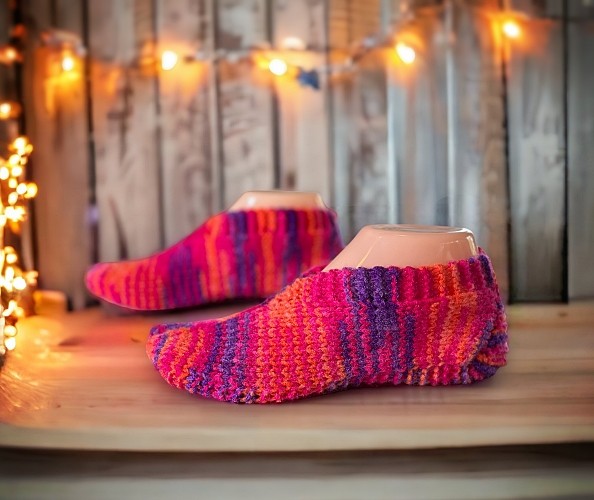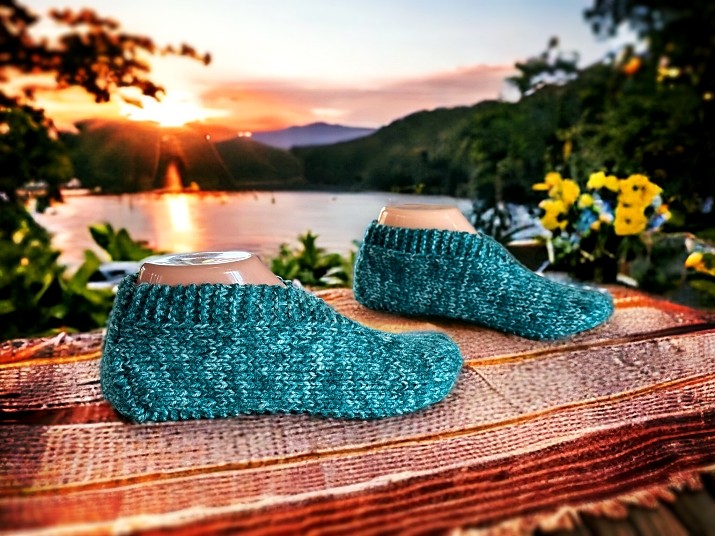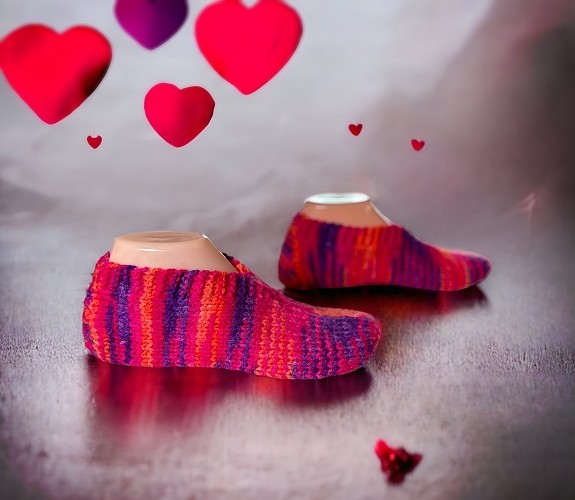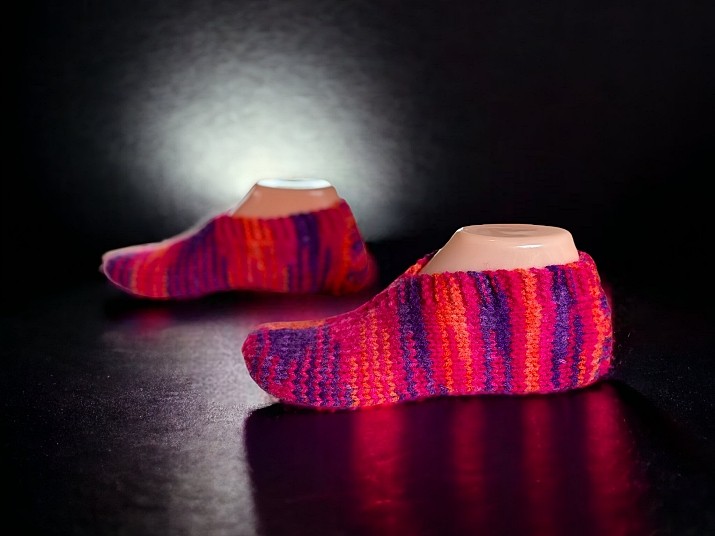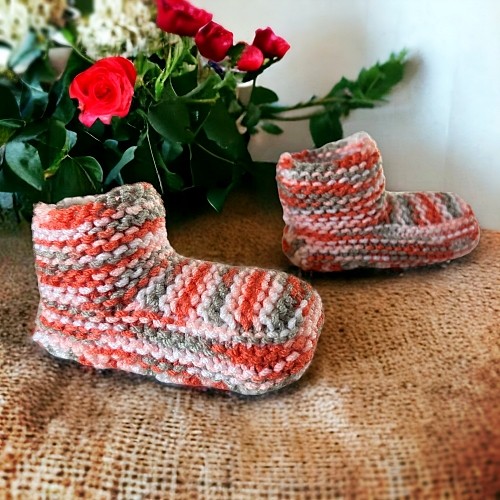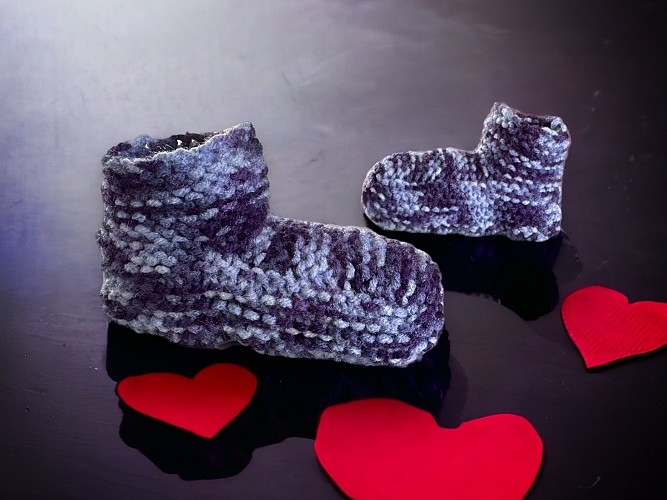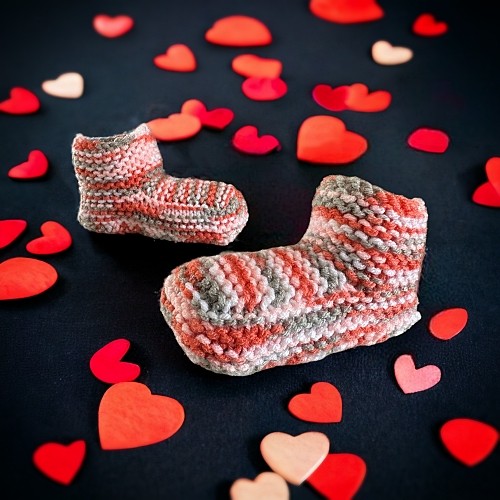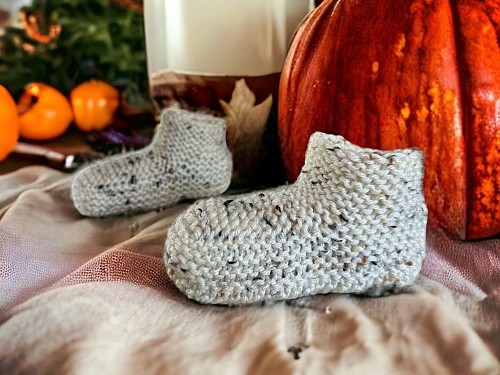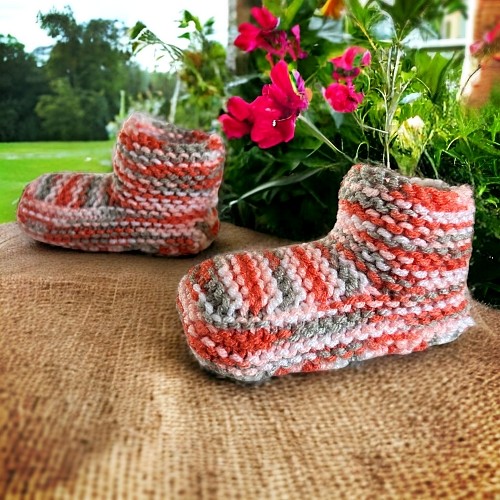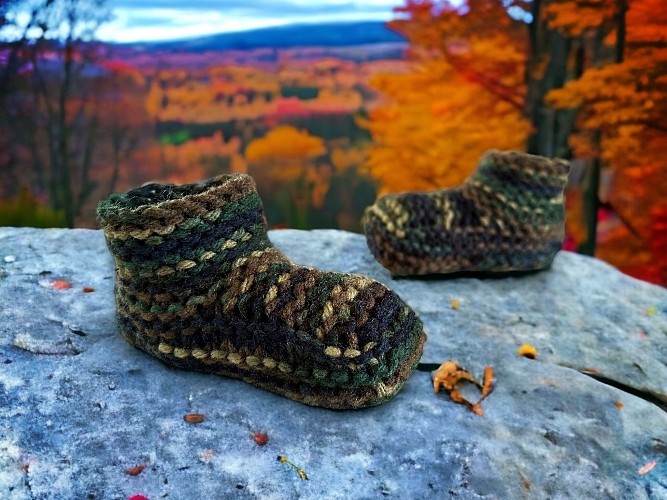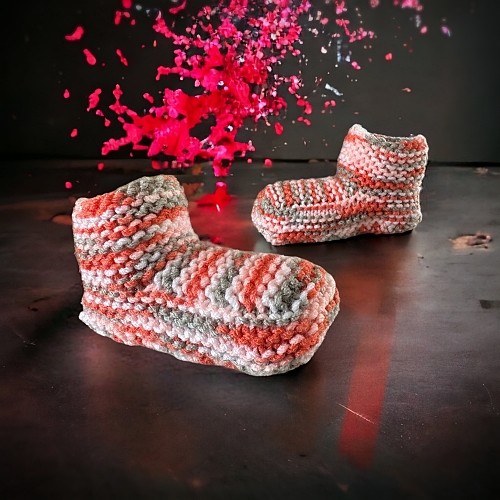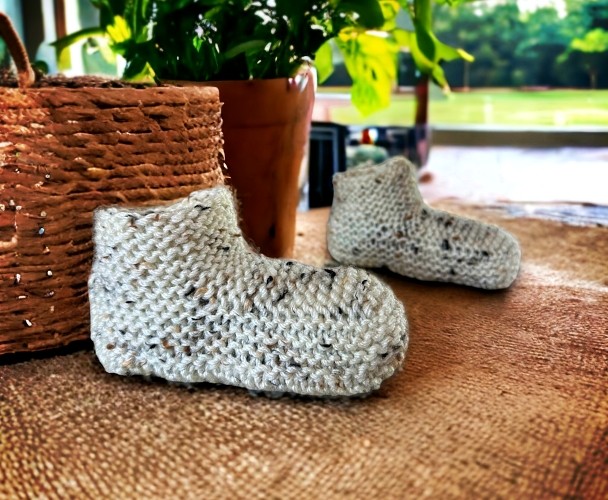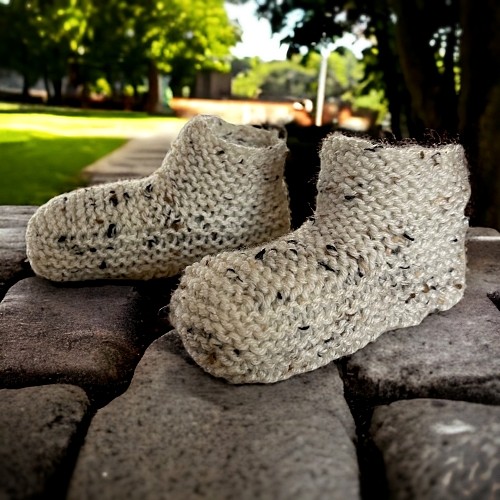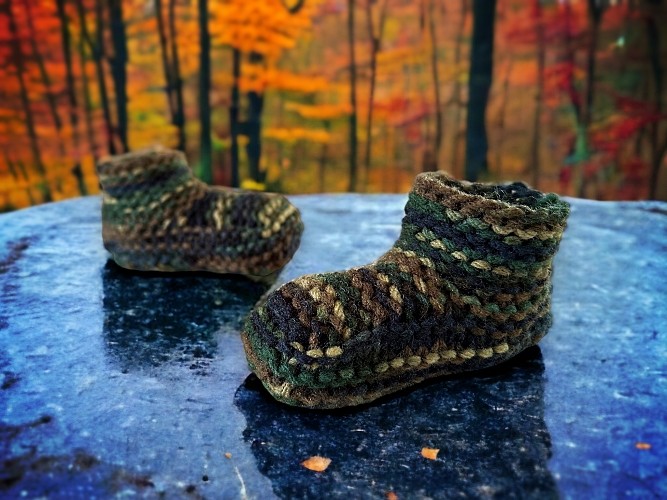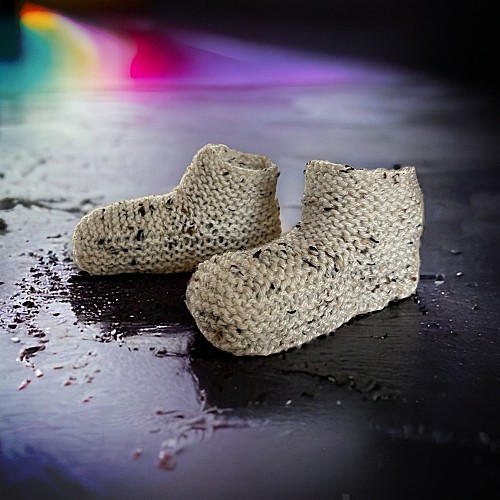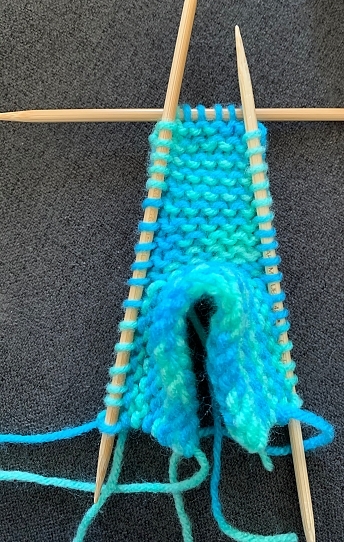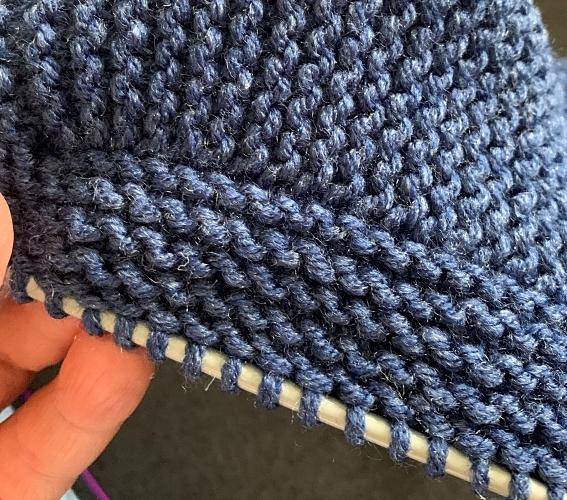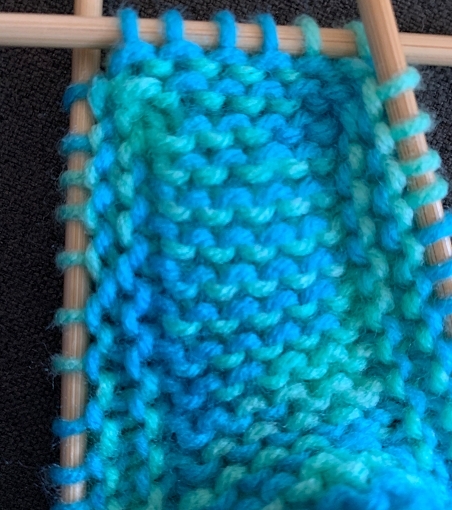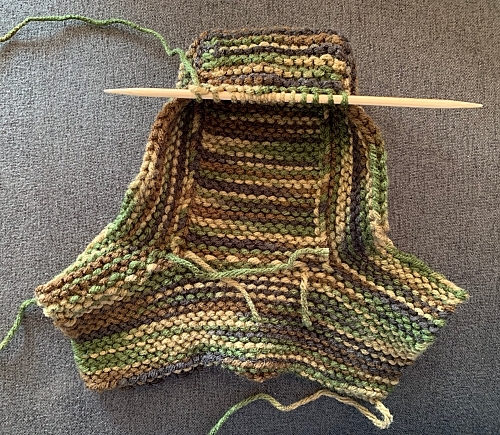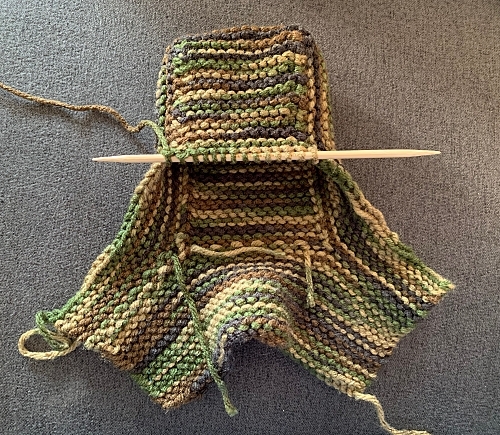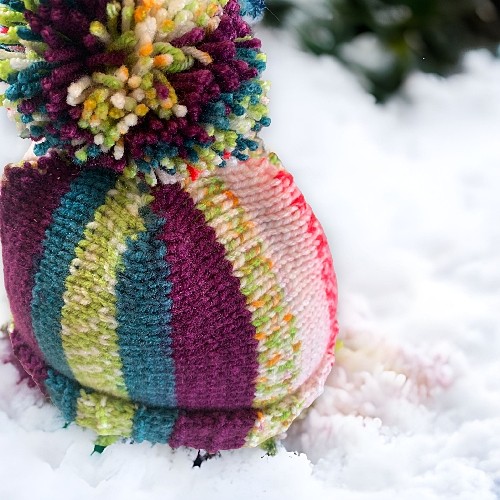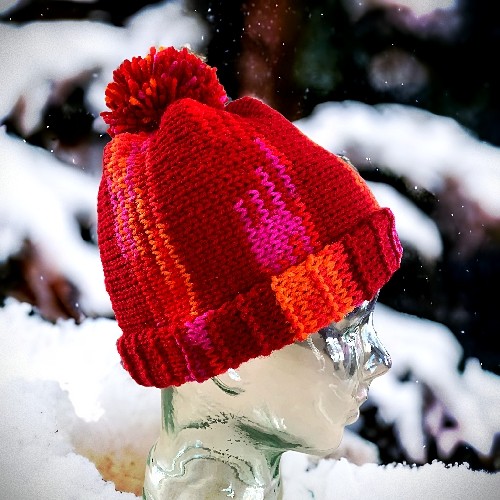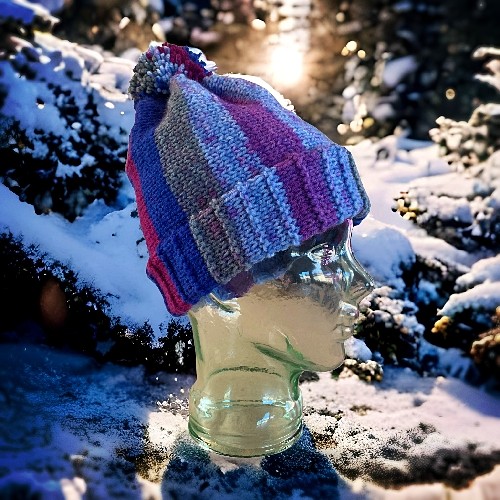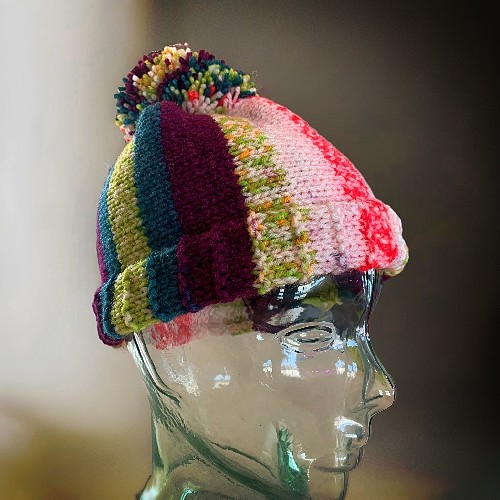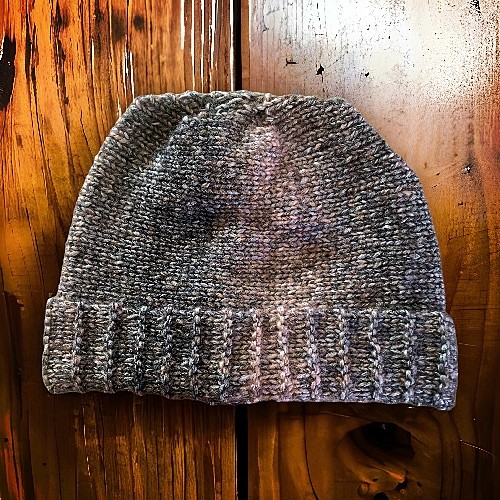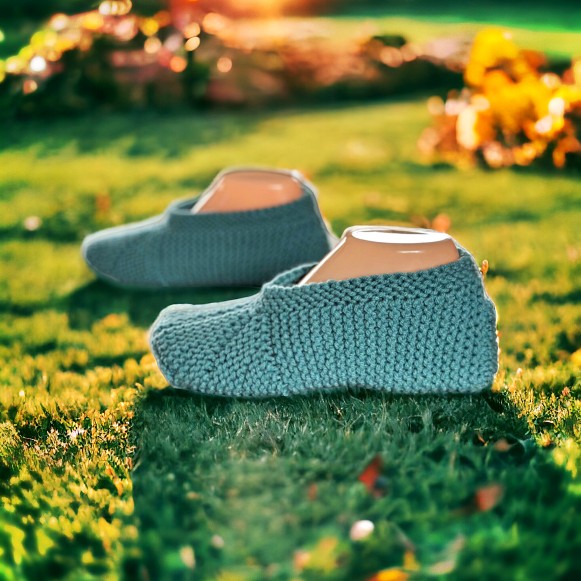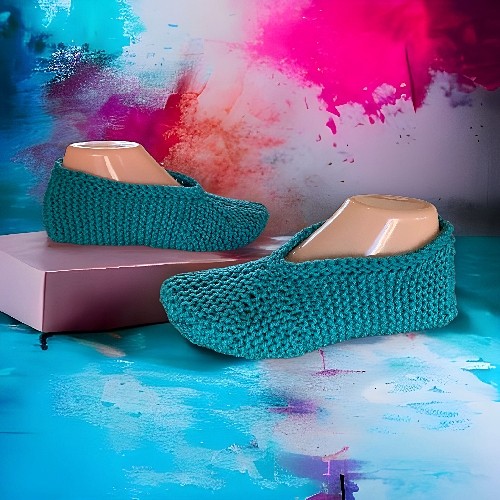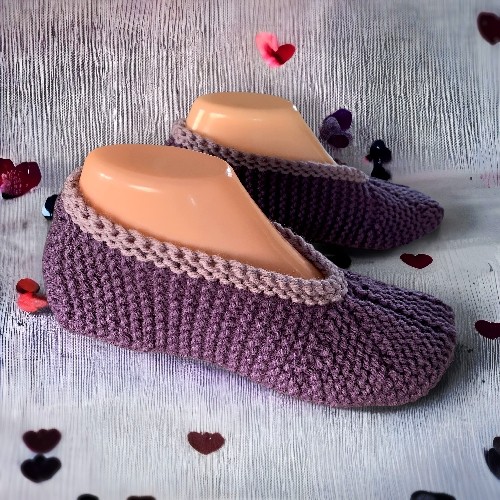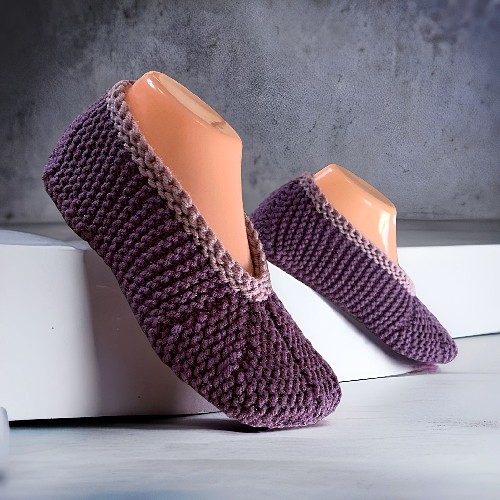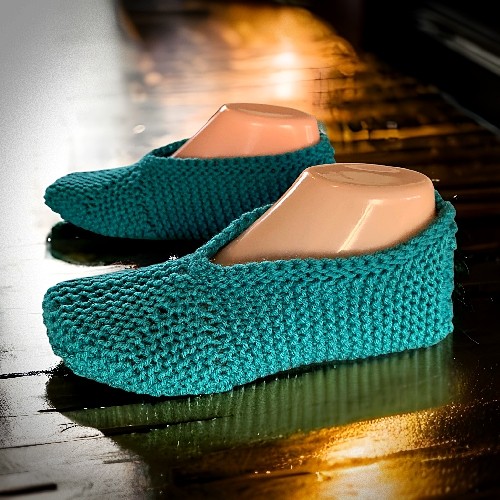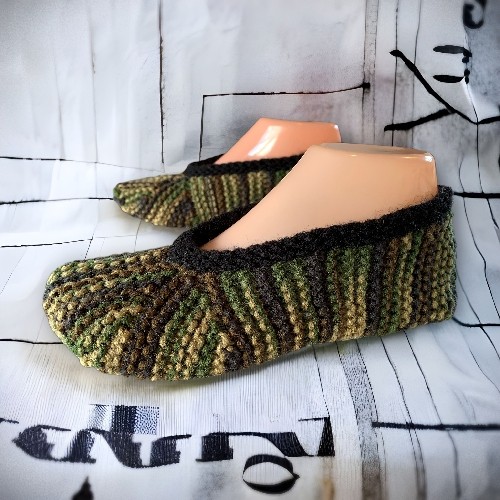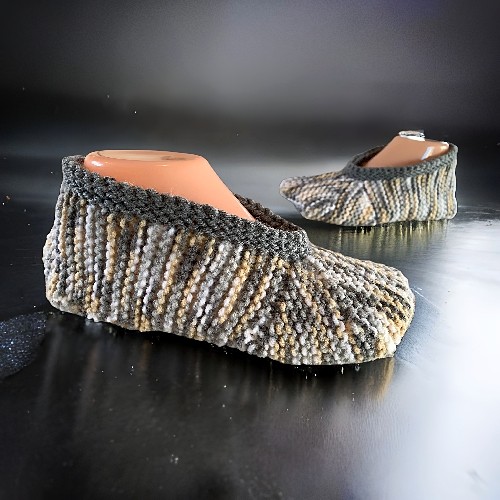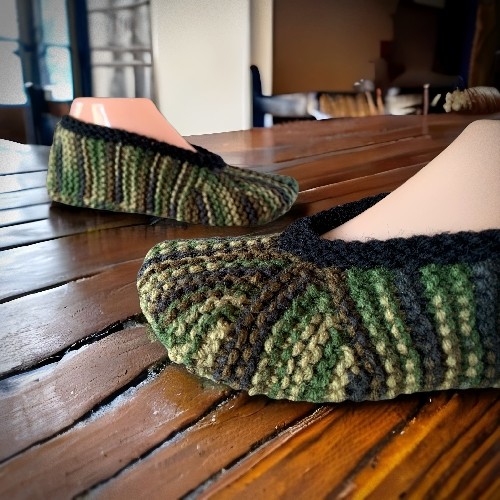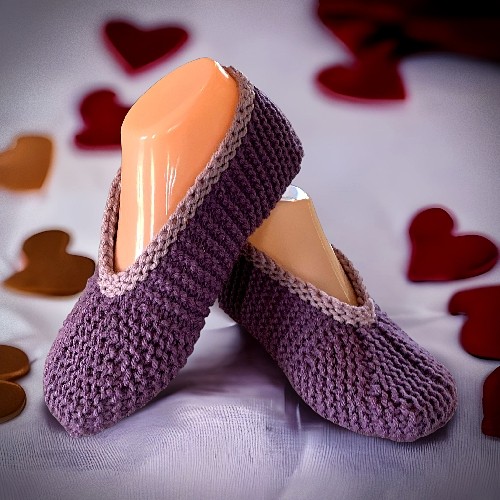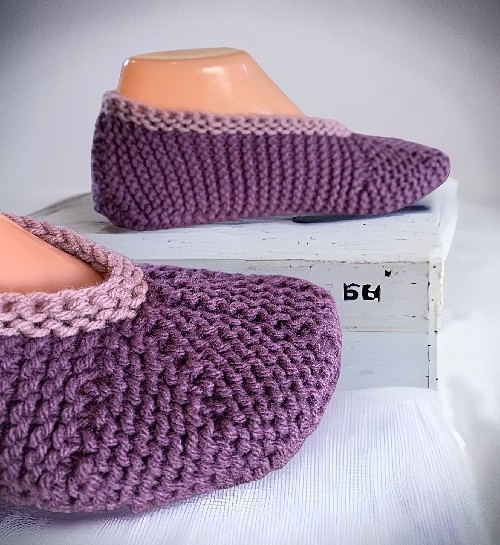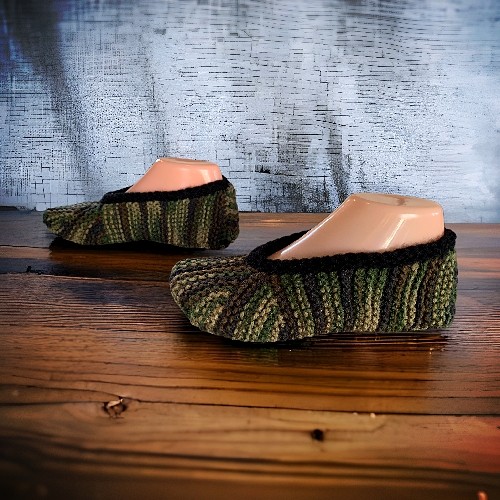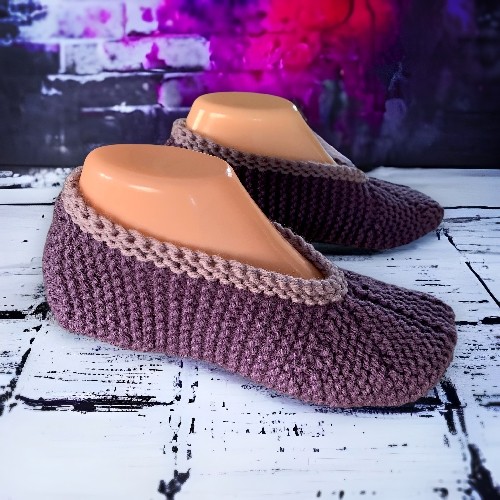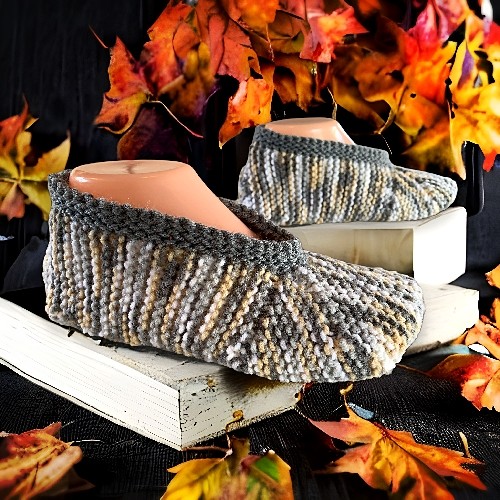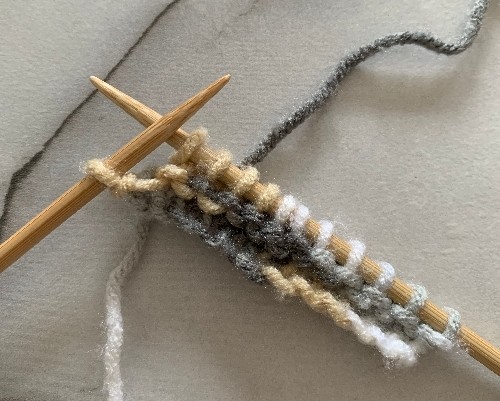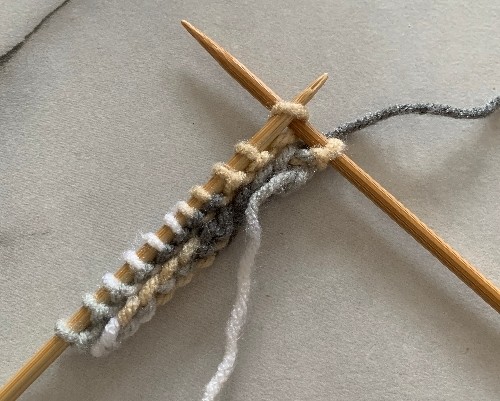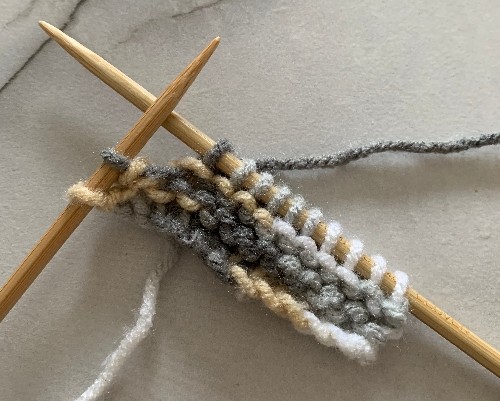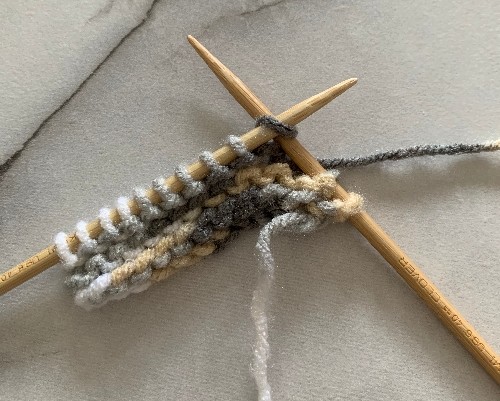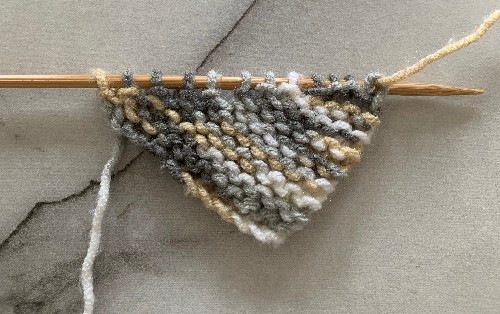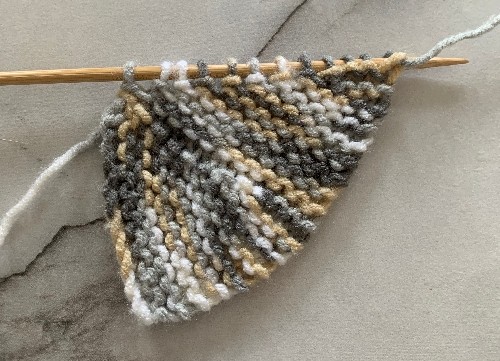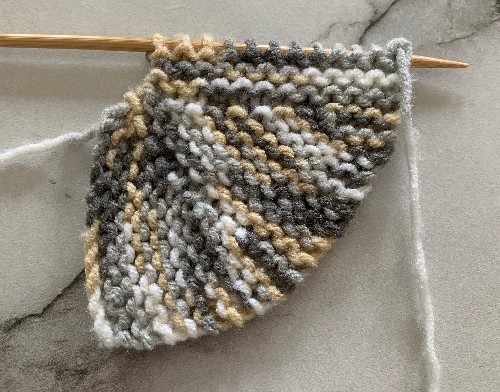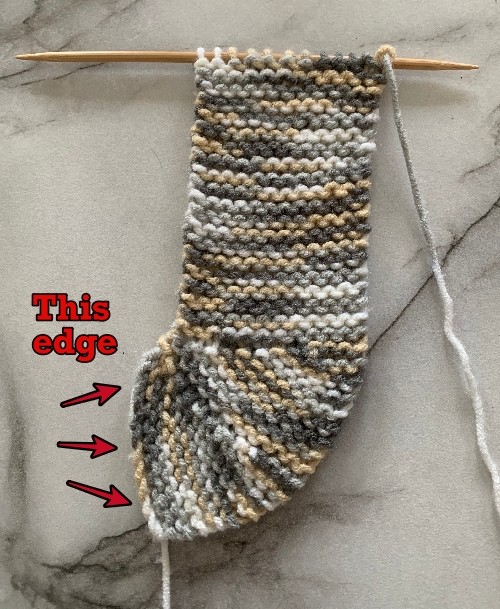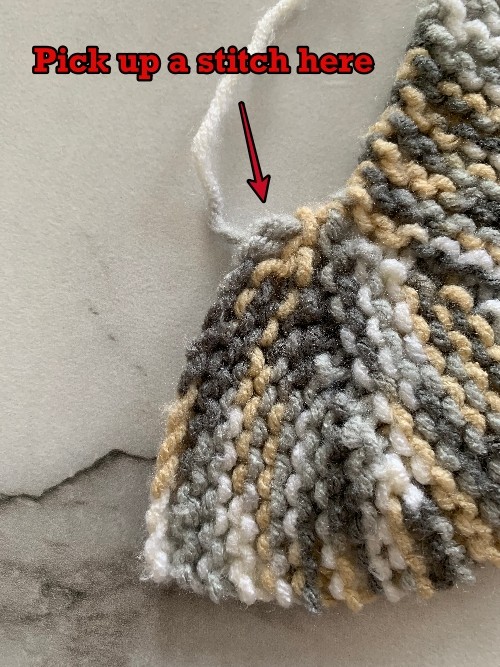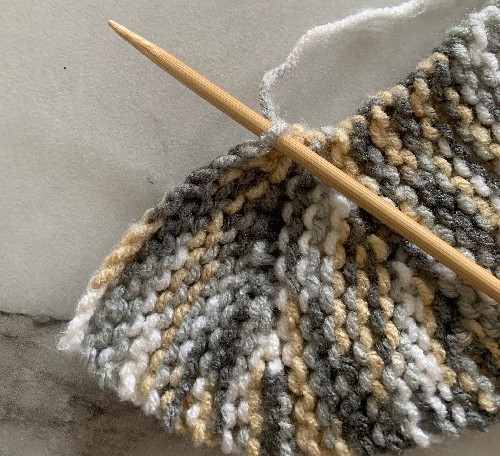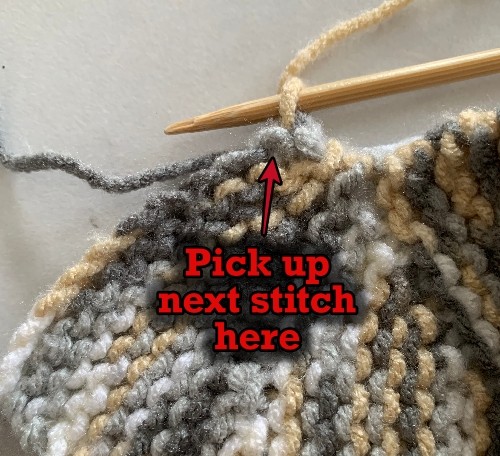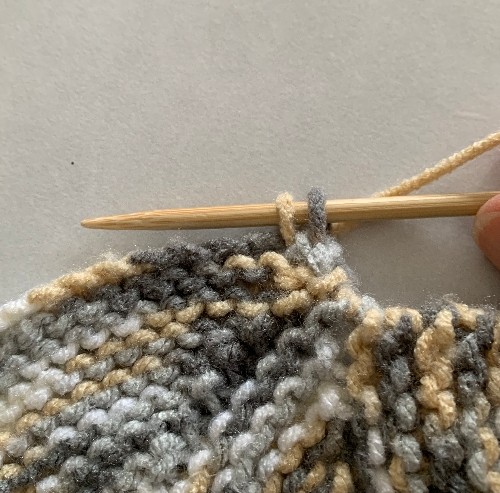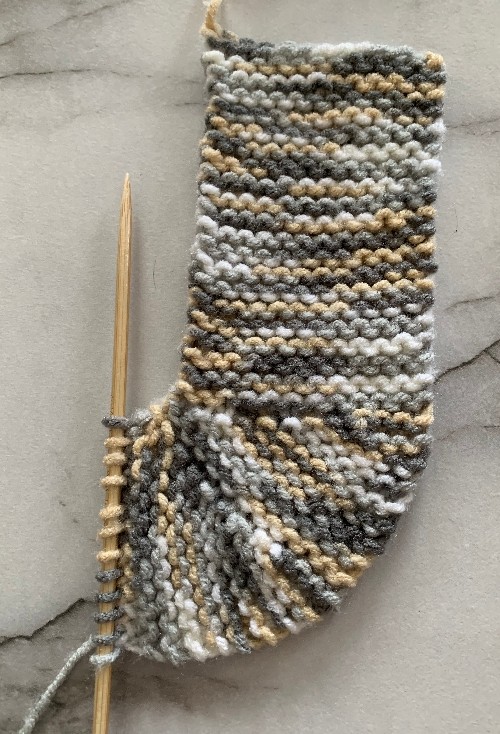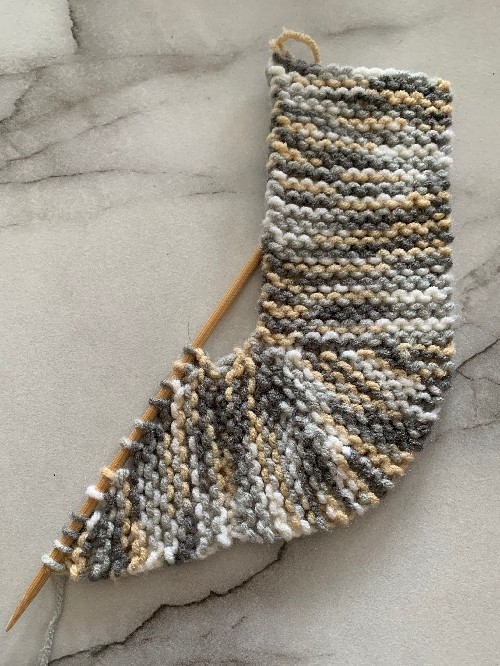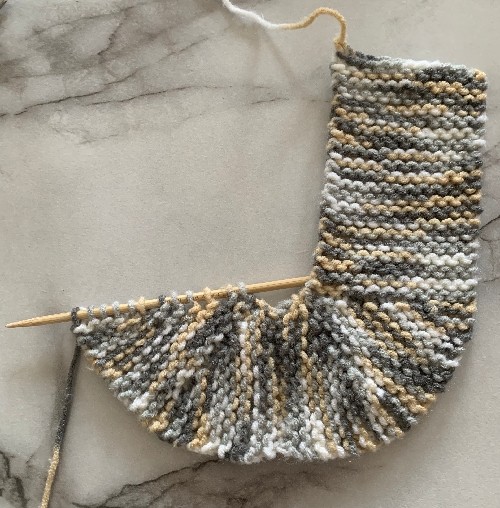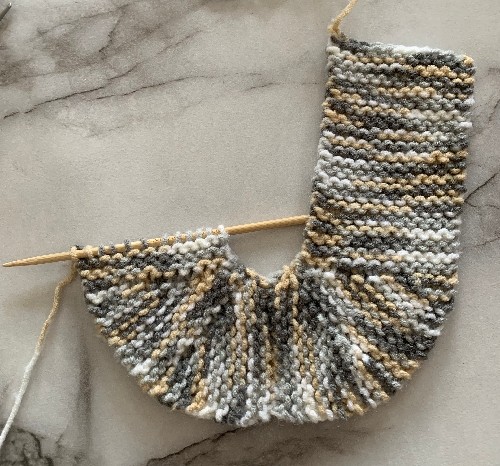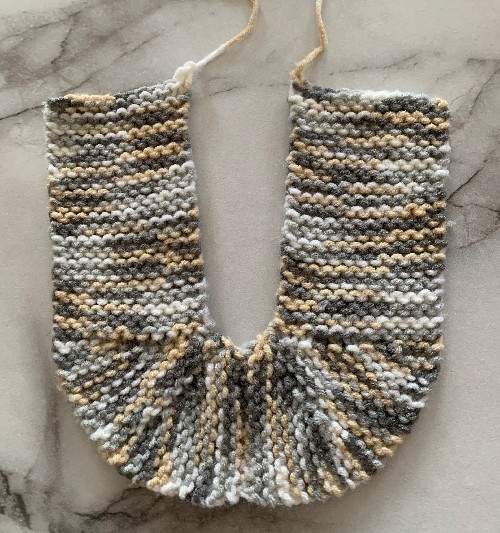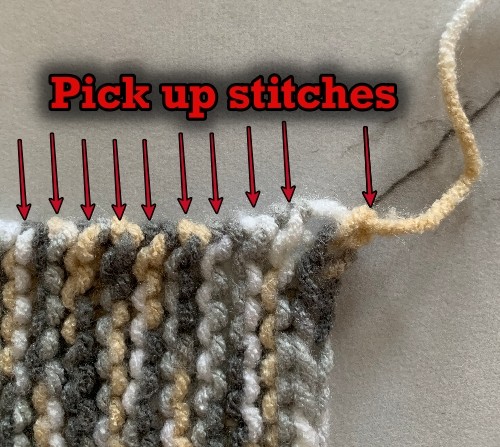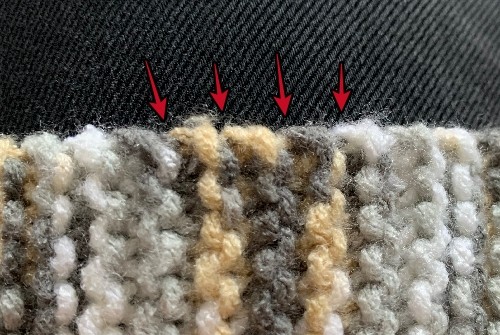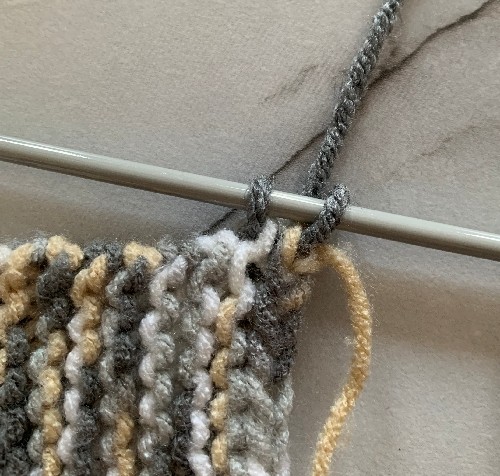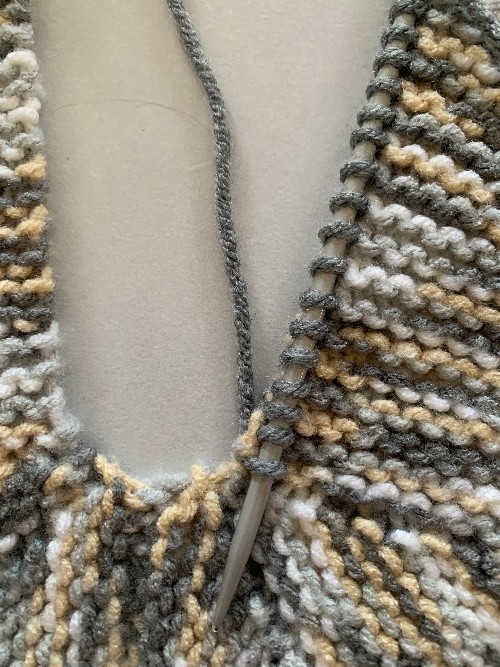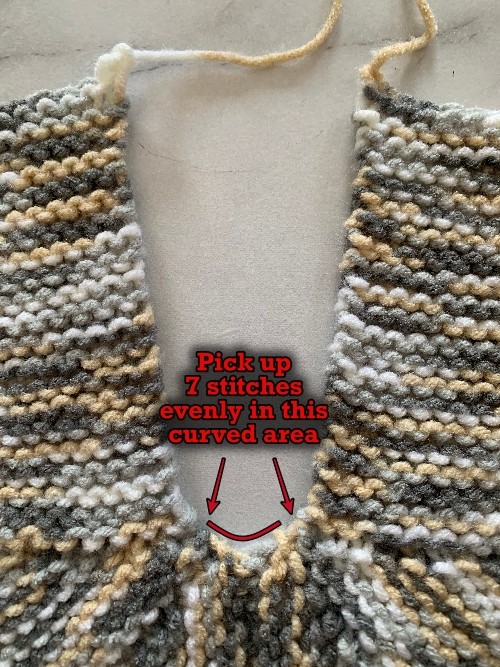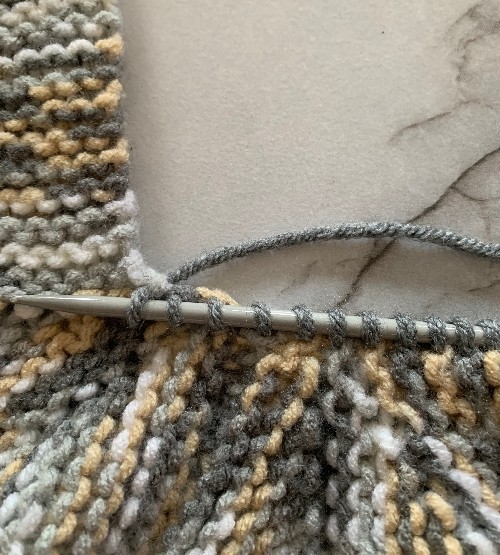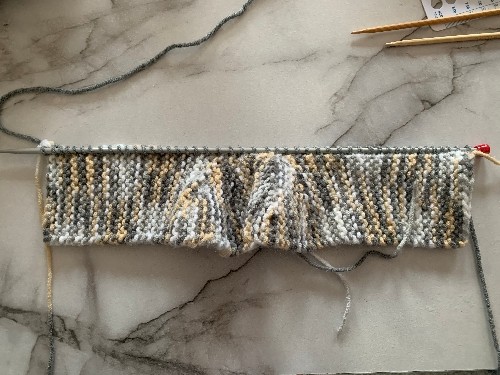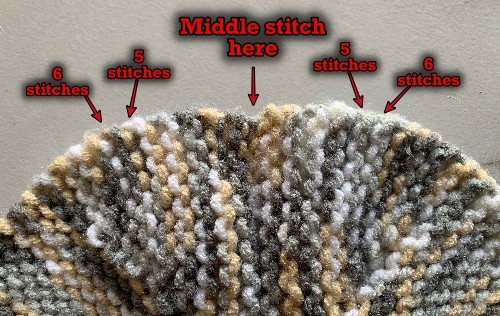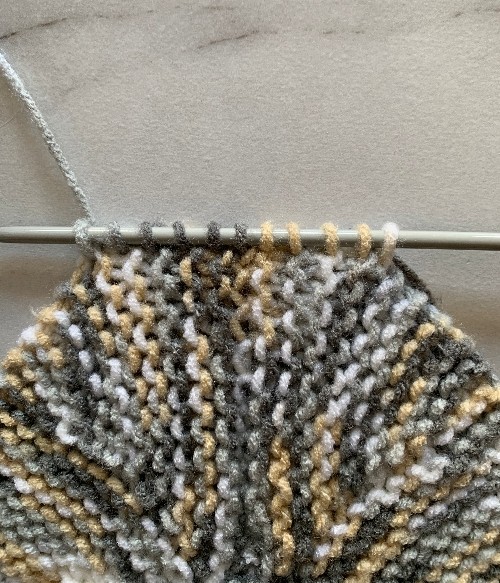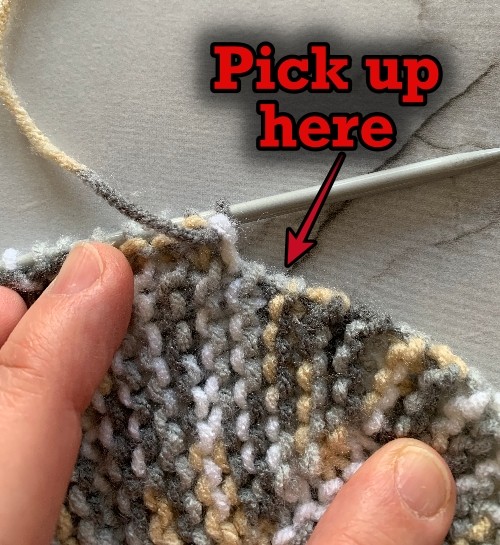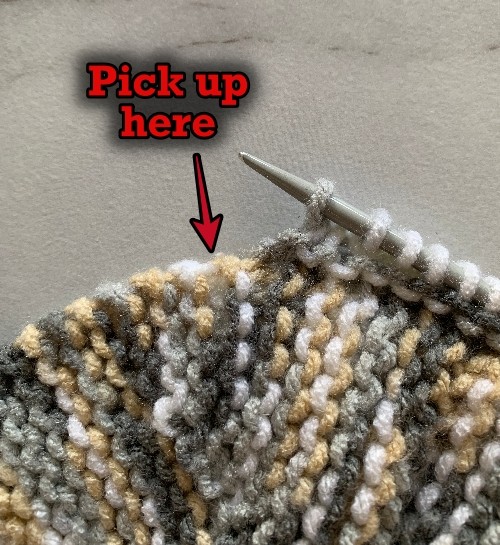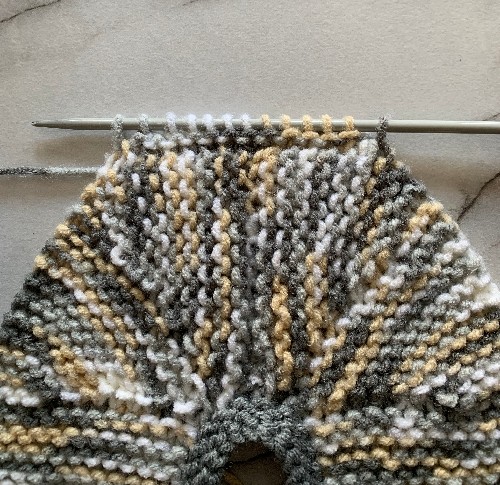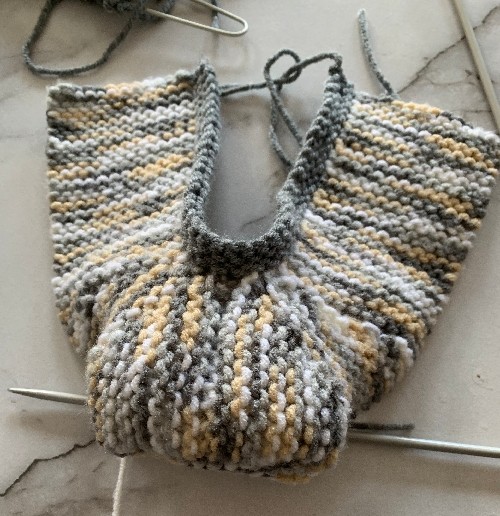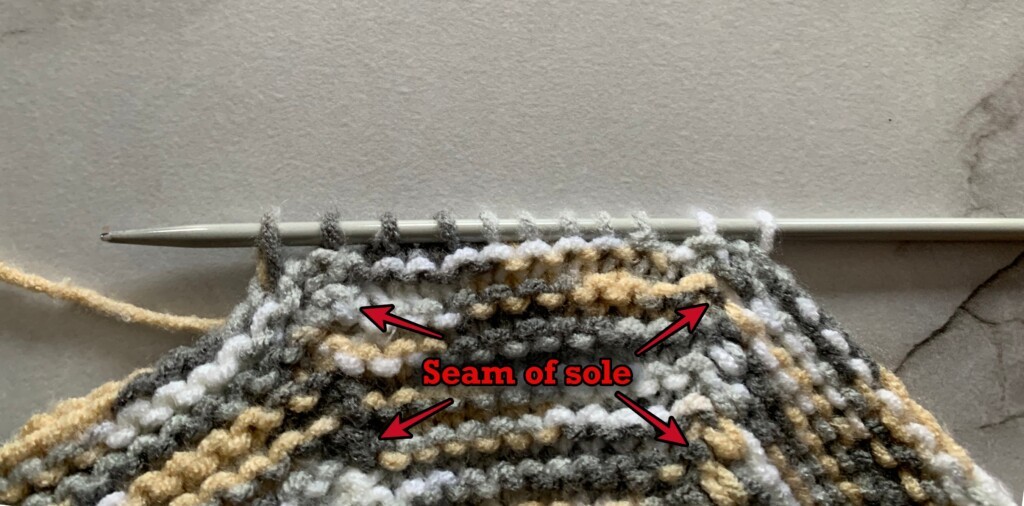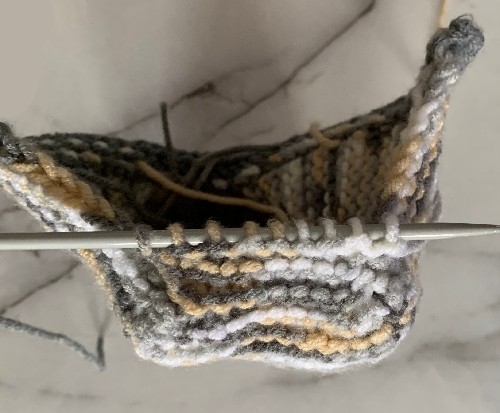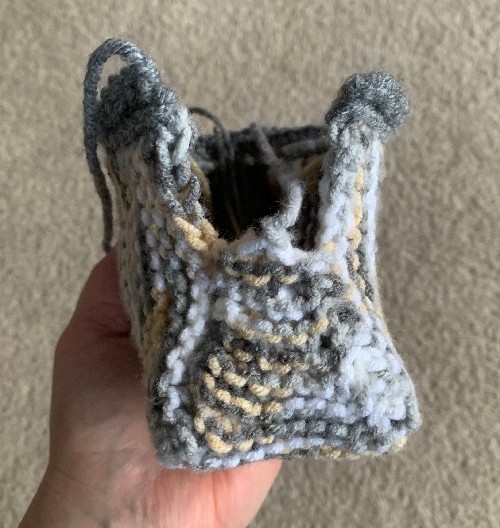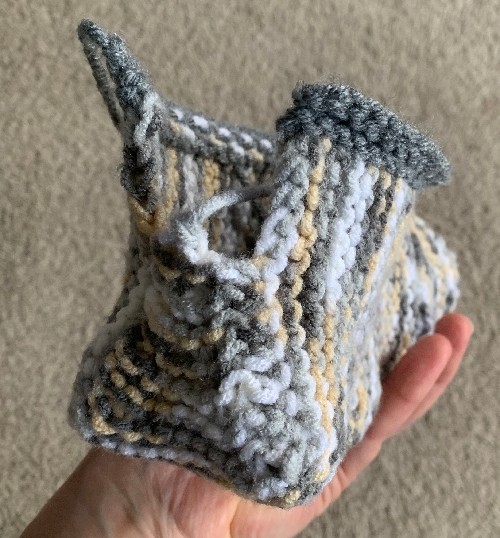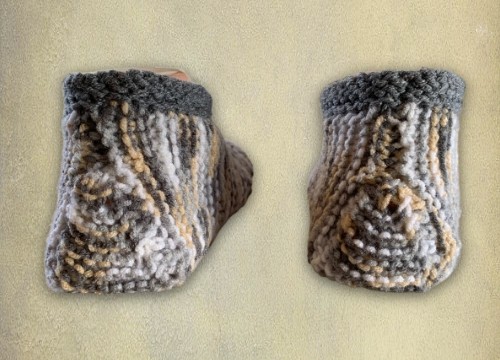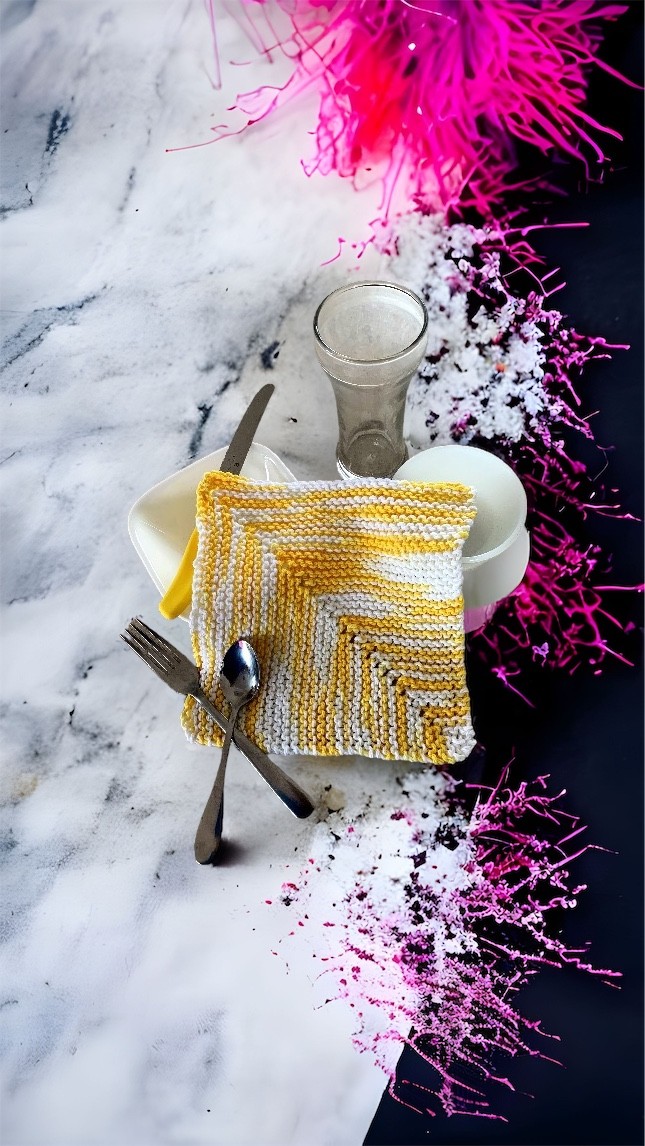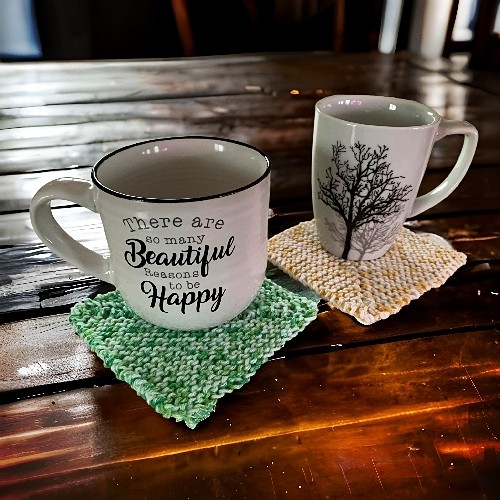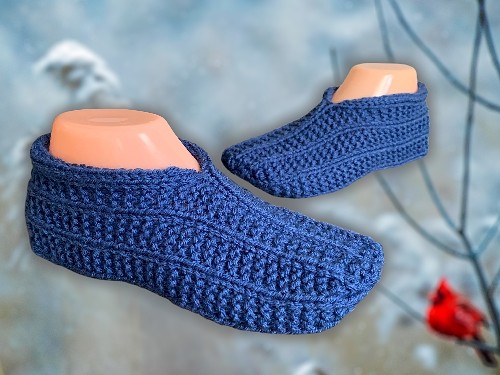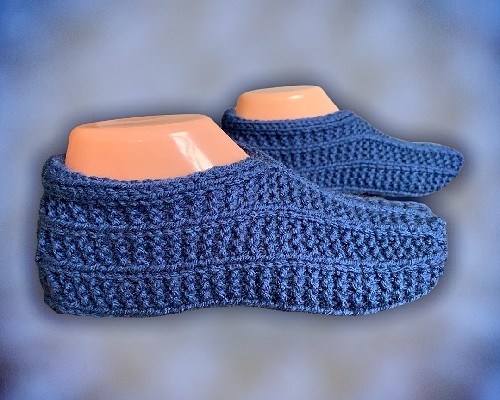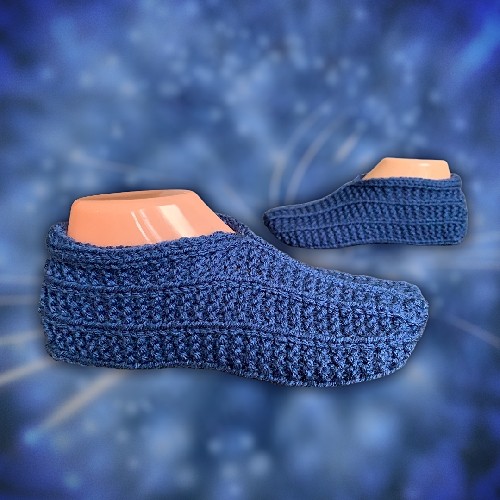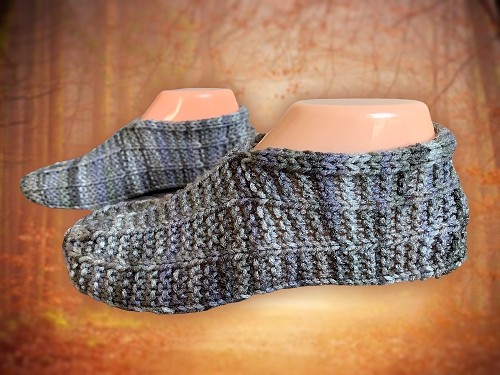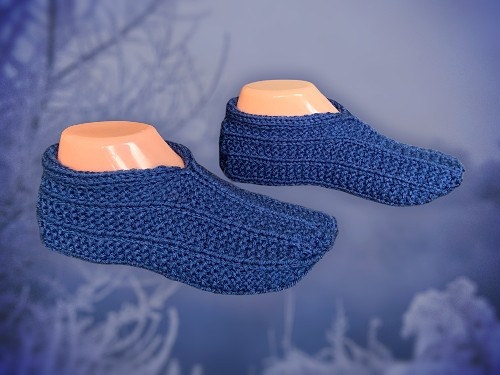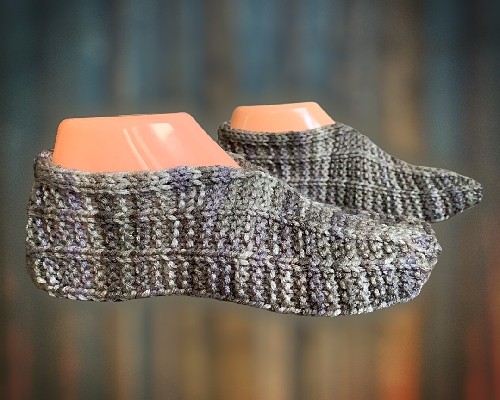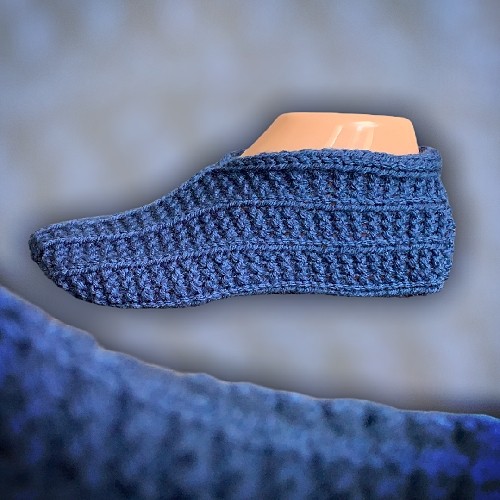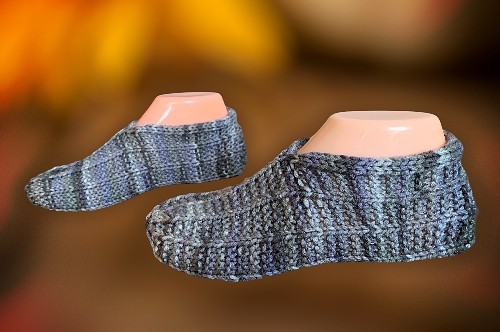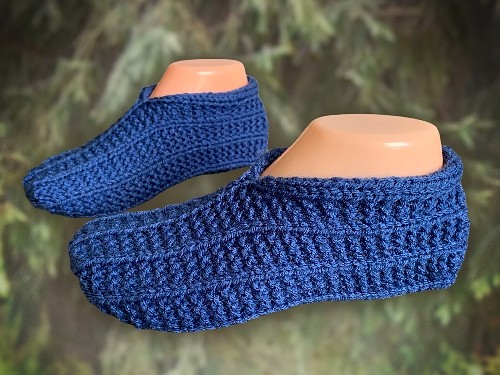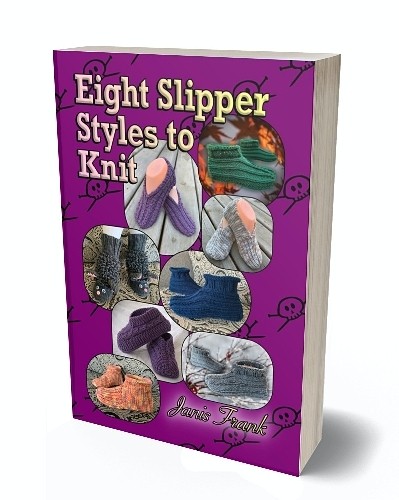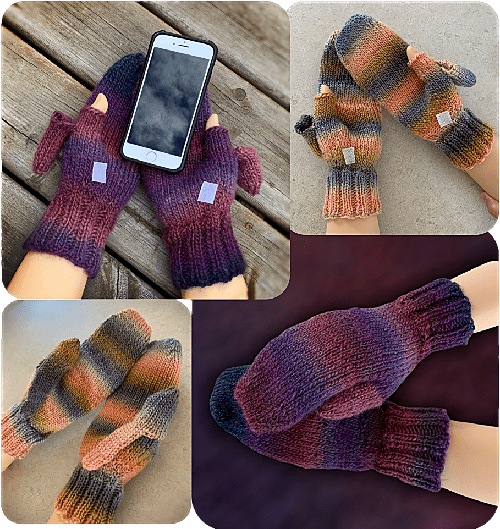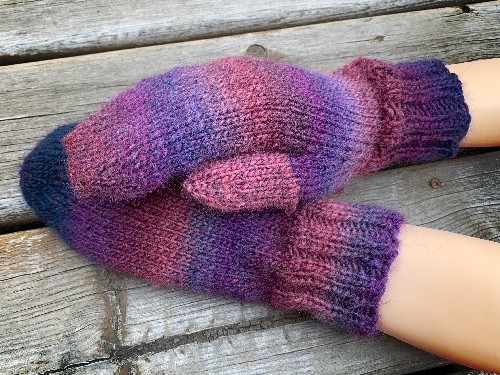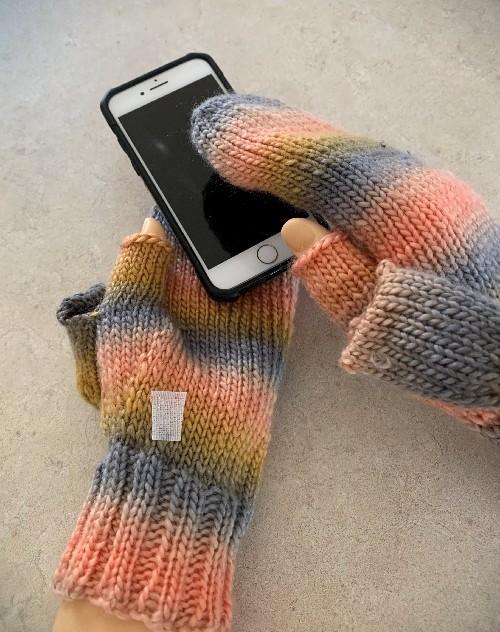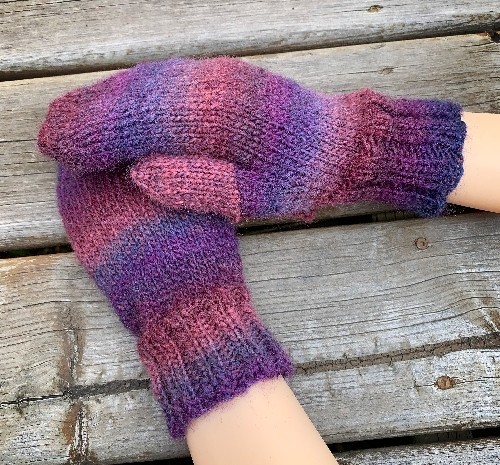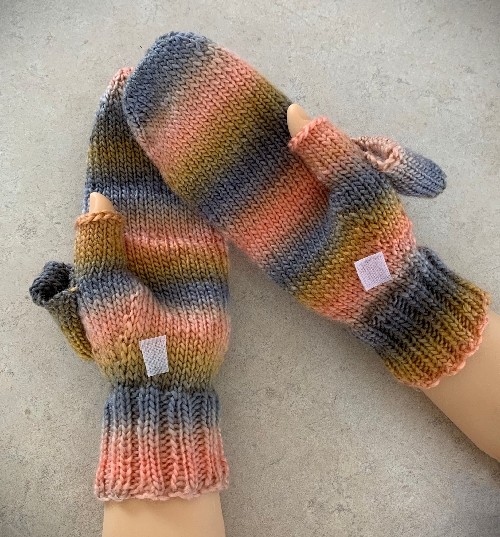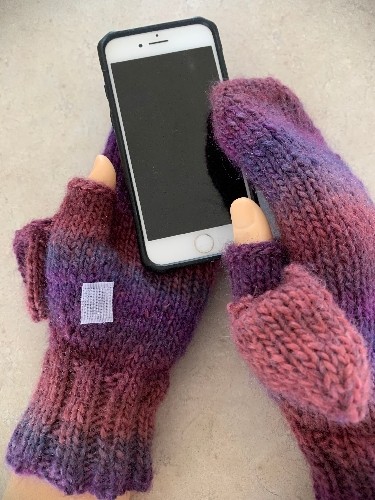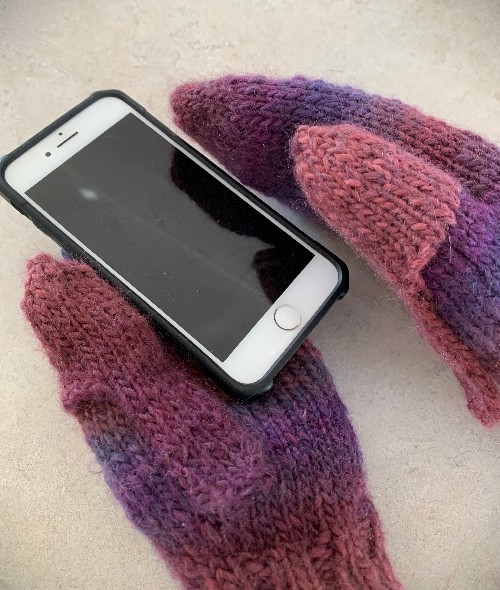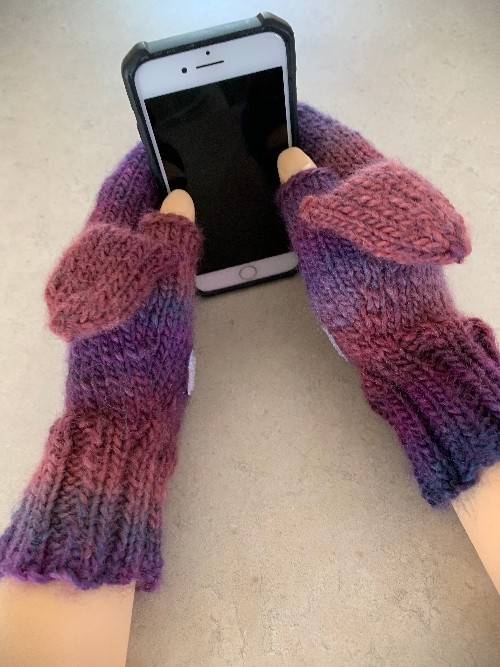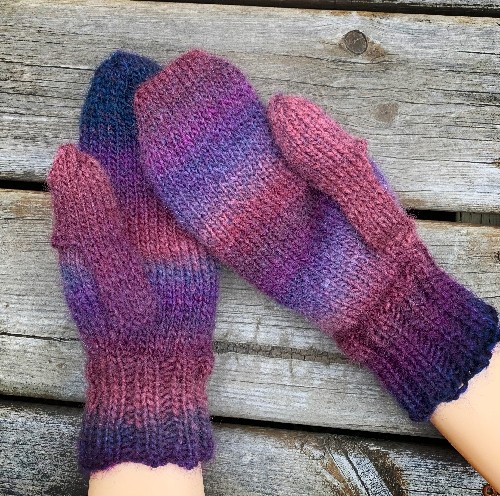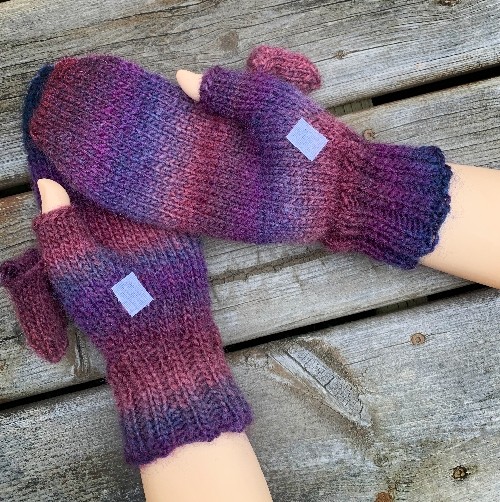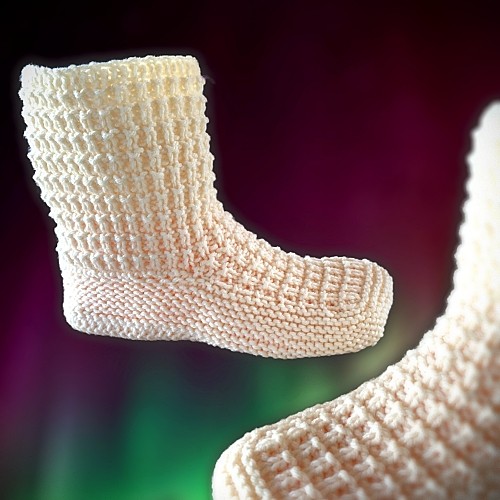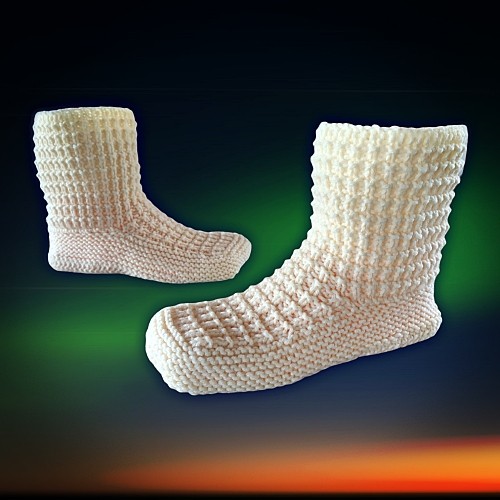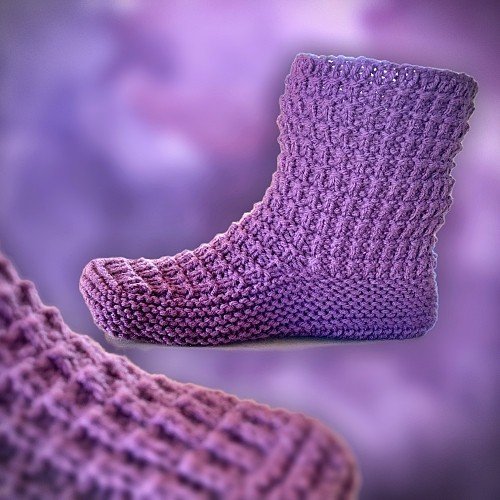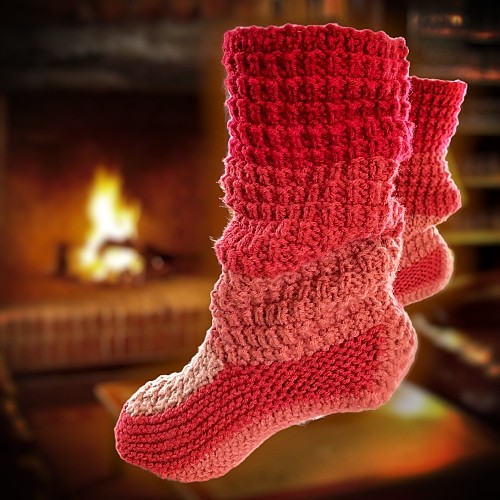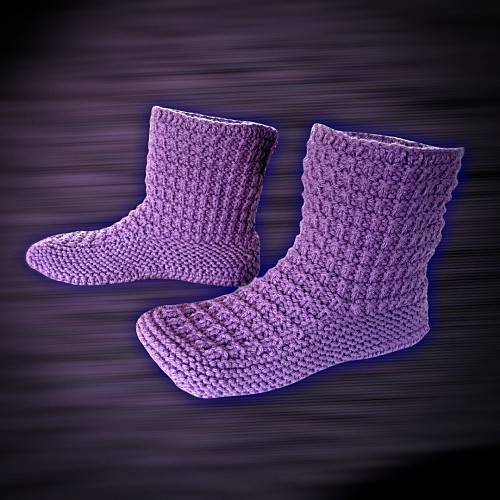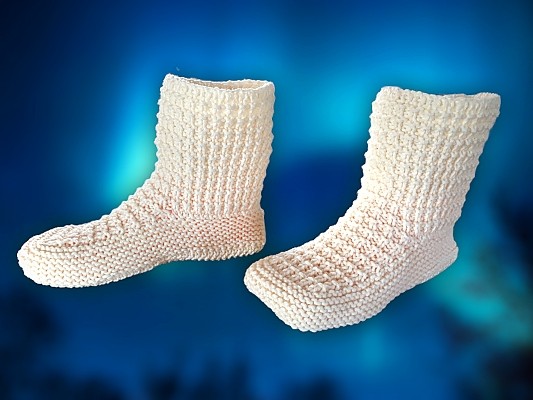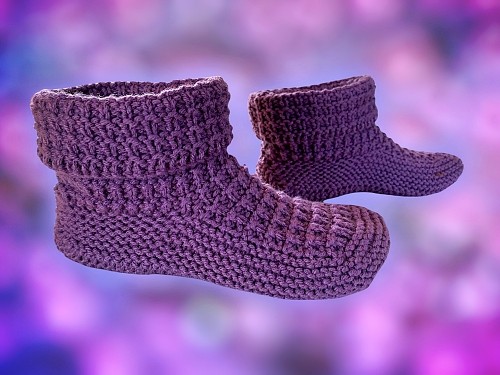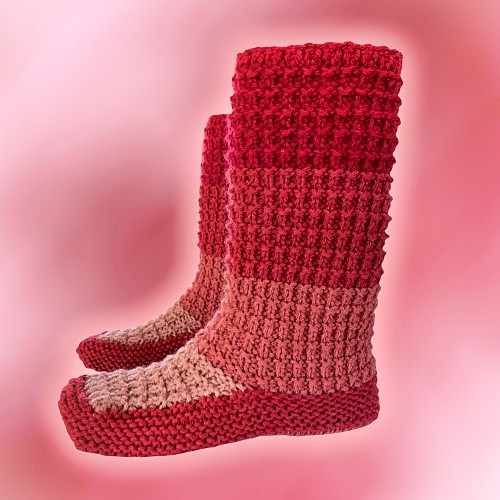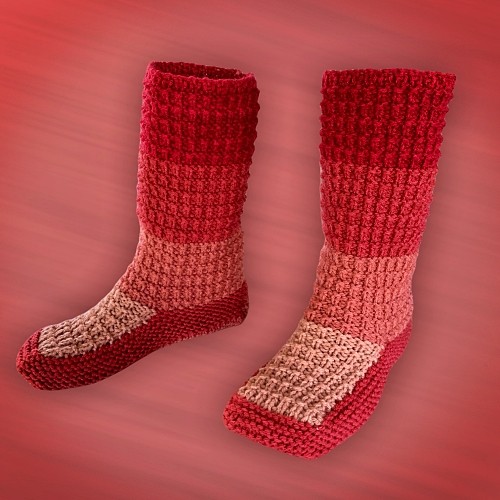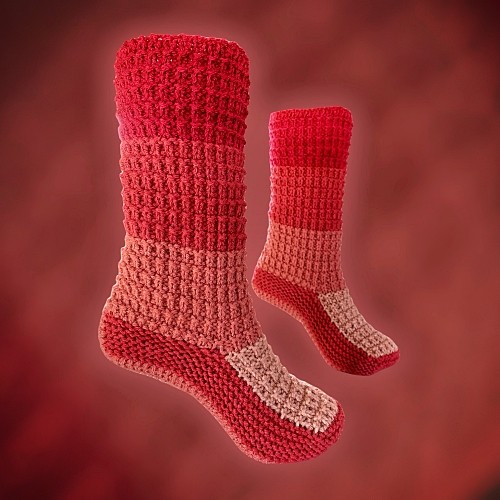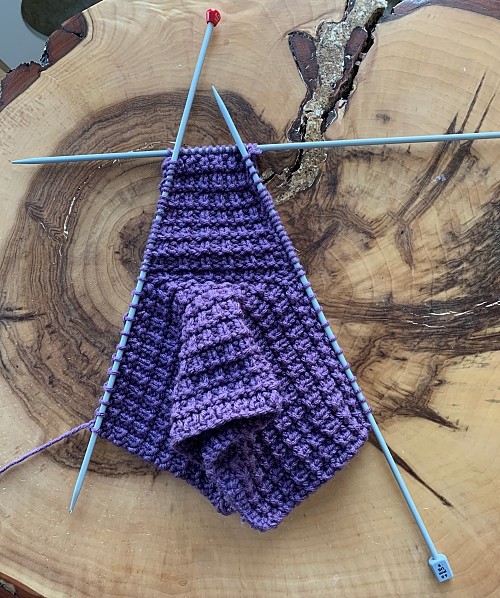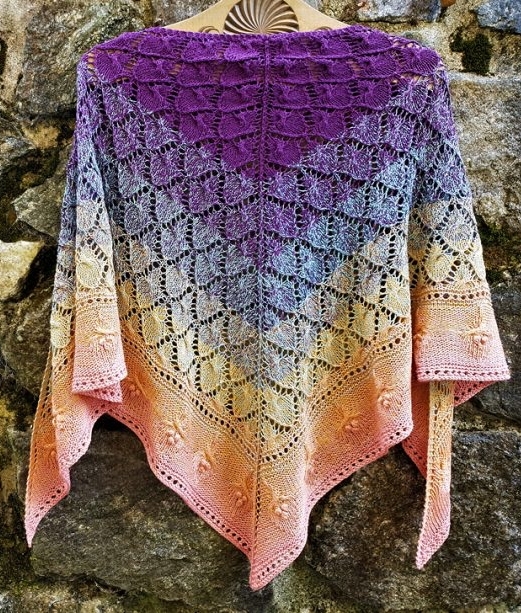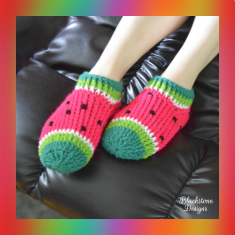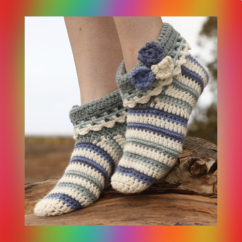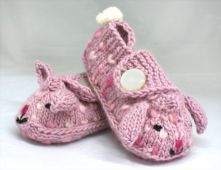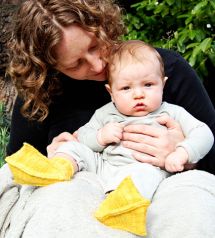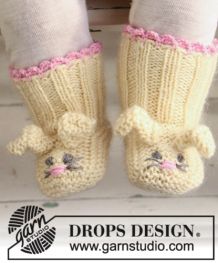
I finally hit the threshold for another compilation of slipper knitting patterns. I try to have 7 or 8 of them to bundle together for people to use. This time it’s for a couple of different styles that I’ve been working with. I’m working with more sculptural elements and colour work making some of them a little more complicated than a basic slipper, though I do have those too. The Ultra Thick Bootie Slippers and Lace-Up Slippers are definitely that.
To help everyone with the trickier parts of making these slippers, I’ve added a ton of photos and lots of video links to my YouTube channel. You WILL be able to make these!
If you would like to order the paperback version from Amazon, you can use the links below. Be sure to select your country. If you are a Prime member on Amazon, then your shipping will be free!
If you are a paid member/supporter on Buy Me A Coffee then this publication is FREE for you! Just add it to your cart and check out. The price will automatically turn to zero. You won’t pay a cent. 😊
You can read more about this…
Another way to avoid ads and pop-ups, get instant, PRINTABLE downloads of this pattern and others, is by becoming a Member. When you become a Website Supporter at $4/month, you’ll gain access to exclusive member only posts on Buy Me A Coffee. You can download as many patterns as you like for the same $4 each month. You can go to this page to learn more, become a member and support my work… Exclusive Member Area
The patterns themselves are still all free to read on the website (the links are listed further down this post). You won’t be able to print them from the site. I’ve kept the cost for a printable PDF very low so it’s definitely within everyone’s budget. It’s less than a ball of yarn! You can purchase the PDF through my Etsy shop here – Eight Awesome Slipper to Knit or you can buy it right here in my shop – Eight Awesome Slippers to Knit
For those comfortable with reading patterns online, clicking any of the links below will take you right to it.
Bring the magic of the holidays to your knitting with this Reindeer Fingerless Gloves knitting pattern! Designed in adult sizes only, these cozy and festive gloves feature a sweet reindeer motif with little antlers that make them extra fun for winter wear. Whether you’re getting ready for Christmas parties, enjoying a holiday market, or just want something cozy and seasonal, these fingerless mitts are a perfect choice.
The pattern is not for beginners, but it does include step-by-step photos showing exactly how to create the antlers and work through the trickier details. If you love making handmade Christmas gifts, these reindeer gloves are a great project—ideal as stocking stuffers, gifts for knit-worthy friends, or a special treat just for you.
Inspired by the holiday classic Rudolph the Red-Nosed Reindeer, these festive fingerless gloves capture the charm of winter’s favourite reindeer while keeping your hands warm and practical for everyday wear.
Love the reindeer motif? I also have Christmas slippers with the same deer face you can make for the entire family. Click this link –Reindeer Slippers for the Whole Family or tap the photo.
If you would to prefer to support my work and have access to a printable, ad-free version of this pattern, I offer that too. To get the downloadable pattern for a small fee you can get it in my Etsy Shop, Ravelry, LoveCrafts, Buy Me A Coffee and from the shop section on this website – KweenBee.com.
If you would prefer to order a Kindle or printed paperback version from Amazon, you can now do so! Shipping is free if you are an Amazon Prime member. Make sure you select the country you are in to take advantage of the free shipping. Click the following link for your country –United States, United Kingdom, Canada, and Australia. The Kindle downloadand paperback versions are available in English only.
Another way to avoid ads and pop-ups, get instant, PRINTABLE downloads of this pattern and others, is by becoming a Member. When you become a Website Supporter at $4/month, you’ll gain access to exclusive member only posts on Buy Me A Coffee. You can download as many patterns as you like for the same $4 each month. You can go to this page to learn more, become a member and support my work… Exclusive Member Area
Don’t forget to share this page on Facebook, Pinterest, and the like. Use the icons below for easy click sharing! Your share helps promote my work and helps this website 😊
Things You Need
Worsted weight yarn – 1 standard ball of yarn (215 yards/197 m). Any colours of your choosing.
MC – main colour
DFC – deer face colour
AC – antler colour
CC – cuff colour
Knitting needles: (See notes on sizing)
Small – Size 3 US (3.25 mm) knitting needles
Medium – Size 6 US (4 mm) knitting needles
Large – Size 8 US (5 mm) knitting needles
Cable needle
Tapestry needle – to sew the seam and work in the ends.
0.27 inch (7mm) wiggle eyes or small buttons. You can also embroider eyes on if you prefer.
Pom poms
Gauge
In stockinette stitch
Small
size 3.5 mm (US size 4) knitting needles
11 stitches every 2 inches (5 cm)
16 rows every 2 inches (5 cm)
Medium
size 4 mm (US size 6) knitting needles
10 stitches every 2 inches (5 cm)
14 rows every 2 inches (5 cm)
Large
size 5 mm (US size 8) knitting needles
9 stitches every 2 inches (5 cm)
12 rows every 2 inches (5 cm)
Sizing
Like my other fingerless mitt patterns, I’ve made this as one pattern and adjusted the needle size to change the sizes. This makes it a heck of a lot easier to design and keeps the proportion of the hippo the same on all sizes. Frankly, the overall look is better.
To help with the hand sizing, I’ve included a handy infographic (pun intended). Keep in mind, the garter stitch is very forgiving and will stretch and contract as needed to fit.
RIGHT Hand
With MC or CC – cast on 34
Row 1: (P1 K2). Repeat to the last st. P1.
Row 2: (K1 P2) Repeat to the last st. K1.
Repeat these 2 rows for a total of 6 rows. (If you want to change to MC, do so now.)
Row 7 – 12: Knit across
Row 13: K14 Cast on 13 sts. K20. (47 sts) Watch the video below if you need help with casting on.
Row 14-16: Knit across
Row 17: K14, K2tog K9, K2tog, K20. (45 sts)
Row 18-20: K across
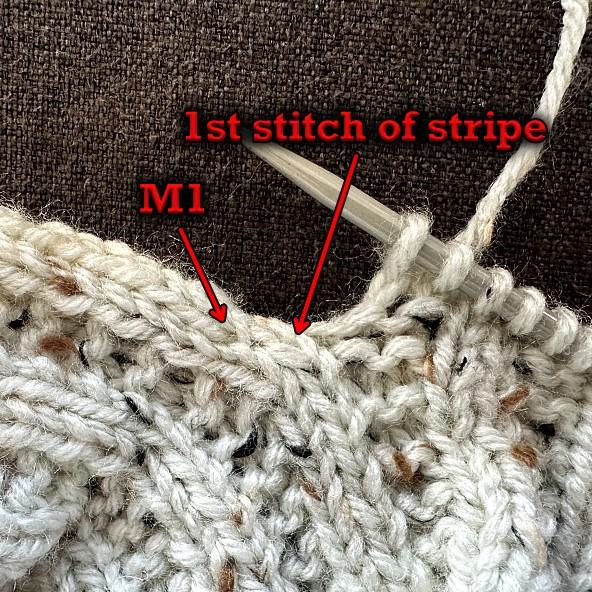
Row 21: K14, K2tog K7 K2tog, K9, In DFC (K3 into one stitch) twice. Turn. Working the following rows into the 6 stitches in the two stitches, P6, turn, K1, M1 K4 M1, K1 turn, P8, turn, K8, turn, P8, turn, K8 (do NOT turn). In MC K9. (49 sts)
Row 22: In MC K9 In DFC P8. In MC K32
Row 23: In MC K32 In DFC K8. In MC K9.
Row 24: In MC K9 In DFC P8. In MC K32
Row 25 : In MC K14, K2tog K5 K2tog, K9, In DFC DFC TWK2tog. K4 K2tog. In MC K9. (45 sts)
Row 26: In MC K9 In DFC P6. In MC K30
Row 27: In MC K30 In DFC TWK2tog. K2 K2tog. In MC K9. (43 sts)
Row 28: In MC K9 In DFC P4. In MC K30
Row 29: In MC K14, K2tog K3 K2tog, K8, In DFC K3 into one stitch by alternating knitting into the front, the back and the front of the stitch, turn. Working the following rows into the 3 stitches in the one stitch, P3, turn, K3, turn, P3, turn, TWK3tog (do NOT turn). In AC TWK2tog K2tog. In DFC K3 into one stitch by alternating knitting into the front, the back and the front of the stitch, turn. Working the following rows into the 3 stitches in the one stitch, P3, turn, K3, turn, P3, turn, K3tog (do NOT turn). In MC K8. (39 sts) Break DFC yarn.
Row 30: In MC K9 In AC P2 In MC K28
Row 31: In MC K27 Pick up the next st with the cable needle. Pull the st BACK. In AC K the st on the non-working needle. In MC K the st on the cable needle. Pick up the next st with the cable needle. Pull the st FORWARD. In MC K the st on the non-working needle. In AC K the st on the cable needle. In MC In MC K8. (39 sts)
Row 32: In MC K8. In AC P1. In MC K2. In AC P1. In MC K27.
Row 33: In MC K14, K2tog K1 K2tog, K7, Pick up the next st with the cable needle. Pull the st BACK, In AC K the st on the non-working needle, IN MC K the st on the cable needle. In AC pick up and K the st BELOW (see photos). In MC K2 . In AC pick up and K in the 2nd st BELOW. Pick up the next st with the cable needle. Pull the st FORWARD. In MC K the st on the non-working needle, In AC K the st on the cable needle. In MC K7 (39 sts)
First Antler
Place it on the non-working needle
Knit the stitch
Stitch completed
Second Antler
Lift and place on non-working needle
Knit the stitch
Use the cable needle to pull the next st FORWARD.Knit the next stitch on the non-working needle with MC. With AC knit the st on the cable needle.
Row 34: In MC K7. In AC P. In MC K. In AC P. In MC K2. In AC P. In MC K. In AC P. In MC K24.
Row 35: In MC K23. Pick up the next st with the cable needle. Pull the st BACK. In AC K the st on the non-working needle. In MC K st on the cable needle. K the next st on the non-working needle. In AC K. In MC K2. In AC K. In MC K. Pick up the next st with the cable needle. Pull the st FORWARD. In MC K the st on the non-working needle, In AC K the st on the cable needle. In MC K6
Row 36: In MC K6. In AC P. In MC K2. In AC P. In MC K2. In AC P. In MC K2. In AC P. In MC K23).
Row 37: In MC K23. In AC K. In MC K8. In AC K. In MC K6.
Row 38: In MC K6. In AC P. In MC K8. In AC P. In MC K23. Break AC.
Rows 39 – 44: Knit across
With the RIGHT side facing (If you want to change to CC, do so now.)
Row 45: K across
Row 46: P1 K1 ☺ P2 K1 ☺ Repeat from ☺ to ☺to the last st. P1.
*Row 47: K1 P1 ◊ K2 P1 ◊. Repeat from ◊ to ◊ to the last st. K1.
Row 48: As row 46 *
Repeat from * to * for 8 more rows. Repeat these 2 rows for a longer cuff.
Cast off.
Make the Thumb
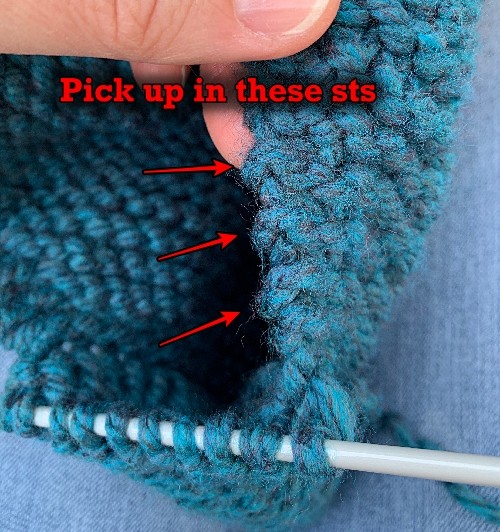
With the RIGHT side facing, Pick up 13 sts from the additional sts you cast on in Row 13. Pick up the st in the twist formed from casting on. If you need help you can watch the video below.
Row 21: K9. In DFC (K3 into one stitch) twice. Turn. Working the following rows into the 6 stitches in the two stitches, P6, turn, K1, M1 K4 M1, K1 turn, P8, turn, K8, turn, P8, turn, K8 (do NOT turn). In MC K9, K2tog K7 K2tog, K14. (49 sts)
Row 22: In MC K32 In DFC P8. In MC K9
Row 23: In MC K9 In DFC K8. In MC K32.
Row 24: In MC K32 In DFC P8. In MC K9
Row 25 : In MC K9, In DFC DFC TWK2tog. K4 K2tog. In MC K9, K2tog K5 K2tog, K14. (45 sts)
Row 26: In MC K30 In DFC P6. In MC K9
Row 27: In MC K9 In DFC TWK2tog. K2 K2tog. In MC K30. (43 sts)
Row 28: In MC K30 In DFC P4. In MC K9
Row 29: In MC K8, In DFC K3 into one stitch by alternating knitting into the front, the back and the front of the stitch, turn. Working the following rows into the 3 stitches in the one stitch, P3, turn, K3, turn, P3, turn, TWK3tog (do NOTturn). In AC TWK2tog K2tog. In DFC K3 into one stitch by alternating knitting into the front, the back and the front of the stitch, turn. Working the following rows into the 3 stitches in the one stitch, P3, turn, K3, turn, P3, turn, K3tog (do NOT turn). In MC K8, K2tog K3 K2tog, K14 (39 sts) Break DFC yarn.
Row 30: In MC K28 In AC P2 In MC K9.
Row 31: In MC K8 Pick up the next st with the cable needle. Pull the st BACK. In AC K the st on the non-working needle. In MC K the st on the cable needle. Pick up the next st with the cable needle. Pull the st FORWARD. In MC K the st on the non-working needle, In AC K the st on the cable needle. In MC K27. (39 sts)
Row 32: In MC K27. In AC P1. In MC K2. In AC P1. In MC K8.
Row 33: In MC K7 Pick up the next st with the cable needle. Pull the st BACK, In AC K the st on the non-working needle, IN MC K the st on the cable needle. In AC pick up and K the st BELOW (see photos). In MC K2 . In AC pick up and K in the 2nd st BELOW. Pick up the next st with the cable needle. Pull the st FORWARD. In MC K the st on the non-working needle, In AC K the st on the cable needle. In MC K7, K2tog K1 K2tog, K14. (39 sts)
Row 34: In MC K24. In AC P. In MC K. In AC P. In MC K2. In AC P. In MC K. In AC P. In MC K7.
Row 35: In MC K6. Pick up the next st with the cable needle. Pull the st BACK. In AC K the st on the non-working needle. In MC K st on the cable needle. K the next st on the non-working needle. In AC K. In MC K2. In AC K. In MC K. Pick up the next st with the cable needle. Pull the st FORWARD. In MC K the st on the non-working needle, In AC K the st on the cable needle. In MC K23.
Row 36: In MC K23. In AC P. In MC K2. In AC P. In MC K2. In AC P. In MC K2. In AC P. In MC K6.
Row 37: In MC K6. In AC K. In MC K8. In AC K. In MC K23.
Row 38: In MC K23. In AC P. In MC K8. In AC P. In MC K6. Break AC.
Rows 39 – 44: Knit across
With the RIGHT side facing (If you want to change to CC, do so now.)
Row 45: K across
Row 46: P1 K1 ☺ P2 K1 ☺ Repeat from ☺ to ☺to the last st. P1.
*Row 47: K1 P1 ◊ K2 P1 ◊. Repeat from ◊ to ◊ to the last st. K1.
Row 48: As row 46 *
Repeat from * to * for 8 more rows. Repeat these 2 rows for a longer cuff.
Cast off.
Make the Thumb
With the RIGHT side facing, Pick up 13 sts from the additional sts you cast on in Row 13. Pick up the st in the twist formed from casting on.
With the WRONG side facing
Row 1: (K1 P2) Repeat to the last st. K1.
Row 2: (P1 K2) Repeat to the last st. P1.
Row 3: Repeat row 1
Cast off.
Sew the seams on the thumb and side of the glove.
Hints and Tips
Picking up the stitch to make the second branch of the antler is sort of up to you. If you pick up the stitch right below where you just knitted, it won’t be a disaster. Most deer antlers aren’t perfectly symmetrical in real life anyways. In fact, the more off they are, the more desirable; especially if it has a drop tine.
Work in the ends on the backside of the reindeer and sew the thumb seam before you sew the seam along the side of the glove. It’s easier to do it this way.
Depending on how you do your colour work, your antler stitches may not all be the same size with some being larger and some smaller. It doesn’t bother me but if it’s an issue for you, you can adjust them slightly with the yarn carried behind your work. Regardless, stretch your work horizontally and vertically to even out the stitches when you’re done.
Abbreviations
K – knit
P – Purl
K2tog – knit 2 together
st – stitch
sts – stitches
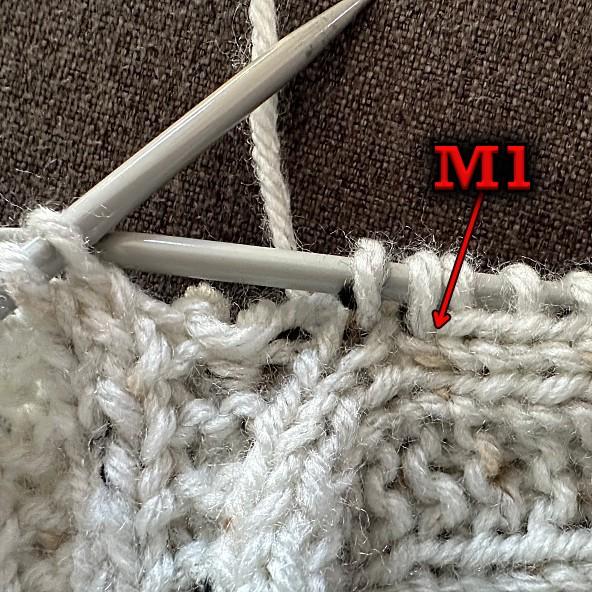
M1 – Make one (knit wise). Increase one stitch between the stitches. Pick up the yarn between the stitches. Twist it slightly and place it on your non-working needle. Knit the stitch. Watch the video that shows you how.
TWK2tog – (Twist and Knit 2 sts together) – Pick up a stitch as if to knit. Twist the stitch and place it back on your non-working needle. Knit the 2 stitches together from right to left. Yes, the video is showing how to make a mushroom, but I’ve cued up how to make the st.
TWK3tog – same as TWK2tog but knit 3 stitches together instead of 2.
If you’ve been looking for a fun and cozy project, this stuffed wolf knitting pattern is a great one to try. The toy is knit flat on straight needles, so you don’t need to fuss with knitting in the round. Once you sew the pieces together and add stuffing, you’ll have a handmade wolf that’s soft, cuddly, and full of character.
I designed this wolf knitting pattern to be simple and enjoyable, with clear instructions that make it easy to follow along. It’s perfect if you’ve been wanting to try a knitting pattern for stuffed animals but don’t want anything too complicated. Whether you’re making it as a gift, adding to your collection of knitted toys, or just looking for your next relaxing project, this wolf is a fun way to bring a little wild charm into your knitting. Grab your yarn, cast on, and let’s knit a wolf!
As a side note, I’ve always wanted to make videos for kids starring stuffed animals. Good wholesome stuff for the kids to watch. I’ve received some negative feedback on the use of AI to animate the wolf. I thought that this would be a great use of the new tech, but now I’m not so sure. I made a demo video you can watch here. Let me know your thoughts in the comments. Should I do this or not? Even with AI it’s a lot of work to make these videos. Just because I’m not making the animations myself, there is still the story and video editing required.
If you would to prefer to support my work and have access to a printable, ad-free version of this pattern, I offer that too. To get the downloadable pattern for a small fee you can get it in my Etsy Shop, Ravelry, LoveCrafts, Buy Me A Coffee and from the shop section on this website – KweenBee.com.
If you would prefer to order a Kindle or printed paperback version from Amazon, you can now do so! Shipping is free if you are an Amazon Prime member. Make sure you select the country you are in to take advantage of the free shipping. Click the following link for your country –United States, United Kingdom, Canada, andAustralia. The Kindle downloadand paperback versions are available in English only.
Another way to avoid ads and pop-ups, get instant, PRINTABLE downloads of this pattern and others, is by becoming a Member. When you become a Website Supporter at $4/month, you’ll gain access to exclusive member only posts on Buy Me A Coffee. You can download as many patterns as you like for the same $4 each month. You can go to this page to learn more, become a member and support my work… Exclusive Member Area
Worsted weight yarn – one standard ball size: 250g / 8.8 oz, 381 meters / 417 yards.
4 mm (US 6) single point knitting needles
Stitch holder
Tapestry needle
Stuffing – how much depends on the size you make and how firm or soft you like your stuffed animals and dolls.
You can use any type and thickness of yarn you like for this project. If it’s a thinner yarn, it will be smaller. If thicker – larger. I recommend using a needle size one size smaller than recommended for the yarn. It makes the stitches tighter to help the wolf hold its shape and contain the stuffing.
Gauge
In garter stitch and with 4 mm needles and worsted weight yarn
34 rows – 4 inches
18 sts – 4 inches
Wolf Body
Cast on 30
Row 1: K across.
Row 2: P across. Repeat row 1 and 2 for a total of 24 rows.
Row 25: K5 K2tog K12 K2tog K9. (28 sts)
Row 26: P5 TBLP2tog P11 TBLP2tog P8. (26 sts)
Row 27: K4 K2tog K10 K2tog K8. (24 sts)
Row 28: P4 TBLP2tog P9 TBLP2tog P7. (22 sts)
Row 29: * K1 K2tog * Repeat from * to * to the last st. K1. (15 sts)
Row 30: P across.
Row 31: K across.
Row 32: P across.
Head
Row 33: Reach down and increase in every st. (30 sts)
Knit the stitch as you normally would.
Pick up the stitch below the stitch you just knit.
Pick up the stitch and knit as you normally would.
Stitch completed
Row 34: P across
Row 35: K13 M1 Sl 4 sts (do NOT knit slipped stitches now and for the rest of the pattern) M1 K13 (32 sts)
Row 65: K2tog across. Break yarn leaving a long enough length to sew seam up the back of the body and head. Draw through.
Foot and Leg (make 2)
Cast on 22
Row 1: K across
Row 2: P across. Repeat row 1 and 2 for a total of 8 rows.
Row 9: K7. Cast off 8 sts. K6. (One st remains on your working needle when casting off). (14 sts)
Row 10: P across. (Bring the sts on the left and right side of the cast off section together so they touch. Purl across as you normally would) (14 sts)
Bring the sts on each side of the cast off sts together.
Purling the sts
Row 10 complete. Wrong side.
View from the side.
Row 11: K across
Row 12: P across. Repeat row 11 and 12 for a total of 12 rows.
Row 2: P across. Repeat row 1 and 2 for a total of 20 rows.
Row 21: K3 K2tog K9 (13 sts)
Row 22: P3 TBLP2tog P8 (12 sts)
Row 23: K across
Row 24: P across
Row 25: K3 M1 Sl 6 M1 K3 (14 sts)
Row 26: P across
Row 27: K across
Row 28: P across. Repeat row 27 and 28, 3 more times.
Row 35: K2tog across (7 sts)
Row 36: P across
Row 37: K2tog across to the last st. K1.
Break yarn leaving a long enough length to sew seam up the back of the paw and arm. Draw through.
Ear (make 2)
Cast on 10 sts. Leave a long length of yarn when casting on to sew the ear to the head
Row 1: K across
Row 2: P across
Row 3: K7 K2tog. K1 (9 sts)
Row 4: P6 TBLP2tog P1 (8 sts)
Row 5: K5 K2tog. K1 (7 sts)
Row 6: P4 TBLP2tog P1 (6 sts)
Row 7: K3 K2tog. K1 (5 sts)
Row 8: P2 TBLP2tog P1 (4 sts)
Row 9: K1 K2tog. K1 (3 sts)
Row 10: TBLP2tog P1 (2 sts)
Row 11: K2tog. Break yarn. Draw through.
Tail
Cast on 8 sts
Row 1: K across
Row 2: P across. Repeat row 1 and 2 for a total of 4 rows.
Row 5: K3 M1 Sl 2 M1 K3 (10 sts)
Row 6: P across
Row 7: K4 M1 Sl 2 M1 K4 (12 sts)
Row 8: P across
Row 9: K5 M1 Sl 2 M1 K5 (14 sts)
Row 10: P across
Row 11: K6 M1 Sl 2 M1 K6 (16 sts)
Row 12: P across
Row 13: K across
Row 14: P across. Repeat row 13 and 14, 2 more times.
Row 19: K2 K2tog K12 (15 sts)
Row 20: P2 TBLP2tog P11 (14 sts)
Row 21: K2 K2tog K10 (13 sts)
Row 22: P2 TBLP2tog P9 (12 sts)
Row 23: K2 K2tog K8 (11 sts)
Row 24: P2 TBLP2tog P7 (10 sts)
Row 25: K2 K2tog K6 (9 sts)
Row 26: P2 TBLP2tog P5 (8 sts)
Row 27: K2 K2tog K4 (7 sts)
Row 28: P2 TBLP2tog P3 (6 sts)
Row 29: K2tog across. Break yarn leaving a long enough length to sew seam up the back of the tail and sew to body. Draw through.
Hints and Tips
If you have difficulty picking up the sts below in row 33 of the head, you can always do a simple increase in each st (2 sts in one st). I’m showing you how to do it this way so you avoid holes around the neck.
Sew together however you feel is best. The legs are large enough at the top the form what you could call butt cheeks. Sew the legs together, then sew them to the back and front. They don’t match st for st so you’ll need to fiddle with making it go together.
You may need another length of yarn when sewing to top of the foot.
Stuff it as firmly as you like. I like mine more on the squishy side yet firm enough to hold its shape.
Embroider on a nose and eyes or you can use googly eyes. You can leave the front paws as is or add lines to separate the “fingers”. Or are they toes? I’m not sure how to refer to them.
I have not done this, but if you use pure wool you can felt this. I would recommend you felt it BEFORE you sew the pieces together and stuff it. If you do this, let me know how it works out for you.
Abbreviations
st – stitch
sts – stitches
Sl – slip the stitch
K – knit
P – purl
K2tog – knit 2 stitches together
M1 – Make one (knit wise). Increase one stitch between the stitches. Pick up the yarn between the stitches. Twist it slightly and place it on your non-working needle. Knit the stitch. Click this link to watch this video on How to M1 or Make 1 to see how.
TBLP2tog – (Through the Back Loop, Purl 2 sts together) – Purl 2 together through the back loop from left to right. Click this link TBLP2tog to watch the video. Yes it’s for a different pattern but the stitch technique is the same.
Like all of my patterns you have my permission to sell and/or give away the physical items that you make using this pattern. You are NOT permitted to reprint or sell this pattern in any form unless you have obtained my written permission to do so.
Help Support My Work!
Follow me on Instagram, Facebook, Pinterest and YouTube. Every follow, subscribe, thumbs up, like, heart and share help increase my popularity on the web and get more viewers to my work. It costs you nothing but helps me sooooo much!
If you would like to help a little more, you can always become a Website Member to download and print over 60 patterns by becoming a member on Buy Me a Coffee.
Are you just learning to knit? Tired of making dishcloths and scarves and want to make something awesome? Here is something that will make you look like a pro when it comes to knitting. A total brag-worthy design that any knitting newbie can make.
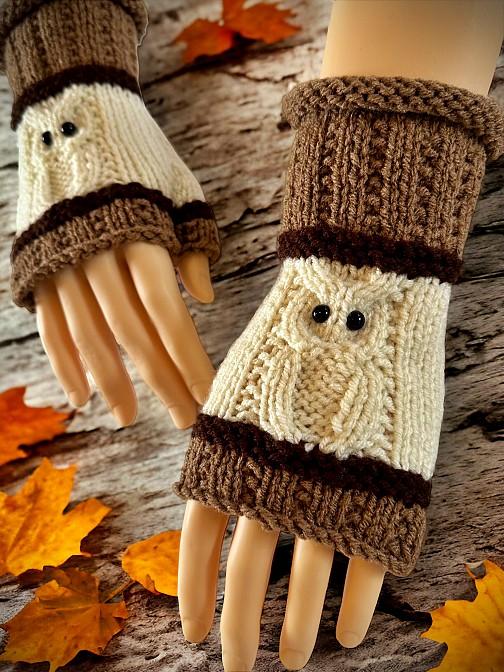
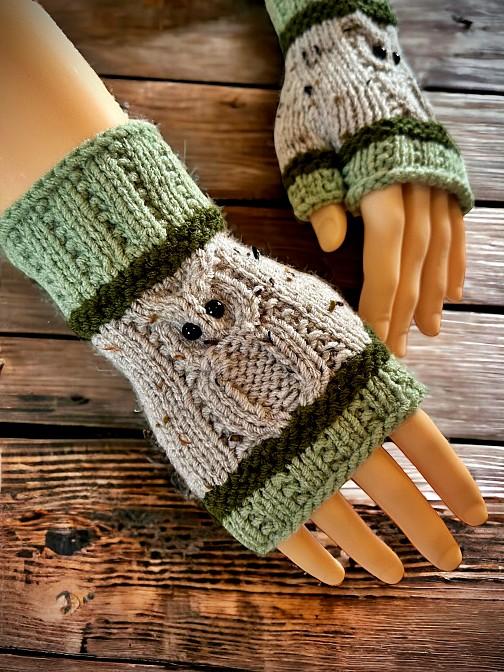
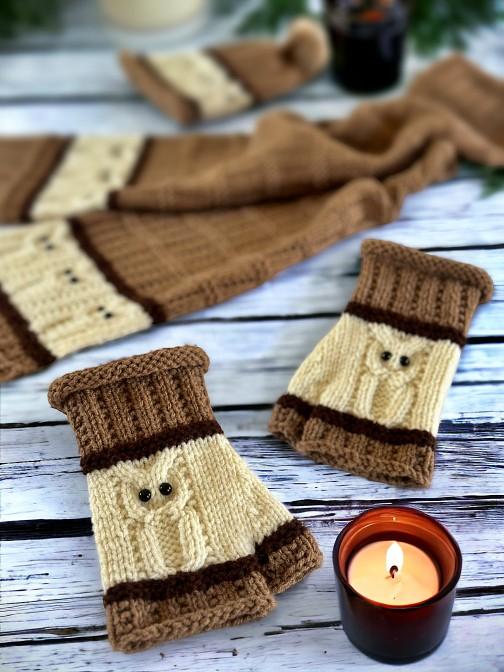
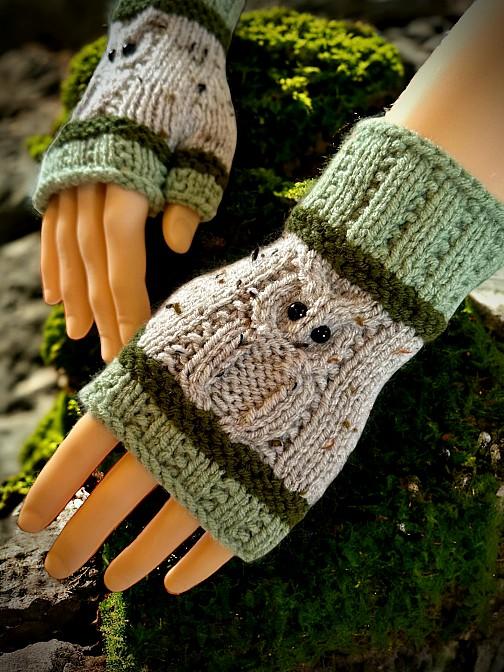
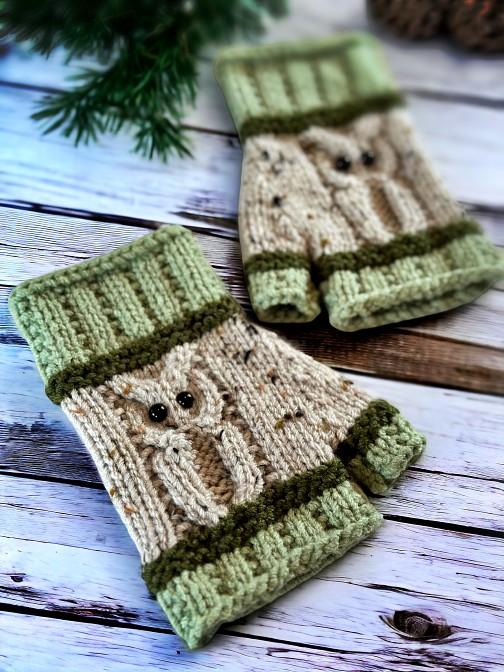
I’ve written a bunch of beginner patterns for slippers, but never for fingerless gloves. It was a common request, but for some reason, I never felt compelled to do so. After a bit of false starts and redesigns, I’ve finally come up with a fingerless glove pattern that I am happy with. I’ve kept the seams to a minimum and placed the seam along the outside of the hand and inside of the thumb. If you’re not a fan of seams my other fingerless gloves and mitts knitted on dpn can be found here – Fingerless Gloves – with OWLS, How to Knit Texting Mittens, How to Knit Fingerless Gloves and How to Knit Flip Mitts.
I’ve also jazzed up this basic design a bit. If you want to knit owl gloves flat on 2 needles just like this pattern is, You can use this link – Easy to Knit Owl Fingerless Gloves to read the free knitting pattern online. I also made another variation of this pattern. This time it’s for a pair with a butterfly on the back of the hand – Butterfly Fingerless Gloves – Easy Knit Flat Fingerless Mitts Pattern. The video how’s you how to make the 🦋 butterfly.
These mitts are knitted completely flat, on 2 needles and are perfect for the beginner. There is use of a stitch holder and picking up those stitches to complete the thumb, but it isn’t difficult. Slide them on to the holder, slide them back on the needle when instructed and knit them like any other set of stitches.
And finally, after much procrastinating, the complete how-to video is done! I even show how to sew up the seams and work in the ends. I know there have been a few of you out there that don’t like how their seams turn out. This is how I make mine flat and even.
I’ve also written the pattern to fit different sizes – small, medium and large. Once again I’ll use the analogy of what fits my hand. I wear a medium rubber glove and the medium size fits my hand perfectly. I wash dishes and scrub my toilets. I wear gloves when I do. If you never wear rubber or latex gloves, this won’t make any sense to you, I guess. I’m only saying this because I have had complaints about my sizing references. I don’t live in a gloveless kind of world but I’m glad some people do. It always amazes me what some “Karens” feel the need to bitch about ? If you want to go to a specific size you can try these links. If I’ve done my code correctly, it should take you to the right point on the webpage:
I’ve made a PDF download for this pattern. I didn’t think it was going to be this long until I wrote it out. I made the decision to write each size and hand out separately to make it even easier for the new knitters out there who want to give this pattern a go. And btw, you can totally do it! To get the downloadable pattern for a small fee you can get it in my Etsy Shop, Ravelry, LoveCrafts, Buy Me A Coffee and from this website – KweenBee.com.
If you would prefer to order a printed paperback version from Amazon, you can now do so! Shipping is free if you are an Amazon Prime member. Make sure you select the country you are in to take advantage of the free shipping. Click the following link for your country – United States, United Kingdom, Canada, and Australia. Available in English only.
Another way to avoid ads and pop-ups, get instant, PRINTABLE downloads of this pattern and others, is by becoming a Member. When you become a Website Supporter at $4/month, you’ll gain access to exclusive member only posts on Buy Me A Coffee. You can download as many patterns as you like for the same $4 each month. You can go to this page to learn more, become a member and support my work… Exclusive Member Area
Love the free patterns? You can say thanks in a couple of ways. You can read more about how you can Support My Work by clicking that link or make a small donation and Buy Me a Coffee. 👈🏼 That is a website where you can make a one time donation as a thanks. If you don’t want or are unable to make a financial donation, sharing this pattern through social media is a great way to help out too! The links below are a super easy way for you to do so.
Gauge
This is important to follow for correct sizing.
2″ (5 cm) = 10 sts
2″ (5 cm) – 16 rows
If You Need Help with the M1 or P1
Scroll down to the end of the page to watch quick how-to videos showing how to do these simple stitches. There’s a video showing how to use a stitch holder too!
Things You Need:
Worsted weight yarn – one regular ball will be more than enough
Sew seam along the side of the glove and the inside of the thumb. Work in ends.
Now that you know you can make fingerless gloves, why not try a winter hat or beanie? Or if you’re like me, you call it a toque. 😊 You can watch the how to video below. and read the pattern for FREE right here on the website too! Just click the button…
Sew seam along the side of the glove and the inside of the thumb. Work in ends.
Hints and Tips
Make your seams as narrow as possible when sewing them. The bulkier the seam the more noticeable and possibly uncomfortable for the wearer.
The purple fingerless mitts have 60 rows total between the garter stitch cuff and the start of the thumb gusset (Row 15 – 22). I don’t think I would increase much further than that. The glove itself isn’t very stretchy and won’t fit further up the forearm. Too much bunching may also make the glove push its way further down and off the fingers.
I used some self-striping yarn to make these. Not all striping yarn is created equal. Some of them are designed to stripe for larger projects and don’t really work for smaller projects like this. Though with saying that, you could always cut the yarn and start a new colour where you choose. You will have more ends to deal with, but I have a post that shows you How to Work in the Ends While Knitting. ?? This link will take you right there.
Abbreviations
K – knit
P – purl
M1 – Make one (knit wise). Increase one stitch between the stitches. Pick up the yarn between the stitches. Twist slightly. Place it on your non-working needle. Knit the stitch. Watch this video below to see how.
How to make one or M1 – Increase between stitches.
PM1- Make one (purl wise). Pick up the stitch as you did for M1, but purl the stitch as you regularly would. You can watch the video below.
And for those of you who are unsure of how to use a stitch holder, I made a quick little video that shows you how to do it without cutting the yarn. It’s a time saver for sure. No one likes working in ends if they can avoid it.
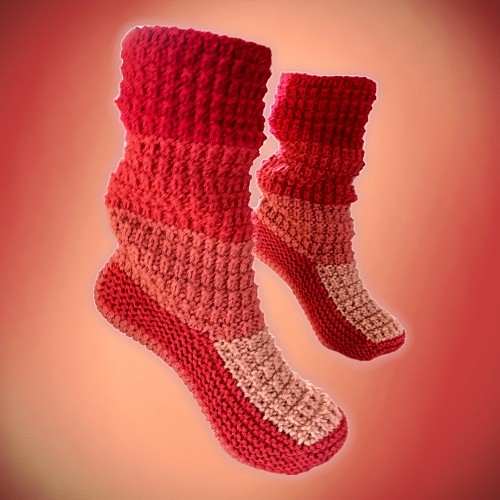
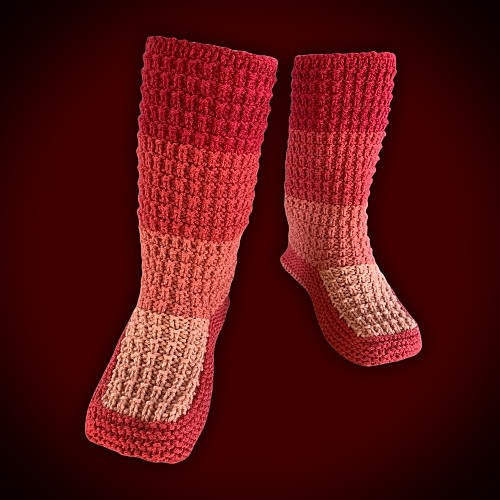
What happens when you cross a slipper with a dishcloth? No, this isn’t a joke. This is exactly what inspired me to design this new slipper. I had recently written and published my latest pattern Textured Easy to Knit Dishcloth Pattern and thought to my self, “That texture is reversible. I bet I could work that into a slipper pattern. But which one?” Then it dawned on me. Because this isn’t a very stretchy texture, it would be slouchy and baggy, but it would have to fit snuggly around the foot to stay on. Then I realized my super popular Free Knitted Moccasin Slipper Pattern does exactly that! And this knitting pattern was born… But enough about the genesis of slipper patterns.
This pattern is written for adult sizes. If there are enough folks that leave a comment requesting child sizes, I’ll happily do it. It involves a lot of math and if there is no demand, I don’t want to put all the effort into it for nothing.
Another way to avoid ads and pop-ups, get instant, PRINTABLE downloads of this pattern and others, is by becoming a Member. When you become a Website Supporter at $4/month, you’ll gain access to exclusive member only posts on Buy Me A Coffee. You can download as many patterns as you like for the same $4 each month. You can go to this page to learn more, become a member and support my work… Exclusive Member Area
Loving the free knitting patterns? Then please help support this site. You can learn more by going to my Help Support My Work page and make a small financial contribution. Or, you can use these share links below ?????? and share this and my other patterns through your social media. More eyeballs on my work helps a bunch too.
Things You Need
1 ball of worsted weight yarn (average 260 yard, 5 oz or 141 gram ball will be more than enough). I used Red Heart worsted weight yarn when designing the pattern but any worsted weight yarn will suffice.
With size 4 mm (US size 6) needles or whatever size you needto obtain the correct number of stitches and rows. Be sure to check your gauge otherwise the sizing won’t be correct.
In garter stitch
4” = 16 sts
4” = 40 rows
Sizes (are written as such)
Women’s 6-7 (8-9, 10-11, 12-13)
Men’s 5-6 (7-8, 9-10, 11-12)
To Begin
Cast on 58 (62, 66, 70)
🦉 Row 1 – 2: K1 P1 across.
Row 3 – 4: K across. 🦉
Repeat from 🦉 to 🦉 8 more times. (If you want a longer bootie, make more repeats of these 4 rows.)
Repeat Row 1 – 2 one more time.
Break yarn when completed row 2.
Toe Flap
Next Row: With RIGHTside facing, transfer the first 22 (24, 26, 28) stitches to a stitch holder. Reattach the yarn and K1 P1 across the next 14 stitches(the start of the toe flap). Leave the remaining 22 (24, 26, 28) stitches on the needle unworked.
The following rows are worked back and forth on the 14 toe flap stitches only!
🌸 Next 2 Rows: Knit across.
Next 2 Rows: K1 P1 across. 🌸
Repeat from 🌸 to 🌸 6 (7, 8, 9) more times. You now have 28 (32, 36, 40) rows total for the toe flap.
Break yarn. You’ll have the 14 stitches of the toe flap on your needle and the 22 (24, 26, 28) stitches you left on the needle when you started making the toe flap.
Making the Sides of the Slipper
This is where you’re going to need the extra set of knitting needles. You’ll be knitting back and forth in rows but the turn around of the toe is too tight to use circular needles. For this, you’ll put the 14 toe flap stitches on one of your extra needles. It’s a little unconventional, but it works.
Next Row: With the RIGHTside facing, transfer the 22 (24, 26, 28) stitches from the stitch holder onto one of your needles. Attach your yarn and K2tog the 22 (24, 26, 28) stitches. You will now have 11 (12, 13, 14) stitches on your working needle.
With the working needle, pick up 21 (22, 23, 24) stitches evenly along the edge of the toe flap. (All of these stitches are on ONEneedle. (There are now 32, (34, 36, 38) stitches on this needle.)
With another needle, knit the 14 stitches of the toe flap. (14 stitches on this needle)
With another needle, pick up 21 (22, 23, 24) stitches evenly along the side of the toe flap.
With your working needle that has the picked up stitches, K2tog the 22 (24, 26, 28) stitches that are on the non-working needle. You will now have 32 (34, 36, 38)stitches on this needle.
You should now have 3 needles holding stitches with all the points pointing as shown below when laid flat. You also have one spare needle to knit with. You are now going to knit in rows, back and forth with these three needles. Once you finish knitting all the stitches on one needle, move on to the next needle (the point of the needle is right there) until you complete the row.
How the needle arrangement should look.
Knit the next 10 (12, 14, 16) rows
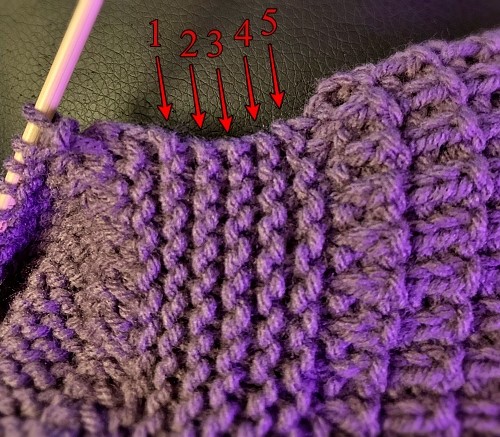
There are 5 (6, 7, 8) ridges on the tip of the toe.
The photo below shows the 5 ridges for the women’s size 6-7 or the men’s 5-6.
Five ridges picked up along the toe flap. The ridges going vertically are the textured motif. I forgot to take a new photo and reused the photo from another pattern. The horizontal ridges look the same for you.
Making the Sole
If you need help with the sole, you can watch the video. It starts right where you need it to.
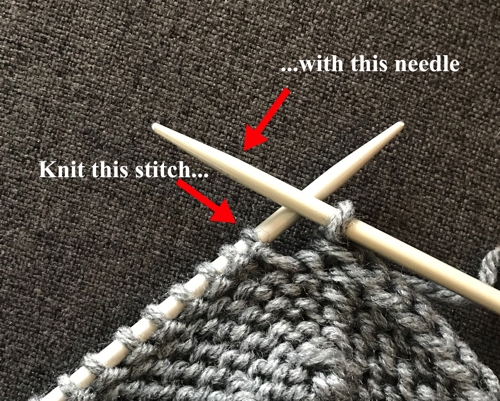
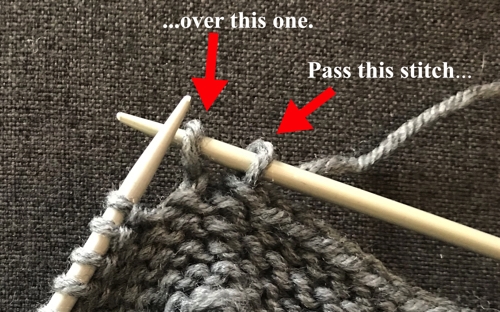
Next Row: With WRONGside facing. Cast off all the stitches from the first needle loosely. You’ll need to pass the last stitch from the first needle over the first stitch of the toe flap stitches (second needle).
Using the same needle that now has one stitch, knit the remaining 13 stitches of the toe flap. Cast off all the stitches from the third needle loosely. Break yarn.
Next Row: With the RIGHTside facing, attach yarn and knit the first stitch of the cast off stitches by the toe flap (cast off stitch on the right by the point of the needle).
K2tog. Knit to the last 2 stitches K2tog. Pick up the cast off stitch by the point of your needle. (14 stitches).
PLEASE NOTE: To make the picking up of the cast off stitches easier, count the number of cast off stitches on one side and count off the same number of cast off stitches on the other side. In other words, count up 32 (34, 36, 38) cast off stitches when picking up the first stitch, work across as written above, count up 32 (34, 36, 38) cast off stitches on the opposite side and pick up a stitch.
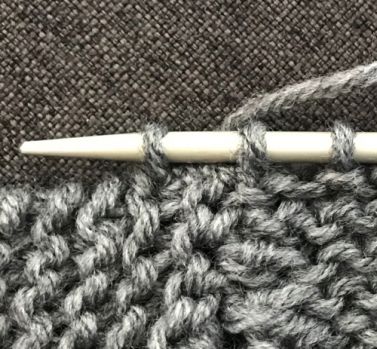
Quick tip – wrap the yarn counterclockwise around your needle and turn it down to pull the yarn through the cast off stitch on the right. If you have a hard time doing this, you can also use a crochet hook to pull the loop through and place that loop on your working needle.
You now are working back and forth along the bottom of the foot picking up one cast off stitch on each side as you go.
Next Row: Knit across.
🐿️ Next Row: Pick up the next stitch of the cast off stitches. K2tog. Knit to the last 2 stitches K2tog. Pick up the cast off stitch on the other side of the slipper by the point of your needle. (14 stitches).
Next Row: Knit across 🐿️
Repeat from 🐿️ to 🐿️ down the entire length of the foot. There are equal number of cast off stitches along each side. How many rows varies depending on the size of slipper you’re making. Be sure to end with a completed knit across row.
Starting the sole. Right side. (I reused the photos but making the sole is the same for this pattern. The centre portion has the textured motif for what you’re making.)
Working your way down while making the sole. Wrong side.
Continue to work down the length of the sole.
Still further down the sole. Note how the cast off edges are being picked up as you go. Keep going until you reach the end of the cast off stitches.
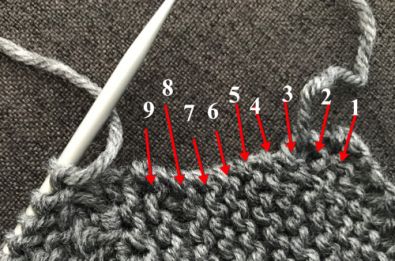
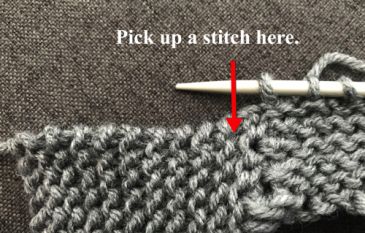
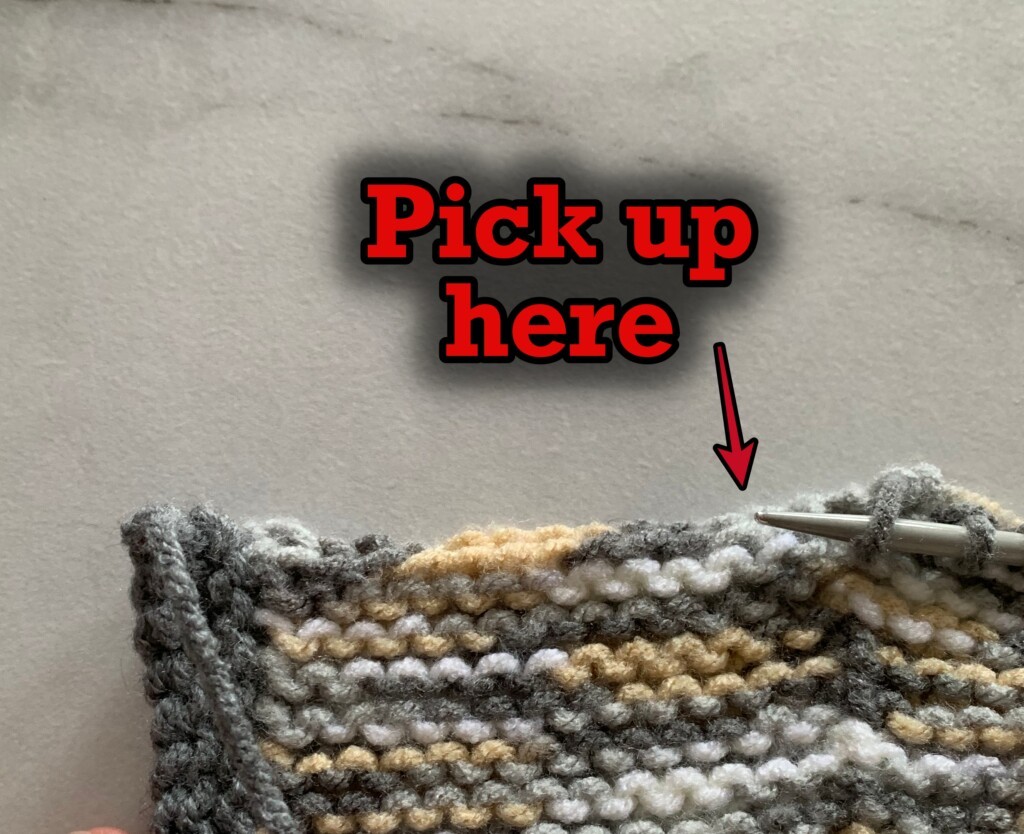
♥︎ Next Row: With the RIGHT side facing, pick up a stitch in the row closest to the sole of the slipper. Count how many ridges it is for the size you are making. (There are 5 (6, 7, 8) ridges on the side of the slipper before the cuff pattern begins.)
The photo above shows 5 rows of ridges. You’ll have more than 5 ridges when making the larger sizes.
The above photo shows 9 rows of ridges.
K2tog. Knit to the last 2 stitches. K2tog. Count down the same number of ridges on the other side and pick up a stitch in the space beneath it. (14 stitches).
Picking up the stitch on the other side.
Next Row: Knit across ♥︎
Repeat from ♥︎ to♥︎ 0 (1, 2, 3) more times. Count down one less ridge for each row where you pick up a stitch along the side of the slipper. Another way to say it is…Work your way up the ridges closer to the cuff pattern when you pick up a stitch on each side when the RIGHT side facing you.
Making the Heel
I recently made a video showing how to do this. It’s how I make a lot of my slipper heels including this pattern. You can watch the video below to help you.
♦︎ Next Row: Count down one ridge less than the previous row and pick up a stitch in the space beneath it. K2tog twice. Knit until the last 4 stitches. K2tog twice. Count down the same number of ridges and pick up a stitch in the space beneath it on the other side.
Next Row: Knit across. ♦︎
Repeat from ♦︎ to ♦︎ until 6 stitches remain. You will start picking up stitches in the patterned cuff on each side. That’s OK!!!
Next Row: Pick up a stitch. K2tog 3 times. Pick up a stitch on the other side.
Next Row (wrong side): K2tog K1 K2tog.
Next Row: Knit the 3 sts together.
Break yarn leaving a length of yarn long enough (12ish inches) to sew up the remaining seam.
Make another slipper.
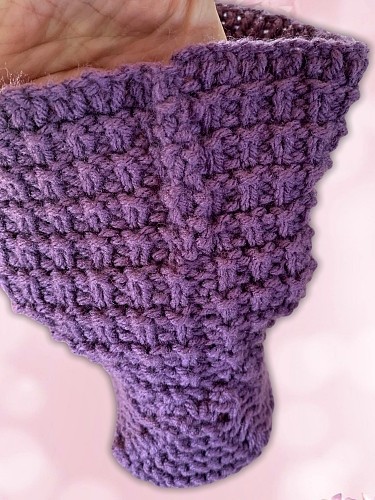
Yes, they do look a little boxy when they’re done and not on a foot. The stretch of the garter stitch on the sides and the sole allows these slippers to stretch around the contours of any foot easily.
If you want a longer cuff at the top, work more repeats of the first 4 rows than stated at the beginning when you cast on. The red striped slippers have approximately twice the number of repeats as written. The purple slippers have the exact number of repeats as written.
If you want to fold the slipper and create a cuff, sew the seam on the wrong side as you usually would.. Work your way down until a little less than half way. Sew the rest of the seam on with the right side facing. You’ll have a nearly invisible seam if you do this. See the photo below.
When picking up stitches from the cast off row, be sure you’re really moving on to the next cast off stitch! It’s an easy mistake to pick up a stitch in a stitch you previously picked up. If in doubt, give the needle holding the stitches a bit of a tug. You’ll see the yarn move slightly at the very back, closest to the needle. Pick up a stitch at the NEXT cast off stitch.
If you don’t have the same number of stitches on both sides when you are forming the sole, you may have picked up a stitch twice in one stitch or missed one. Don’t worry! This is fixable. You can skip one cast off stitch if you need to make it even, or pick up a cast off stitch twice on the other side. There’s enough stretch in the slipper that any puckering this causes won’t be overly visible if you’re off by a stitch or two.
To speed up finishing the slippers and not have so many ends to sew in, hold the yarn ends to the back of your work as you knit. I have a tutorial on my website at KweenBee.com that shows you how. You can search my website for the title How to Work in the Ends While Knitting – KweenBee.com You have to add KweenBee to the title to get my how-to when doing a search through your preferred search engine.
Abbreviations
k – knit
p – purl
k2tog – knit 2 together
st – stitch
sts – stitches
Like all of my patterns you have my permission to sell and/or give away the slippers that you make using this pattern. You are NOT permitted to reprint this pattern in any form unless you have obtained my written permission to do so.
If you have any questions, please feel free to leave a comment or send me your questions at kweenbee_crafts@hotmail.ca.
Help Support My Work!
Follow me on Instagram, Twitter, Facebook, Pinterest and YouTube. Every follow, subscribe, thumbs up, like, heart and share help increase my popularity on the web and get more viewers to my work. It costs you nothing but helps me sooooo much!
For more printable patterns like this one, support me on Patreon! I’m adding new patterns regularly. As of this printing there are 8 additonal patterns to download for only $4 per month. You can read more about that at www.Patreon.com/JanisFrank
Get ready to knit a pair of slippers that are as cozy as they are charming! This knitting pattern brings together the best of warmth and whimsy, featuring a delightful owl motif perched right on top of the foot. These adult-sized slippers have been crafted with both style and function in mind, thanks to a fitted cuff that hugs your ankle for extra warmth and coziness. Perfect for chilly mornings or relaxed evenings, these slippers will be a go-to pair for any owl lover.
This pattern is designed for knitters with a bit of experience—if you’re comfortable with basic stitches, you’ll be able to follow along with ease. And don’t worry, you won’t be left to navigate the trickier parts alone! I’ve included detailed, how-to videos to help guide you through each step, ensuring that even challenging sections feel doable. Before you know it, you’ll have a cozy, owl-adorned pair of slippers that are sure to turn heads and keep feet warm.
if you are a lover of owls, then you are in LUCK! I have a number of patterns with owls including fingerless gloves, owl beanie, owl bucket hat, and an owl scarf. All are knit flat on 2 needles and are FREE to read on this website. Click any of the links and a new window will open a new page with the entire pattern there for you to enjoy.
Another way to avoid ads and pop-ups, get instant, PRINTABLE downloads of this pattern and others, is by becoming a Member. When you become a Website Supporter at $4/month, you’ll gain access to exclusive member only posts on Buy Me A Coffee. You can download as many patterns as you like for the same $4 each month. You can go to this page to learn more, become a member and support my work… Exclusive Member Area
If you enjoy this pattern and my other free online knitting patterns, please consider making a small donation or helping me out by visiting my Help Support My Work page. If that’s not possible, that’s totally fine too! Even sharing this page on your social media helps me out immensely. You can use the buttons below to do so easily.
Happy Knitting!
Things You Need
1 ball of worsted weight yarn (average 260 yard, 5 oz or 141 gram ball will be more than enough). You can use a second colour for the cuff.
2 sets of size 4 mm (US size 6) single point knitting needles.
Stitch holder
Cable Needle
Tapestry needle to sew in ends. You can also use this handy video tutorial to show you how to work in the ends while knitting these slippers. The embedded video is in the Abbreviations section
Gauge
With size 4 mm (US size 6) needles or whatever size you needto obtain the correct number of stitches and rows. Be sure to check your gauge otherwise the sizing won’t be correct.
In garter stitch
2” = 9 sts
2” = 18 rows
Sizes (are written as such)
Women’s 6-7 (8-9,10-11, 12-13)
Men’s 5-6 (7-8,9-10, 11-12)
Cuff
With CUFF colour
Cast on 36 (38, 40, 42) loosely
Row 1: K across
Row 2: With the RIGHT side facing you, (K1 P2) across. Maintain this pattern with any remaining sts at the end of the row.
Repeat from to 10 (12, 14, 16) times more for a total of 12 (14, 16, 18) rows
Next Row: With the RIGHT side facing, P across.
Next Row: K across. If cuff colour differs from the MAIN colour, break yarn now. Start the new colour when done knitting this row.
Next Row: K across for 13 (15, 17, 19) rows. Break yarn.
Toe Flap
Next Row: With the MAIN colour and the WRONG side of the ribbing facing you, transfer the first 11 (12, 13, 14) stitches to a stitch holder. Reattach the yarn and knit the next 14 stitches(the start of the toe flap with the owl motif). Leave the remaining 11 (12,13, 14) stitches on the needle unworked.
The following rows are worked back and forth on the 14 toe flap stitches only!
Knit across for 7 (9, 9, 11) rows.
Next Row (with the RIGHT side of the ribbing facing you): K3 P2 K4 P2 K3
Next Row (with the WRONG side of the ribbing facing you): K2 P1 K8 P1 K2
Next Row: K3 P8 K3
♦ Next Row: K2 P1 C4F C4B P1 K2
Next Row: K3 P8 K3
♥ Next Row: K2 P1 K8 P1 K2
Next Row: K3 P8 K3 ♥Repeat from ♥to♥2 more times
Next Row: Repeat row marked with♦
Next Row: K3 P2 K4 P2 K3
♪ Next Row: K2 P1 K2 P4 K2 P1 K2
Next Row: K3 P2 K4 P2 K3 ♪ Repeat from ♪ to♪ 3 more times
This is where you’re going to need the extra set of knitting needles. You’ll be knitting back and forth in rows but the turn around the toe is too tight to use circular needles. For this, you’ll put the 14 toe flap stitches on one of your extra needles. It’s a little unconventional, but it works.
Next Row: With the RIGHTside facing, transfer the 11 (12, 13, 14) stitches from the stitch holder onto one of your needles. Attach your yarn and knit the 11 (12, 13, 14) stitches. Pick up 21 (22, 23, 24) stitches evenly along the edge of the toe flap. (All of these stitches are on ONEneedle. (32, 34, 36, 38) stitches on this needle)
With another needle, knit the 14 stitches of the toe flap. (14 stitches on this needle)
With another needle, pick up 21 (22, 23, 24) stitches evenly along the side of the toe flap. Knit the remaining 11 (12, 13,14) stitches on the next needle. (32, 34, 36, 38)stitches on this needle)
You should now have 3 needles holding stitches with all the points pointing as shown below when laid flat. You also have one spare needle to knit with. You are now going to knit in rows, back and forth with these three needles. Once you finish knitting all the stitches on one needle, move on to the next needle (the point of the needle is right there) until you complete the row.
I used a double pointed needle to work my 14 stitches for the toe only because it was handy. A regular needle works!
Knit the next 8 (10, 12, 14) rows
There are 4 (5, 6, 7) ridges on the tip of the toe.
The following photo shows the 5 ridges for the women’s size 8-9 or the men’s 7-8.
These are the ridges picked up along the side.
Next Row: With WRONG side facing. Cast off all the stitches from the first needle loosely. You’ll need to pass the last stitch from the first needle over the first stitch of the toe flap stitches (second needle).
Using the same needle that now has one stitch, knit the remaining 12 stitches of the toe flap. Cast off all the stitches from the third needle loosely. Break yarn.
Making the Sole
If you need more help than the photos provide, you can watch the how-to video. The link starts the video in the correct section. No need to find the spot. I already have it cued up for you.
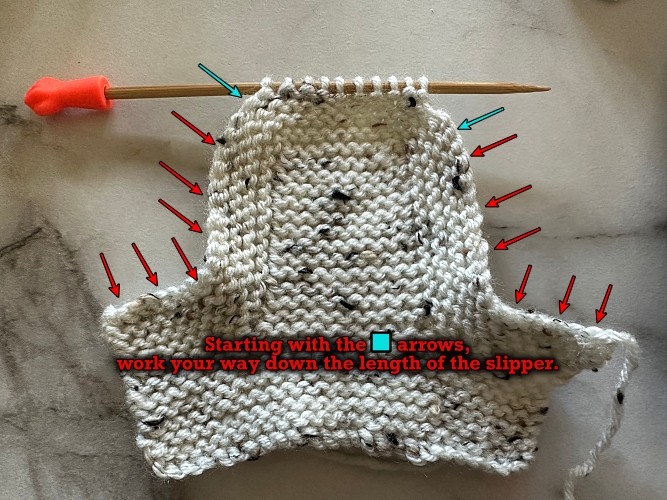
Next Row: With the RIGHT side facing, attach yarn and knit the first stitch of the cast off stitches by the toe flap (cast off stitch on the right by the point of the needle).
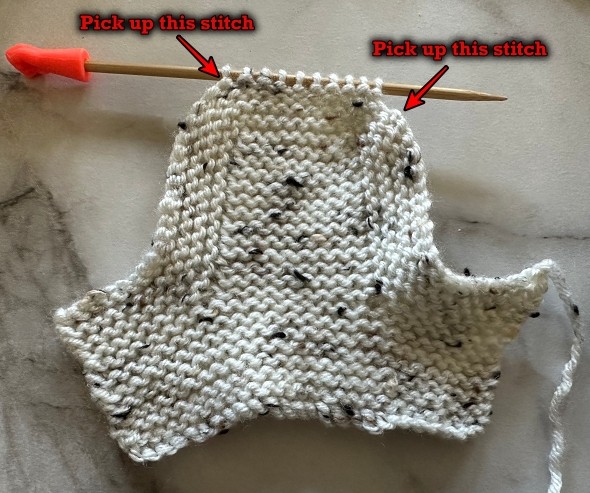
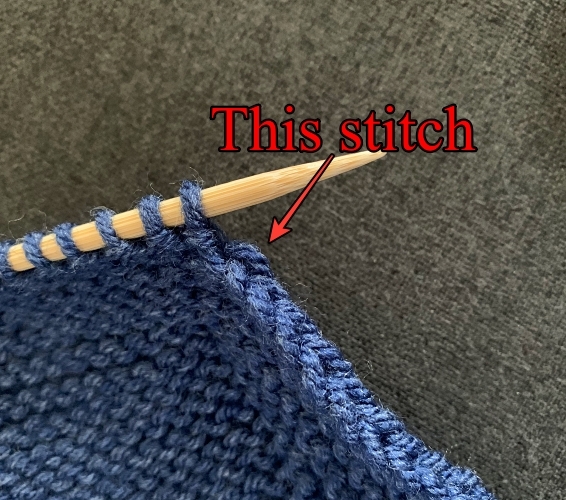
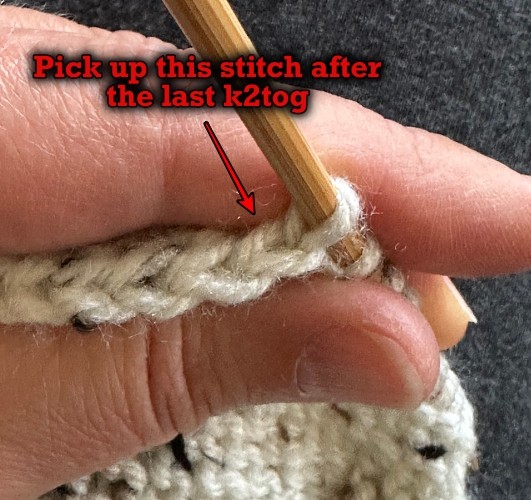
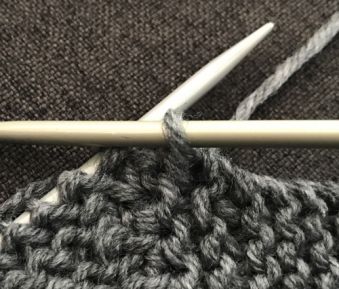
Pick up this stitch at the start of the row.
K2tog. Knit to the last 2 stitches K2tog. Pick up the cast off stitch by the point of your needle. (14 stitches).
Pick up this stitch at the end of the row.
Quick tip – wrap the yarn counterclockwise around your needle and turn it down to pull the yarn through the cast off stitch on the right. If you have a hard time doing this, you can also use a crochet hook to pull the loop through and place that loop on your working needle.
You now are working back and forth along the bottom of the foot picking up one cast off stitch on each side as you go.
Next Row: Knit across.
ʤNext Row: Pick up the next stitch of the cast off stitches. K2tog. Knit to the last 2 stitches K2tog. Pick up the cast off stitch on the other side of the slipper by the point of your needle. (13 stitches).
Keep working your way down the slipper to make the sole.
Next Row: Knit across ʤ
Repeat from ʤ to ʤ down the entire length of the foot. There are equal number of cast off stitches along each side. How many rows varies depending on the size of slipper you’re making. Be sure to end with a completed knit across row.
Starting the sole. Right side.
Working your way down while making the sole. Wrong side.
Continuing to work down the length of the sole.
Still further down the sole. Note how the cast off edges are being picked up as you go. Keep working your way down the length of the sole until you’ve picked up all the cast off stitches.
Making the Heel
If you need more help than the photos provide, you can watch the how-to video. The video starts in the correct section. No need to find the spot. I already have it cued up for you.
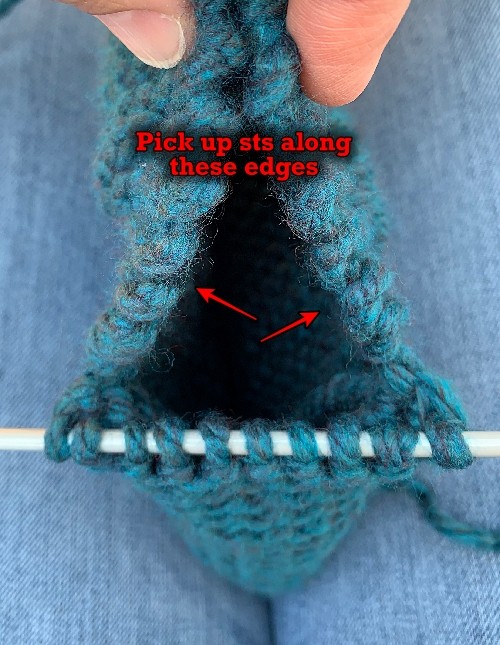
You’re now going to make a small triangle to fit in the back of the heel. You’re going to fill this space in the slipper.
ҨNext Row: With the RIGHT side facing, pick up a stitch in the row closest to the sole of the slipper. Count how many ridges it is for the size you are making. K2tog twice. Knit to the last 4 stitches. K2tog twice. Count down the same number of ridges on the other side and pick up a stitch in the space beneath it. (12 stitches).
The photo above shows 9 rows of ridges.
These are rows you knit to form the edges of the slipper.
Stitch picked up on the right edge in the 9th row shown above
After you K2tog at the end of the row, you’ll pick up a stitch here.
Stitch picked up.
Next Row: Knit across.
Next Row: Count down one ridge less than the previous row and pick up a stitch in the space beneath it. K2tog. Knit until the last 2 stitches. K2tog. Count down the same number of ridges and pick up a stitch in the space beneath it on the other side.
Next Row: Knit across. Ҩ Repeat from Ҩ to Ҩ until 6 stitches remain.
Next Row: Pick up a stitch beneath the next ridge. K2tog 3 times. Pick up a stitch in the space beneath the next ridge on the other side.
Next Row: Knit across.
Next Row: K2tog, K1, K2tog. Pass the middle stitch on your working needle over the stitch on the left. Pass the stitch on the right over the stitch on the left. (Or you can turn your work and K3tog).
Break yarn leaving a length of yarn long enough (8ish inches) to sew up the remaining seam.
Make another slipper.
Yes, they do look a little boxy when they’re done and not on a foot. The stretch of the garter stitch allows these slippers to stretch around the contours of any foot easily.
Hints and Tips
If you want a longer cuff at the top, work more rows than stated at the beginning when you cast on. Make sure to increase the same amount of garter stitch rows and ribbed rows equally. If increasing 10 rows, do so on both.
When picking up stitches from the cast off row, be sure you’re really moving on to the next cast off stitch! It’s an easy mistake to pick up a stitch in a stitch you already picked up. If in doubt, give the needle holding the stitches a bit of a tug. You’ll see the yarn move slightly at the very back, closest to the needle. Pick up a stitch at the NEXT cast off stitch.
If you don’t have the same number of stitches on both sides when you are forming the sole, you may have picked up a stitch twice in one stitch or missed one. Don’t worry! This is fixable. You can skip one cast off stitch if you need to make it even, or pick up a cast off stitch twice on the other side. There’s enough stretch in the slipper that any puckering this causes won’t be overly visible if you’re off by a stitch or two.
To speed up finishing the slippers and not have so many ends to sew in, hold the yarn ends to the back of your work as you knit. You can watch the how to video here – how to work in the ends while knitting these slippers.
Abbreviations
K – knit
P – purl
K2tog – knit 2 together
K3tog – knit 3 together
st – stitch
sts – stitches
Side note: I use both versions of the terminology when it comes to cable stitches. I’ve been corrected that I’m using the wrong one for both occasions so it’s a no win for me. What I mean is that C4F is the same technique as C2F. Just like how C2B is the same as C4B. Do you think of it as the just the stitches you’re pulling or the number of stitches you’re using in total when you do it? It’s a personal choice, I guess.
C4F – Pick up the next 2 stitches with your cable needle. Pull the stitches to the FRONT of your work. Knit the next 2 stitches on your non-working needle. Knit the 2 stitches from the cable needle. Watch this video to see how. How to C4F or Cable 4 Forward.
C4B – Pick up the next 2 stitches with your cable needle. Pull the stitches to the BACK of your work. Knit the next 2 stitches on your non-working needle. Knit the 2 stitches from the cable needle. Watch this video to see how. How to C4B or Cable 4 Back
Like all of my patterns you have my permission to sell and/or give away the slippers that you make using this pattern. You are NOT permitted to reprint this pattern in any form unless you have obtained my written permission to do so.
If you have any questions, please feel free to leave a comment or send me your questions at kweenbee_crafts@hotmail.ca.
I’ve always wanted to design a pair of slippers that had a bit more character and substance—something that not only looks good but fits snugly and keeps you cozy. The deer motif on top of the foot gives these slippers a rustic charm, while the substantial cuff provides extra warmth and a secure fit. These slippers are great for knitters who are comfortable with basic stitches and ready to dive into something a bit more intricate.
This pattern is packed with various cable stitches, so you’ll get plenty of practice with your cable needle. The cables vary—sometimes you’ll be knitting the stitches on the cable needle, sometimes purling, and the number of stitches will also change. To keep things simple, I explain how to work each cable stitch as you go along, so you won’t need to constantly check the Abbreviations section.
This isn’t a beginner pattern, but if you’re familiar with the basics of knitting and feel comfortable using a cable needle, you’ll be able to handle this. I’ve included lots of helpful photos to guide you through the deer motif, so you’ll have plenty of visual aids as you knit.
You can download it from a number of places. In particular, my site here – Knitted Deer Moccasin Slippers with a Cuff. You can also get it at a number of other online book retailers such as Ravelry, LoveCrafts, CreativeFabricaand Etsy. It is also available as paperback and as a Kindle book on Amazon. I think that’s enough options to make nearly everyone happy 🥰. If a link isn’t working, I either haven’t formatted it for the distributor or I’m waiting for approval.
Another way to avoid ads and pop-ups, get instant, PRINTABLE downloads of this pattern and others, is by becoming a Member on this website. When you become a Website Supporter for $3/month, you’ll gain access to exclusive member only posts. These posts contain one click downloads of the patterns. Simply click the Download & Print button. The PDF will automatically download to your computer or smart device. You can then read it on your device or print it at your leisure. You can download as many patterns as you like for the same $3 each month. You can go to this page to learn more, become a member and support my work… Exclusive Member Area
If you enjoy this pattern and my other free online knitting patterns, please consider making a small donation or helping me out by visiting my Help Support My Work page. If that’s not possible, that’s totally fine too! Even sharing this page on your social media helps me out immensely. You can use the buttons below to do so easily.
Happy Knitting!
Things You Need
1 ball of worsted weight yarn (average 260 yard, 5 oz or 141 gram ball will be more than enough)
2 sets of size 4 mm (US size 6) single point knitting needles.
Stitch holder
Cable Needle
Tapestry needle to sew in ends. You can also use this handy video tutorial to show you how to work in the ends while knitting these slippers. The embedded video is in the Abbreviations section
Gauge
With size 4 mm (US size 6) needles or whatever size you needto obtain the correct number of stitches and rows. Be sure to check your gauge otherwise the sizing won’t be correct.
In garter stitch
2” = 9 sts
2” = 18 rows
Sizes (are written as such)
Women’s 6-7 (8-9,10-11, 12-13)
Men’s 5-6 (7-8,9-10, 11-12)
Toe Flap
Cast on 14 sts
🦌 Row 1: P across
Row 2: K across 🦌
Repeat from 🦌 to 🦌 2 (3, 4, 5) times more for a total of 6 (8, 10, 12) rows
Next Row: P6 K2 P6
Next Row: K5 Pick up the next st with the cable needle. Pull the st FORWARD, P the next st. P the st on the cable needle. Pick up the next st with the cable needle. Pull the st BACK, P the next st. P the st on the cable needle. K5
🌼 Next Row: P5 K4 P5
Next Row: K5 P4 K5 🌼 Repeat from 🌼 to 🌼 one more time
Next Row: P4 Pick up the next st with the cable needle. Pull the st BACK, K the next st. K the st on the cable needle. K2 Pick up the next st with the cable needle. Pull the st FORWARD, K the next st. K the st on the cable needle. P4
Next Row: K4 P6 K4
Next Row: P4 K6 P4
Next Row: K4 P6 K4
Next Row: P3 Pick up the next st with the cable needle. Pull the st BACK, K the next 2 sts. K the st on the cable needle. K2 Pick up the next 2 sts with the cable needle. Pull the st FORWARD, K the next st. K the 2 sts on the cable needle. P3
Next Row: K3 P8 K3
Next Row: P3 K2 P1 K1 PM1 K1 P1 K2 P3 (15 sts)
Next Row: K3 P2 K1 P1 K1 M1 P1 K1 P2 K3 (16 sts)
Next Row: P3 K2tog (When making this stitch, pick up a stitch as if to knit. Twist the stitch and place it back on your non-working needle. Knit the 2 stitches together from right to left.) P1 K1 P2 K1 P1 K2tog (as you normally would left to right) P3 (14 sts) This video shows how to knit the first K2tog. It’s for the leaf but it’s done the same way.
Next Row: K5 P1 K2 P1 K5
Next Row: P4 Pick up the next st with the cable needle. Pull the st BACK, K1 in the st BELOW (see photos). P1 the st on the cable needle. K1 P2 K1 P1 K1 in the 2nd st BELOW (knit this st in the knit st you made before the P1 as shown in the photos). P4 (16 sts)
Knit in the stitch below
Pull up a loop knit-wise like this.
After purling the st from the cable needle, knit the next st on your non-working needle
The other antler. You already knitted the st so it needs to be 2 sts down as shown. This is the st that is bold and italicized in the pattern.
Pick up this st with the non-working needle.
Branch of second antler complete.
Next Row: K4 P1 K1 P1 K2 P1 K1 P1 K4
Next Row: P3 Pick up the next st with the cable needle. Pull the st BACK, K the next st. P the st on the cable needle. P1 K1 P2 K1 P1 Pick up the next st with the cable needle. Pull the st FORWARD, P the next st. K the st on the cable needle. P3
Next Row: K3 P1 K2 P1 K2 P1 K2 P1 K3
Next Row: P2 Pick up the next st with the cable needle. Pull the st BACK, K the next st. P the st on the cable needle. P8 Pick up the next st with the cable needle. Pull the st FORWARD, P the next st. K the st on the cable needle. P2
Next Row: K2 P1 K10 P1 K2
🍄 Next Row: P across
Next Row: K16 🍄 Repeat from 🍄 to 🍄 1 (2, 3, 4) times more. If you want a different colour for the cuff, break yarn when the last row is completed.
Making the Cuff
Next Row:(with the optional cuff colour) K16. Cast on an additional 11 (12, 13, 14). You now have 27 (28, 29, 30) sts on your needle.
Next Row: K27 (28, 29, 30). Cast on an additional 11 (12, 13, 14). You now have 38 (40, 42, 44) sts on your needle.
Next Rows: K across for a total of 13 (15, 17, 19) rows.
Next Row: With the WRONG side facing you, P across.
🌸 🐿️ Next Row: With the RIGHT side facing you, (K1 P2) across. Maintain this pattern with any remaining sts at the end of the row.
Next Row: K across. 🌸 Repeat from 🌸 to 🌸 6 (7, 8, 9) times more. For a total of 14 (16, 18, 20) rows.
Repeat the row marked with 🐿️ one more time.
Cast off loosely with the WRONG side facing you.
If you would like to change the colour around the toe and foot, change colour now.
This is where you’re going to need the extra set of knitting needles. You’ll be knitting back and forth in rows but the turn around the toe is too tight to use circular needles. For this, you’ll put the 13 toe flap stitches on one of your extra needles. It’s a little unconventional, but it works.
he sections of the slipper.
Next Row: With the RIGHTside facing, pick up 11 (12,13, 14) stitches evenly along the edge of the cuff and place onto one of your needles. Pick up 18 (20,22, 24) stitches evenly along the edge of the toe flap. (All of these stitches are on ONEneedle. (29, 32,35, 38) stitches on this needle)
With another needle, pick up 13 stitches evenly along the end of the toe flap.
With another needle, pick up 18 (20,22, 24) stitches evenly along the side of the toe flap. Pick up 11 (12,13, 14) stitches evenly along the edge of the cuff and place onto the next needle. (29, 32,35, 38)stitches on this needle)
You should now have 3 needles holding stitches with all the points pointing as shown below when laid flat. You also have one spare needle to knit with. You are now going to knit in rows, back and forth with these three needles. Once you finish knitting all the stitches on one needle, move on to the next needle (the point of the needle is right there) until you complete the row.
I used a capped double pointed needle to work my 13 stitches for the end of the toe. A regular needle also works.
Knit the next 8 (10, 10, 12) rows
There are 4 (5, 5, 6) ridges on the tip of the toe.
The photo below shows the 5 ridges for the women’s size 8-9 or the men’s 7-8.
These are the ridges picked up along the side.
Next Row: With WRONG side facing. Cast off all the stitches from the first needle loosely. You’ll need to pass the last stitch from the first needle over the first stitch of the toe flap stitches (second needle).
Using the same needle that now has one stitch, knit the remaining 12 stitches of the toe flap. Cast off all the stitches from the third needle loosely. Break yarn.
Making the Sole
If you need more help than the photos provide, you can watch the how-to video. The link starts the video in the correct section. No need to find the spot. I already have it cued up for you.
Next Row: With the RIGHT side facing, attach yarn and knit the first stitch of the cast off stitches by the toe flap (cast off stitch on the right by the point of the needle).
Pick up this stitch at the start of the row.
K2tog. Knit to the last 2 stitches K2tog. Pick up the cast off stitch by the point of your needle. (13 stitches).
Pick up this stitch at the end of the row.
Quick tip – wrap the yarn counterclockwise around your needle and turn it down to pull the yarn through the cast off stitch on the right. If you have a hard time doing this, you can also use a crochet hook to pull the loop through and place that loop on your working needle.
You now are working back and forth along the bottom of the foot picking up one cast off stitch on each side as you go.
Next Row: Knit across.
ʤNext Row: Pick up the next stitch of the cast off stitches. K2tog. Knit to the last 2 stitches K2tog. Pick up the cast off stitch on the other side of the slipper by the point of your needle. (13 stitches).
Keep working your way down the slipper to make the sole.
Next Row: Knit across ʤ
Repeat from ʤ to ʤ down the entire length of the foot. There are equal number of cast off stitches along each side. How many rows varies depending on the size of slipper you’re making. Be sure to end with a completed knit across row.
Starting the sole. Right side.
Working your way down while making the sole. Wrong side.
Continuing to work down the length of the sole.
Still further down the sole. Note how the cast off edges are being picked up as you go. Keep working your way down the length of the sole until you’ve picked up all the cast off stitches.
Making the Heel
If you need more help than the photos provide, you can watch the how-to video. The video starts in the correct section. No need to find the spot. I already have it cued up for you.
You’re now going to make a small triangle to fit in the back of the heel. You’re going to fill this space in the slipper.
ҨNext Row: With the RIGHT side facing, pick up a stitch in the row closest to the sole of the slipper. Count how many ridges it is for the size you are making. K2tog twice. Knit to the last 4 stitches. K2tog twice. Count down the same number of ridges on the other side and pick up a stitch in the space beneath it. (11 stitches).
The photo above shows 9 rows of ridges.
These are rows you knit to form the edges of the slipper.
Stitch picked up on the right edge in the 9th row shown above
After you K2tog at the end of the row, you’ll pick up a stitch here.
Stitch picked up.
Next Row: Knit across.
Next Row: Count down one ridge less than the previous row and pick up a stitch in the space beneath it. K2tog. Knit until the last 2 stitches. K2tog. Count down the same number of ridges and pick up a stitch in the space beneath it on the other side.
Next Row: Knit across. Ҩ Repeat from Ҩ to Ҩ until 7 stitches remain. End with the K across row.
Next Row: Count down one ridge less than the previous row and pick up a stitch in the space beneath it. K2tog. K3tog. K2tog. Count down the same number of ridges and pick up a stitch in the space beneath it on the other side.
Next Row: Knit across.
Next Row: K2tog, K1, K2tog.
Next Row: Knit the 3 sts together.
Break yarn leaving a length of yarn long enough (8ish inches). to sew up the remaining seam. Fold the cuff over when done sewing.
Make another slipper.
Yes, they do look a little boxy when they’re done and not on a foot. The stretch of the garter stitch allows these slippers to stretch around the contours of any foot easily.
Hints and Tips
Picking up the stitch to make the second branch of the antler is sort of up to you. If you pick up the stitch right below where you just knitted, it won’t be a disaster. Most deer antlers aren’t perfectly symmetrical in real life anyways. In fact, the more off they are, the more desirable; especially if it has a drop tine.
If you want a longer cuff at the top, work more rows than stated at the beginning when you cast on. Make sure to increase the same amount of garter stitch rows and ribbed rows.
When picking up stitches from the cast off row, be sure you’re really moving on to the next cast off stitch! It’s an easy mistake to pick up a stitch in a stitch you already picked up. If in doubt, give the needle holding the stitches a bit of a tug. You’ll see the yarn move slightly at the very back, closest to the needle. Pick up a stitch at the NEXT cast off stitch.
If you don’t have the same number of stitches on both sides when you are forming the sole, you may have picked up a stitch twice in one stitch or missed one. Don’t worry! This is fixable. You can skip one cast off stitch if you need to make it even, or pick up a cast off stitch twice on the other side. There’s enough stretch in the slipper that any puckering this causes won’t be overly visible if you’re off by a stitch or two.
Picking up the stitches evenly along the toe flap is about 1 stitch every ridge.
To speed up finishing the slippers and not have so many ends to sew in, hold the yarn ends to the back of your work as you knit. You can watch the how to video here – how to work in the ends while knitting these slippers.
Abbreviations
K – knit
P – purl
K2tog – knit 2 together
K3tog – knit 3 together
M1 – Make one (knit wise). Increase one stitch between the stitches. Pick up the yarn between the stitches. Twist slightly. Place it on your non-working needle. Knit the stitch. Watch this video to see how.
PM1 – Make one (purl wise). Increase one stitch between the purl stitches. Pick up the yarn between the stitches. Place it on your non-working needle. Purl the stitch as you regularly would. Watch this video to see how.
st – stitch
sts – stitches
Like all of my patterns you have my permission to sell and/or give away the slippers that you make using this pattern. You are NOT permitted to reprint this pattern in any form unless you have obtained my written permission to do so.
If you have any questions, please feel free to leave a comment or send me your questions at kweenbee_crafts@hotmail.ca.
Welcome to the next book in the series of my collection of knitting patterns! If you enjoyed my Nine Fingerless Gloves and Mitts to Knit, I’m sure you’ll enjoy this one just as much.
This delightful collection of practical yet stylish fingerless glove designs is sure to inspire knitters of all skill levels. Each pattern is knit flat on two straight needles, making them accessible even to those who may be new to knitting or prefer simpler techniques. Whether you’re a beginner eager to complete your first project or an intermediate knitter looking to expand your repertoire with charming new details, this collection offers something for everyone.
The designs range from playful, whimsical animals that add a touch of fun to your wardrobe, to elegant leaves and decorative motifs that showcase a refined sense of style. Each pattern is thoughtfully crafted with the perfect balance of simplicity and creativity, ensuring that the process is as enjoyable as the result.
As you work through the patterns, you’ll find yourself fully supported by helpful step-by-step videos and detailed photos, making even the trickiest techniques feel approachable. With these resources, you’ll gain confidence in your knitting skills and be able to complete each glove with pride. This collection will not only add a unique flair to your knitting projects but will also fill your crafting time with joy and satisfaction.
There are a number of options available to make the fingerless gloves. All the fingerless gloves patterns are free to read on this website. You can use this link – Fingerless Glove and Mitten Patterns to see all of them. I listed them all individually at the end of this post if you are looking for a specific one. 😁
Another option is to purchase and print the pattern yourself. If you are ok with printing the 104 page document, you can buy it from this website – Eight Fingerless Gloves to Knit or from my Etsy shop. You can click or tap either of those links to see the collection.
If you would prefer to have the paperback version fully printed, bound and sent directly to your door, you can order the book online from Amazon. Be sure to click on your country so shipping will be as low as possible. If you are an Amazon Prime Member, the shipping is free! If you have a Kindle, the cheaper, digital version is available at the same links.
I understand that not everyone is in the financial position to purchase patterns, and that’s ok. That’s why I offer them for free; to enable anyone to use my work and be able to enjoy and even profit from it. That’s why while I give permission for everyone to sell what they make from my patterns, I ask that you respect the patterns themselves. Do NOT make illegal copies of them.
If you know someone who wants to use the patterns, send them the link so they can read the pattern online themselves. It helps me VERY much when you do this. More people on the website tell search engines that what is on my site is valuable and people like it. This makes it more likely that Google, Bing, Yahoo, etc will suggests my patterns when people do a search online.
To make sharing the patterns even easier, there are floating share buttons along the side of this and every page of the website. All you need to do is click it to share it. You can also use these share buttons to share this page.
Now that we’re through all that, here is the list of individual patterns that you can read online for free.
I’m thrilled to share my latest knitting pattern for fingerless mitts, and yes, my love for these cozy accessories shows no sign of stopping! This time around, I’ve added a twist—quite literally—with a unique cable pattern that elegantly winds its way down the back of the hand. It’s a design element that adds both texture and visual interest, making these mitts a true standout piece.
If you’re someone who’s mastered the basics and is looking to elevate your knitting game, this pattern is the perfect next step. It’s designed to bridge the gap between a beginner and an experienced knitter. And if cabling is new to you, don’t worry—this is the ideal project to dive in and learn something new! I’ve made sure to include video tutorials in the Abbreviations section to guide you through the cabling process, so you’ll have all the support you need.
But that’s not all! I’ve also added links to help you with any other potentially tricky parts of the pattern, like increasing for the thumb gusset. I want to ensure you feel confident and supported every step of the way. So, grab your needles, and let’s knit something beautiful together!
Another way to avoid ads and pop-ups, get instant, PRINTABLE downloads of this pattern and others, is by becoming a Member on this website. When you become a Website Supporter for $3/month, you’ll gain access to exclusive member only posts. These posts contain one click downloads of the patterns. Simply click the Download & Print button. The PDF will automatically download to your computer or smart device. You can then read it on your device or print it at your leisure. You can download as many patterns as you like for the same $3 each month. You can go to this page to learn more, become a member and support my work… Exclusive Member Area
If you enjoy this pattern and my other free online knitting patterns, please consider making a small donation or helping me out by visiting my Help Support My Work page. If that’s not possible, that’s totally fine too! Even sharing this page on your social media helps me out immensely. You can use those buttons below to do so easily.
Things You Will Need
Worsted weight yarn (less than 100 grams was more than enough to make a pair of large knitted gloves as written. I know because I weighed them). I used Red Heart worsted weight yarn when designing the pattern but any kind will do.
Set of single pointed needles (see note on sizing)
Stitch holder
Tapestry needle to sew the seams and work in ends
Cable needle
Sizing
Like my other fingerless gloves I’ve designed such as my owl fingerless gloves, I use the size of the needles to change the size of the mitt. This keeps the proportion of the design consistent to the size of the glove.
My standard for sizing was my hand and designed the knitting pattern according to what kind of rubber gloves fit me comfortably. I wear a medium sized rubber glove and the medium sized glove fits perfectly. You may need to use different sized needles to get the correct gauge.
Gauge
In stockinette stitch
Small
size 3.5 mm (US size 4) single pointed needles
11 stitches every 2 inches (5 cm)
16 rows every 2 inches (5 cm)
Medium
size 4 mm (US size 6) single pointed needles
10 stitches every 2 inches (5 cm)
14 rows every 2 inches (5 cm)
Large
size 5 mm (US size 8) single pointed needles
9 stitches every 2 inches (5 cm)
12 rows every 2 inches (5 cm)
Left Hand
Cast on 36
Row 1: P1 * K2 P2 * repeat from * to * to the last 3 sts. K2 P1
Row 2: K1 ✥ P2 K2 ✥ repeat from ✥ to ✥ to the last 3 sts. P2 K1
Repeat rows 1 and 2 for a total of 6 rows.
Row 7: K15 P1 K16 P1 K3
✰ Row 8: P3 K1 P16 K1 P15
❀ Row 9: K15 P1 K4 C4F C4B K4 P1 K3
Row 10: Repeat ✰ Row 8
Row 11: K15 P1 C4F K8 C4B P1 K3
Row 12: Repeat ✰Row 8 ❀ Repeat from ❀ to ❀ 3 times more. If you would like longer gloves, make more repeats.
Next row: K12 M1 K M1 K2 P1 K4 C4F C4B K4 P1 K3 (38 sts)
Next row: P3 K1 P16 K1 P17
Next row: K17 P1 C4F K8 C4B P1 K3
Next row: P3 K1 P16 K1 P3 PM1 P PM1 P13 (40 sts)
Next row: K19 P1 K4 C4F C4B K4 P1 K3
Next row: P3 K1 P16 K1 P19
Next row: K14 M1 K M1 K4 P1 C4F K8 C4B P1 K3 (42 sts)
Next row: P3 K1 P16 K1 P21
Next row: K21 P1 K4 C4F C4B K4 P1 K3
Next row: P3 K1 P16 K1 P5 PM1 P PM1 P15 (44 sts)
Next row: K23 P1 C4F K8 C4B P1 K3
Next row: P3 K1 P16 K1 P23
Next row: K16 M1 K M1 K6 P1 K4 C4F C4B K4 P1 K3 (46 sts)
Next row: P3 K1 P16 K1 P25
Next row: K25 P1 C4F K8 C4B P1 K3
Next row: P3 K1 P16 K1 P7 PM1 P PM1 P17 (48 sts)
Next row: K27 P1 K4 C4F C4B K4 P1 K3
Next row: P3 K1 P16 K1 P27
Next row: K12 Pass the next 13 sts onto a stitch holder K2 P1 C4F K8 C4B P1 K3 (35 sts)
❤ Next row: P3 K1 P16 K1 P14
Next row: K14 P1 K4 C4F C4B K4 P1 K3
Next row: Repeat row marked with ❤
✪ Next row: ♦ P2 K2 ♦ Repeat from ♦ to ♦ to last 3 sts P2 K1
Next row: P1 ☺ K2 P2 ☺ Repeat from ☺ to ☺ to the last 2 sts. K2 ✪ Repeat from ✪ to ✪ one more time.
Cast off
Thumb
Pass the 13 sts on the stitch holder back onto your knitting needle. With the RIGHT side facing,
Row 1: P1 * K2 P2 * repeat from * to * to the last 3 sts. K2 P1
Row 2: K1 ✥ P2 K2 ✥ repeat from ✥ to ✥ to the last 3 sts. P2 K1
Repeat rows 1 and 2 for a total of 6 rows.
Row 7: K3 P1 K16 P1 K15
✰ Row 8: P15 K1 P16 K1 P3
❀ Row 9: K3 P1 K4 C4F C4B K4 P1 K15
Row 10: Repeat ✰ Row 8
Row 11: K3 P1 C4F K8 C4B P1 K15
Row 12: Repeat ✰ Row 8 ❀ Repeat from ❀ to ❀ 3 times more. If you would like longer gloves, make more repeats.
Next row: K3 P1 K4 C4F C4B K4 P1 K2 M1 K M1 K12 (38 sts)
Next row: P17 K1 P16 K1 P3
Next row: K3 P1 C4F K8 C4B P1 K17
Next row: P13 PM1 P PM1 P3 K1 P16 K1 P3 (40 sts)
Next row: K3 P1 K4 C4F C4B K4 P1 K19
Next row: P19 K1 P16 K1 P3
Next row: K3 P1 C4F K8 C4B P1 K4 M1 K M1 K14 (42 sts)
Next row: P21 K1 P16 K1 P3
Next row: K3 P1 K4 C4F C4B K4 P1 K21
Next row: P15 PM1 P PM1 P5 K1 P16 K1 P3 (44 sts)
Next row: K3 P1 C4F K8 C4B P1 K23
Next row: P23 K1 P16 K1 P3
Next row: K3 P1 K4 C4F C4B K4 P1 K6 M1 K M1 K16 (46 sts)
Next row: P25 K1 P16 K1 P3
Next row: K3 P1 C4F K8 C4B P1 K25
Next row: P17 PM1 P PM1 P7 K1 P16 K1 P3 (48 sts)
Next row: K3 P1 K4 C4F C4B K4 P1 K27
Next row: P27 K1 P16 K1 P3
Next row: K3 P1 C4F K8 C4B P1 K2 Pass the next 13 sts onto a stitch holder K12 (35 sts)
❤ Next row: P14 K1 P16 K1 P3
Next row: K3 P1 K4 C4F C4B K4 P1 K14
Next row: Repeat row marked with ❤
✪ Next row: K ♦ P2 K2 ♦ Repeat from ♦ to ♦ to last 2 sts P2
Next row: ☺ K2 P2 ☺ Repeat from ☺ to ☺ to the last 3 sts. K2 P1 ✪ Repeat from ✪ to ✪ one more time.
Cast off
Thumb
Pass the 13 sts on the stitch holder back onto your knitting needle. With the RIGHT side facing,
Next row: K across
Next row: P across
Next row: K across
Next row: P across
Cast off
Sew the seams of the thumbs and along the side of each hand. Work in the ends.
Hints and Tips
You can make the gloves as long or as short as you like. I made 3 repeats of the design. You could do less for a shorter version. The grey pair were repeated 7 times to give you an idea of what it looks like when longer.
Make the seam as narrow as you can when sewing it along the side. Less seam means less irritation. Make sure that it still looks good. If you don’t know how, there are a number of videos online that will show you how to do a blanket stitch.
Abbreviations
K – knit
P – Purl
Side note: I use both versions of the terminology when it comes to cable stitches. I’ve been corrected that I’m using the wrong one for both occasions so it’s a no win for me. What I mean is that C4F is the same technique as C2F. Just like how C2B is the same as C4B. Do you think of it as the just the stitches you’re pulling or the number of stitches you’re using in total when you do it? It’s a personal choice, I guess.
C4F – Pick up the next 2 stitches with your cable needle. Pull the stitches to the FRONT of your work. Knit the next 2 stitches on your non-working needle. Knit the 2 stitches from the cable needle. Watch this video to see how. How to C4F or Cable 4 Forward.
C4B – Pick up the next 2 stitches with your cable needle. Pull the stitches to the BACK of your work. Knit the next 2 stitches on your non-working needle. Knit the 2 stitches from the cable needle. Watch this video to see how. How to C4B or Cable 4 Back
M1 – Make one (knit wise). Increase one stitch between the stitches. Pick up the yarn between the stitches. Twist slightly. Place it on your non-working needle. Knit the stitch. Click this link to watch this video to see how. How to Make One or M1 – Increase between stitches
PM1 – Make one (purl wise). Increase one stitch between the stitches. Pick up the yarn between the stitches. Twist it slightly and place it on your non-working needle. Purl the stitch. Watch this video on How to PM1 or Purl Make 1 to see how.
Like all of my patterns you have my permission to sell and/or give away the physical items that you make using this pattern. You are NOT permitted to reprint this pattern in any form unless you have obtained my written permission to do so.
If you have any questions, please feel free to leave a comment or send me your questions at kweenbee_crafts@hotmail.ca.
Perfect for new knitters, these slippers are knit flat on just two needles, making them an ideal project for beginners or anyone looking for a straightforward, relaxing knit.
These charming slippers feature a lace-up design at the front, adding a delightful touch of customization and ensuring a snug fit. You can easily adjust the colours to match your personal style or to use up those leftover yarns in your stash.
Whether you’re knitting for yourself, a loved one, a thoughtful handmade gift, or to sell, these slippers are sure to bring warmth and comfort to any pair of feet. So, gather your materials, find a cozy spot, and let’s get started on creating your very own pair of Cozy Lace-Up Slippers!
If you are not a fan of ads or following a pattern online, I also have printable PDF version for sale for a small fee. You can purchase and download the pattern from this website – Cozy Knitted Lace Up Slippers, from my Etsy shop, Ravelry, LoveCrafts and the Kindle and paperback versions are available on Amazon.
Another way to avoid ads and pop-ups, get instant, PRINTABLE downloads of this pattern and others, is by becoming a Member on this website. When you become a Website Supporter for $3/month, you’ll gain access to exclusive member only posts. These posts contain one click downloads of the patterns. Simply click the Download & Print button. The PDF will automatically download to your computer or smart device. You can then read it on your device or print it at your leisure. You can download as many patterns as you like for the same $3 each month. You can go to this page to learn more, become a member and support my work… Exclusive Member Area
If you enjoy this pattern and my other free online knitting patterns, please consider making a small donation or helping me out by visiting my Help Support My Work page. If that’s not possible, that’s totally fine too! Even sharing this page on your social media helps me out immensely. You can use the buttons below to do so easily.
Things You Need
1 ball of worsted weight yarn (average 354 yard, 7 oz or 324 m, 198 gram ball will be more than enough to make single colour slippers).
Size 4 mm (US size 6) single point knitting needles.
Tapestry needle to sew in ends. If you are using multiple colours, you can also use this handy tutorial to show you how to work in the ends while knitting these slippers.
Gauge
With size 4 mm (US size 6) needles or whatever size you need to obtain the correct number of stitches and rows. Be sure to check your gauge otherwise the sizing won’t be correct.
In garter stitch
4” = 16 sts
4” = 40 rows
Sizes (are written as such)
Women’s size 6-7 (8-9, 10-11, 12)
Men’s size 6 (7-8, 9-10, 11-12)
The Pattern
Unlike most knitting patterns, this pattern’s right side and wrong side are reversed. All ODD numbered rows are the WRONG side and all the EVEN numbered rows are the RIGHT side.
If you need help with the M1, there is a video in the Hints and Tips section.
With lace up section colour, cast on 52 (60, 60, 68) sts. Leave a longer length to sew the top of the toe (about 18 inches).
Row 1 (wrong side): K8 (P2 K2) to the last 4 sts. P4
Row 2 (right side): K4 (P2tog YO K2) to last 8 sts. P8
Row 3: As row 1
Row 4: K4 (P2 K2) to last 8 sts. P8
Row 5: As row 1
Row 6: As row 4
Row 7: As row 1
Change to other colour – This is the 12 row section you can use to create your colour design. (ie. red, orange, yellow, green, blue, purple). See Hints and Tips section for more information.
♠ Row 8: K to last 8 sts. P8
Row 9: K across ♠ Repeat from ♠ to ♠ 5 more times or a total of 12 rows. (each colour is one repeat if making the rainbow colours)
Change to colour for heel section.
♦ ☺ Row 20: K to last 8 sts. P8
Row 21: K across ☺
Row 22: K to last 8 sts. M1 P8
Row 23: As row 21 ♦ Repeat from ♦ to ♦ 3 more times. (56, 64, 64, 72 sts)
Repeat from ☺ to ☺ 0 (1, 2, 3) times more for an additional 0 (2, 4, 6) rows.
♫ Next row: K to the last 8 sts. P8
Next row: K across
Next row: K to the last 10 sts. K2tog. P8
Next row: K across ♫ Repeat from ♫ to ♫ 3 more times. (52, 60, 60, 68)
Change to other colour – This is the 12 row section you can use to create your colour design. Remember to knit the rows in the reverse order you did originally (ie. purple, blue, green, yellow, orange, red)
♣ Next row: As row 8
Next row: As row 9 ♣ Repeat from ♣ to ♣ 5 more times or a total of 12 rows. (each colour is one repeat if making the rainbow colours)
Change to lace up section colour
Next row: K to the last 8 sts. P8
Next row: K8 (P2 K2) to the last 4 sts. P4
Next row: As row 4
Next row: As row 1
Next row: As row 4
Next row: As row 1
Next row: K4 (P2tog YO K2) to last 8 sts. P8 (As row 2)
If you know how to crochet, you can use a size 5 mm (US size 8) and chain as many sts to make it 3 times the length of the slipper. Slip stitch in every chain. Tie off. Stretch out the lace when done.
If you want to knit it instead, cast on 140 (160, 1600, 180) sts. Cast off. Stretch out the lace when done.
You can also braid 3 lengths of yarn to form the lace. I’m not sure how long of lengths you’ll need to do this.
How I laced up the slipper. The lace up areas are sewn together but you don’t have to.
Hints and Tips
There are 12 rows (6 ridges) that form the pattern on the side of the slipper after the lace up area. You can change colours any way you would like for this section. I’ve shown a number of combinations: 1 colour (beige), 2 colour alternating (purple), 3 colour lighter to darker (browns), 6 colour (rainbow), but you may want to try something else.
The 6 colours are 2 rows each for a total of 12 rows.
To sew the seams, use a simple whip stitch for the toe and the lace up section. You don’t want thick seams for these slippers. And speaking of the lace up section, you don’t have to sew it all the way. Up part way, past the toes, will work. I sewed mine all the way up to the rolled cuff. I like how it fits, looks and feels when it’s sewn all the way. But that’s just my preference.
Use the whip stitch when sewing the toes. Draw the stitches together as tightly as you can to draw them together to give a rounder look. To have them draw together even tighter, when you are done with the whip stitch, pull the ends through each corner. Flip the slipper inside out. Weave in each end. When doing this pull the yarn ends even tighter and work the end back on itself to secure it.
Abbreviations
K – knit
P – purl
P2tog – purl to sts together.
M1 – Make one (knit wise). Increase one stitch between the stitches. Pick up the yarn between the stitches. Twist slightly. Place it on your non-working needle. Knit the stitch.
K2tog – knit 2 sts together.
YO – yarn over. With this pattern, when you go from making the purl st to the knit st, don’t pull the yarn to the back of your work. The YO is forming the hole to weave the lace through.
st – stitch
sts – stitches
Like all of my patterns you have my permission to sell and/or give away the physical items that you make using this pattern. You are NOT permitted to reprint this pattern in any form unless you have obtained my written permission to do so.
If you have any questions, please feel free to leave a comment or send me your questions at kweenbee_crafts@hotmail.ca.
This is an old riff on a new design. As you may know, I have a thing for owls. I’m also starting to develop a thing for hats. In particular, bucket hats. I have a crochet versionand a double thick knit version done thus far. With this hat, the owls can easily be replaceable with any design. And yes, I will be replacing it with various stitch patterns, colours and the like. I may even redesign it so it’s knit in the round on multiple needles so there’s no seam. If you would like that pattern, let me know in the comments.
Unlike my other plain knitted bucket hat, this one doesn’t require anything beyond a single pair of knitting needles and a cable needle. If you’ve made my other owl projects like the scarf, fingerless gloves and the beanie hat, then you’ll be able to make this up in no time.
If you are enjoying the free patterns, please consider helping out financially by going to my page Help Support My Work. If you’re not in the position to make a small donation, please help me out by sharing this pattern with anyone you think may enjoy it. I’ve include these handy buttons to make it super easy. All you have to do is click!
Another option, become a member on this site. It’s not overly expensive, only $3 per month, and you can cancel at any time.
In the exclusive member area, I’ve listed all of my patterns by category and you can download them with a single click. No waiting for links through an email. Simply click the link, the pattern downloads, and depending on your computer or smart device settings, opens automatically. Easy peasy. Once you become a member, you can also read the pattern online without ads or pop-ups. Interested? Click the link below…
Worsted weight yarn (either complimentary colours or single colour)
4 mm (Size 6 US) single pointed knitting needles
Cable needle
Tapestry needle to sew seams and work in ends
16 buttons or jewels for eyes
Gauge
In stockinette
10 sts = 2 inches (5 cm)
13 rows = 2 inches (5 cm)
Sizes are written as such:
S-M (L-XL)
Top
With main colour
Cast on 5
Row 1: INC across (10 sts)
If there are any stitches that you don’t know how to make, please go to the Abbreviations section at the end of the pattern. I embedded the how-to YouTube videos for you to watch there. 😊
Row 2: P across (always P across for every even row, or WRONG side, until told otherwise directed in the instructions)
Row 3: *K1 M1 * Repeat from * to * until last 2 sts. K2 (18 sts)
Row 5: ♠ K2 M1 ♠ Repeat from ♠ to ♠ until last 2 sts. K2 (26 sts)
Row 7: ♦ K3 M1 ♦ Repeat from ♦ to ♦ until last 2 sts. K2 (34 sts)
Row 9: ♥ K4 M1 ♥ Repeat from ♥ to ♥ until last 2 sts. K2 (42 sts)
Row 11: ♪ K5 M1 ♪ Repeat from ♪ to ♪ until last 2 sts. K2 (50 sts)
Row 13: ▲ K6 M1 ▲ Repeat from ▲ to ▲ until last 2 sts. K2 (58 sts)
Row 15: ☼ K7 M1 ☼ Repeat from ☼ to ☼ until last 2 sts. K2 (66 sts)
Row 17: ⌂ K8 M1 ⌂ Repeat from ⌂ to ⌂ until last 2 sts. K2 (74 sts)
Row 19: ∞ K9 M1 ∞ Repeat from ∞ to ∞ until last 2 sts. K2 (82 sts)
Row 21: ♣ K10 M1 ♣ Repeat from ♣ to ♣ until last 2 sts. K2 (90 sts)
Stop here if making the sm/med size hat. Go to row marked with ■ and skip row 23 and 24.
Row 23: ◄ K11 M1 ◄ Repeat from ◄ to ◄ until last 2 sts. K2 (98 sts)
Owl Band
■ Change colour for top stripe.
Next 4 rows: K across.
Change colour for owls.
Next row (right side): K across.
Next row (wrong side): K1 * K2 P2 K4 P2 K1(2) * Repeat from * to * 7 times more. K1
Next row (right side): P1 ♠ P1(2) K2 P4 K2 P2 ♠ Repeat from ♠ to ♠ 7 times more. P1
Next row: K1 ɵ K2 P2 K4 P2 K1(2) ɵ Repeat from ɵ to ɵ 7 times more. K1
Next row (right side): P1 ɸ P1(2) C4F C4B P2 ɸ Repeat from ɸ to ɸ 7 times more. P1
Next row: K1 Ʊ K2 P8 K1(2) Ʊ Repeat from Ʊ to Ʊ 7 times more. K1
☺Next row (right side): P1 ¤ P1(2) K8 P2 ¤ Repeat from ¤ to ¤ 7 times more. P1
Next row: K1 ɚ K2 P8 K1(2) ɚ Repeat from ɚ to ɚ 7 times more. K1 ☺ Repeat from ☺ to ☺
2 times more.
Next row: P1 ☻ P1(2) C2F C2B P2 ☻ Repeat from ☻ to ☻ 7 times more. P1
Next row: K1 * K2 P2 K4 P2 K1 (2) * Repeat from * to * 7 times more. K1
◊ Next row (right side): P1 ♠ P1 (2) K2 P4 K2 P2 ♠ Repeat from ♠ to ♠ 7 times more. P1
Next row: K1 ȸ K2 P2 K4 P2 K1 (2) ȸ Repeat from ȸ to ȸ 7 times more. K1 ◊ Repeat from ◊ to ◊
4 times more.
Change colour for bottom stripe.
Next row: K1 ∆ K1(2) C4F C4B K2 ∆ Repeat from ∆ to ∆ 7 times more. K1
۞Next row: K0(2) ♥ P3 K1 ♥ Repeat from ♥ to ♥ across
Next row: K across
Next row: Repeat row marked with ۞
Next row: ♫ INC K3 ♫ Repeat from ♫ to ♫ across. K0(2). (150 (162 sts)
Next row: K0(2) ɷ P3 K2 ɷ Repeat from ɷ to ɷ across
§ Next row: K across
Next row: K0(2) ɷ P3 K2 ɷ Repeat from ɷ to ɷ across § Repeat from § to § 2 more times.
Cast off.
Hints and Tips
Unlike the other knit bucket hat I have, there is nothing overly tricky about this one. It knits flat on one set of needles making it much easier to make.
Blocking your final project is always up to you. Most things I make I never block. I did with the smaller version (yellow with the yarn eyes) so it would fit the mannequin head better. I cannot recommend a steamer enough! There are a variety on Amazon for fairly cheap. These use nothing but steam, and even when using acrylic yarn, it still holds its shape while relaxing the stitches and doesn’t squash the knitting like a standard iron will.
I also decided to try embroidering on the eyes for the owls. I’m also running out of the half cabochons for eyes so I kinda had to. Do I love it? I don’t hate it and prefer the half cabs but that’s just me. All I did was run a single strand of yarn behind the owls and embroider over the stitches in the eye position. You can see the yarn running behind a bit. If it was a lighter yarn behind a darker colour it would look better. I also left enough yarn between eyes to stretch with the hat. Make sure it’s not too tight if you do this!
Abbreviations
K – knit
P – purl
INC – Make 2 sts in one st. Knit in the front of the stitch and the back of the stitch Click this link to watch this video to see how.
M1 – Make one (knit wise). Increase one stitch between the stitches. Pick up the yarn between the stitches. Twist slightly. Place it on your non-working needle. Knit the stitch. Click this link to watch this video to see how.
Side note: I use both versions of the terminology when it comes to cable stitches. I’ve been corrected that I’m using the wrong one for both occasions so it’s a no win for me. What I mean is that C4F is the same technique as C2F. Just like how C2B is the same as C4B. Do you think of it as the just the stitches you’re pulling or the number of stitches you’re using in total when you do it? It’s a personal choice, I guess.
C4F – Pick up the next 2 stitches with your cable needle. Pull the stitches to the FRONT of your work. Knit the next 2 stitches on your non-working needle. Knit the 2 stitches from the cable needle. Watch this video to see how.
C4B – Pick up the next 2 stitches with your cable needle. Pull the stitches to the BACK of your work. Knit the next 2 stitches on your non-working needle. Knit the 2 stitches from the cable needle. Watch this video to see how.
The knitted owl hat, scarf and mitt collection is now available and you have a few options to choose from. There is the ad-supported, free web versions, the printable 3 patterns in one PDF, and last but not least, the paperback and Kindle versions are now on Amazon! Keep scrolling down the page to see all the options to choose from.
Make the beanie and gloves!
These patterns use very basic stitches, making it a great pattern collection for newbies and super quick for those with more experience. The patterns themselves only involve the knit and purl stitch, k2tog, and cabling. I added scannable QR codes to how-to videos to help you along if you are a new knitter or just need a bit of extra help with how to do cable stitches.
If you would like to get the paperback, you can find it on Amazon. Make sure that you select your country so if you are a Prime Member on Amazon, shipping is included in the final price.
The print and Kindle versions are only in English. Other language are not available.
If you’d prefer to print the 3 pattern collection yourself, there are a couple options for you also. You can buy the printable PDF from my Etsy shop here:
These colourful, cuffed owl fingerless mitts are made to match my very popular Owl Beanieand Owl Scarf, also knit flat on two needles. You can click the links if you would like to make either one; or both 😉. A new window will open so you won’t lose this page.
I’ve made these owl wrist warmers similar to my original knit flat owl half gloves but with this version, they are knit from the fingers to the wrist cuff. The owls are made from feet to head, matching the aforementioned hat and scarf. There is a slight difference with the appearance of the owls when made from head to feet and I couldn’t live with that. Once you see it you can’t not see it, if you know what I mean.
And since I was doing a redesign, I figured I should make the cuffs match. So I did. I did two versions of the glove. One with a rolled cuff edge (blue and brown) and one without (green). It is clearly marked in the pattern where to stop knitting and cast off depending on the edging you want. And speaking of the final appearance of the granny gloves, there is no reason that these gloves have to match anything. You can also knit them in a single colour. It really is up to you and what look you are after.
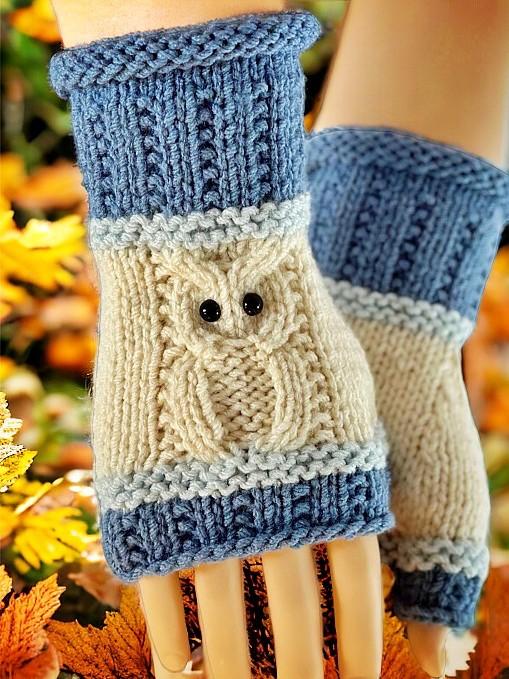
To make the thumb gusset blend as much as possible and match on both sides of the thumb, there are different ways to knit and purl the stitches together. It changes whether it is on the left or the right side of the thumb. It is noted how to knit and purl the stitches in the pattern. I’ve also added links to a helpful how-to video to show you how. You don’t have to make the stitches the way I did, but it gives a much better overall look. There’s more about this in the Hints and Tips section.
If casting on the 13 stitches for the thumb or picking up stitches is confusing for you, there is also a video to help you with that too. The link is after the Hints and Tips section.
If you would prefer a PDF printable version of the pattern, you can download it for a small fee/donation from a number of places. In particular, my site here – Knit Owl Fingerless Gloves. You can also get it at a number of other online book retailers such as Ravelry, LoveCrafts, and Etsy. The Kindle and Paperback version is also on Amazon. The Amazon link goes to the US store. If ordering the paperback, make sure you pick the region where you live!
Another way to avoid ads and pop-ups, get instant, PRINTABLE downloads of this pattern and others, is by becoming a Member on this website. When you become a Website Supporter for $3/month, you’ll gain access to exclusive member only posts. These posts contain one click downloads of the patterns. Simply click the Download & Print button. The PDF will automatically download to your computer or smart device. You can then read it on your device or print it at your leisure. You can download as many patterns as you like for the same $3 each month. You can go to this page to learn more, become a member and support my work… Exclusive Member Area
If you enjoy this pattern and my other free online knitting patterns, please consider making a small donation or helping me out by visiting my Help Support My Work page. If that’s not possible, that’s totally fine too! Even sharing this page on your social media helps me out immensely. You can use those buttons below to do so easily.
Things You Need
Worsted weight yarn – 1 standard ball of yarn (215 yards/197 m) will make the gloves in one colour. Any colour combinations of your choosing will work.
Knitting needles:
Small – Size 3 US (3.25 mm) knitting needles
Medium – Size 6 US (4 mm) knitting needles
Large – Size 8 US (5 mm) knitting needles
Tapestry needle – to sew the seam and work in the ends.
4 – 8 mm flat back cabochons or small buttons. You can also embroider eyes on if you prefer.
Gauge
In stockinette stitch
Small
size 3.5 mm (US size 4) knitting needles
11 stitches every 2 inches (5 cm)
16 rows every 2 inches (5 cm)
Medium
size 4 mm (US size 6) knitting needles
10 stitches every 2 inches (5 cm)
14 rows every 2 inches (5 cm)
Large
size 5 mm (US size 8) knitting needles
9 stitches every 2 inches (5 cm)
12 rows every 2 inches (5 cm)
Sizing
Like my other fingerless mitt patterns, I’ve made this as one pattern and adjusted the needle size to change the sizes. This makes it a heck of a lot easier to design and keeps the proportion of the owl the same on all sizes. Frankly, the overall look is better.
To help with the hand sizing, I’ve included a handy infographic (pun intended). Keep in mind, The gloves will stretch a bit as the stitches relax.
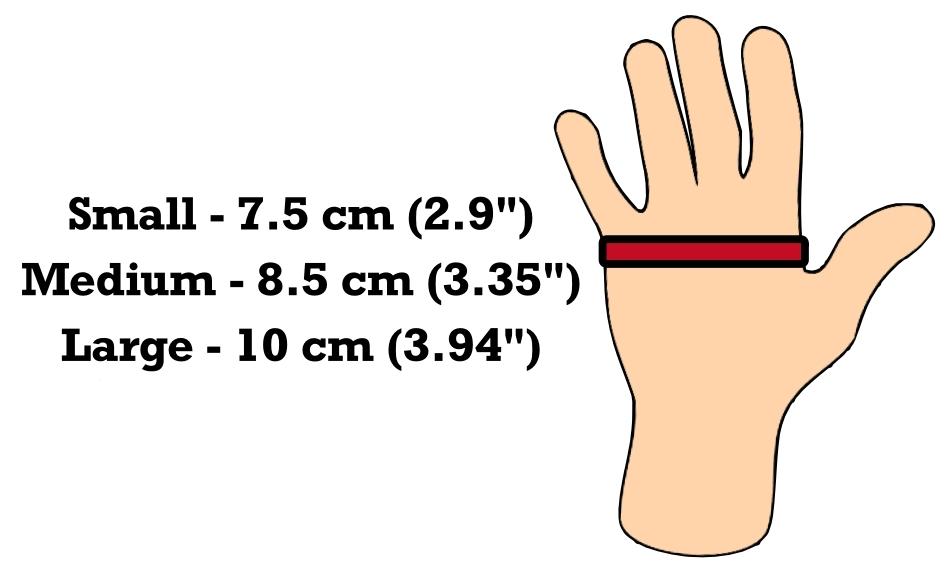
Right Hand
Cast on 34 sts
◊ Row 1: K across
Row 2: *K1 P2* Repeat from * to * to the last st. K1 ◊ Repeat from ◊ to ◊ for a total of 6 rows. (Change colour at the START of row 7 if desired.)
Row 7 – 11: K across (Change colour at the START of row 11 if desired.)
Row 12: P5 K1 P8 K1 P19
Row 13: K14 Cast on 13 sts K6 C4B C4F K6
If you are uncertain how to make the C4B or C4F, you can either click the link or watch the videos below:
Row 14: P5 K1 P2 K4 P2 K1 P32
Row 15: K35 P4 K8
Row 16: P5 K1 P2 K4 P2 K1 P5 P2tog (Slip the next st onto your working needle. Pick up the next st, twist and place back on your non-working needle. Pass the slipped st back onto the non-working needle. Purl the sts together from LEFT to RIGHT). P9 P2tog (Purl these sts together from RIGHT to LEFT – as you normally would). P14
Row 19: K14 K2tog (Knit the sts together from LEFT to RIGHT). K7 K2tog (Pick up the next st, twist and place back on your non-working needle. Knit the 2 sts together from RIGHT to LEFT) K8 P4 K8
This is the same video as above but automatically starts at the how to K2tog section.
Row 20: P5 K1 P2 K4 P2 K1 P28
Row 21: K31 P4 K8
Row 22: P5 K1 P2 K4 P2 K1 P5 P2tog (as before – pass the next st over, pick up and twist next st, pass slipped st back. Purl from left to right) P5 P2tog (P right to left) P14.
Row 23: K27 C4B C4F K6
Row 24: P5 K1 P8 K1 P26
Row 25: K14 K2tog (from left to right) K3 K2tog (as before – pick up next st, twist, knit from right to left). K20
Row 26: P5 K1 P8 K1 P24
Row 27: K across
Row 28: P5 K1 P8 K1 P5 P2tog (as before – pass the next st over, pick up and twist next st, pass slipped st back. Purl from left to right) P1 P2tog (P right to left). P14
Row 29: K across
Row 30: P5 K1 P8 K1 P22
Row 31: K14 K3tog (from left to right) K6 C4B C4F K6
Row 32: P5 K1 P8 K1 P20
(Change colour at the START of row 33 if desired.)
Row 33 – 37: K across. (Change colour at the START of row 37 if desired.)
Row 38: K2tog. ♠ P2 K1 ♠ Repeat from ♠ to ♠ to the end of the row.
☺ Row39: K across
Row 40: ♦ K1 P2 ♦ Repeat from ♦ to ♦ to the last st. K1 ☺ Repeat from ☺ to ☺ for a total of 10 rows.
Continue with the rest of the pattern if you would like a rolled edge to match the edging of the owl beanie hat. If you don’t like the rolled edge, cast off. Leave a longer length of yarn to sew the seam.
◘ Row 49: K across
Row 50: P across. ◘ Repeat from ◘ to ◘ for a total of 8 rows.
Cast off. Leave a longer length of yarn to sew the seam.
Thumb
With the RIGHT side of the glove facing you, pick up the 13 sts you cast on in row 13.
Row 1 – 4: K across (Change colour at the START of row 4 of the thumb if desired.)
Row 5:♦ K1 P2 ♦ Repeat from ♦ to ♦ to the last st. K1
Row 6: K across
Row 7: ♦ K1 P2 ♦ Repeat from ♦ to ♦ to the last st. K1
Cast off. Leave a length of yarn to sew the thumb seam.
Row 2: *K1 P2* Repeat from * to * to the last st. K1 ◊ Repeat from ◊ to ◊ for a total of 6 rows. (Change colour at the START of row 7 if desired.)
Row 7 – 11: K across (Change colour at the START of row 11 if desired.)
Row 12: P19 K1 P8 K1 P5
Row 13: K6 C4B C4F K6 Cast on 13 sts K14
Row 14: P32 K1 P2 K4 P2 K1 P5
Row 15: K8 P4 K35
Row 16: P14 P2tog (Slip the next st onto your working needle. Pick up the next st, twist and place back on your non-working needle. Pass the slipped st back onto the non-working needle. Purl the sts together from LEFT to RIGHT). P9 P2tog (Purl these sts together from RIGHT to LEFT – as you normally would). P5 K1 P2 K4 P2 K1 P5
Row 17: K8 P4 K33
Row 18: P30 K1 P2 K4 P2 K1 P5
Row 19: K8 P4 K8 K2tog (Knit the sts together from LEFT to RIGHT). K7 K2tog (Pick up the next st, twist and place back on your non-working needle. Knit the 2 sts together from RIGHT to LEFT) K14
Row 20: P28 K1 P2 K4 P2 K1 P5
Row 21: K8 P4 K31
Row 22: P14 P2tog (as before – pass the next st over, pick up and twist next st, pass slipped st back. Purl from left to right) P5 P2tog (P right to left) P5 K1 P2 K4 P2 K1 P5
Row 23: K6 C4B C4F K27
Row 24: P26 K1 P8 K1 P5
Row 25: K20 K2tog (from left to right) K3 K2tog (as before – pick up next st, twist, knit from right to left). K14
Row 26: P24 K1 P8 K1 P5
Row 27: K across
Row 28: P14 P2tog (as before – pass the next st over, pick up and twist next st, pass slipped st back. Purl from left to right) P1 P2tog (P right to left). P5 K1 P8 K1 P5
Row 29: K across
Row 30: P22 K1 P8 K1 P5
Row 31: K6 C4B C4F K6 K3tog (from left to right) K14
Row 32: P20 K1 P8 K1 P5
(Change colour at the START of row 33 if desired.)
Row 33 – 37: K across. (Change colour at the START of row 37 if desired.)
Row 38: K2tog. ♠ P2 K1 ♠ Repeat from ♠ to ♠ to the end of the row.
☺ Row39: K across
Row 40: ♦ K1 P2 ♦ Repeat from ♦ to ♦ to the last st. K1 ☺ Repeat from ☺ to ☺ for a total of 10 rows.
Continue with the rest of the pattern if you would like a rolled edge to match the edging of the owl beanie hat. If you don’t like the rolled edge, cast off. Leave a longer length of yarn to sew the seam.
◘ Row 49: K across
Row 50: P across. ◘ Repeat from ◘ to ◘ for a total of 8 rows.
Cast off. Leave a longer length of yarn to sew the seam.
Thumb
With the RIGHT side of the glove facing you, pick up the 13 sts you cast on in row 13.
Row 1 – 4: K across (Change colour at the START of row 4 of the thumb if desired.)
Row 5:♦ K1 P2 ♦ Repeat from ♦ to ♦ to the last st. K1
Row 6: K across
Row 7: ♦ K1 P2 ♦ Repeat from ♦ to ♦ to the last st. K1
Cast off. Leave a length of yarn to sew the thumb seam.
Hints and Tips
If you don’t P2tog and K2tog as indicated in the pattern, you’ll end up with one very defined line on one side of the thumb gusset, and a much less refined edge on the other. I tried many combos to make the side of the gusset match. Making the stitches as indicated in the pattern allow for this.
This photo is what the thumb gusset will look like if you knit and purl the stitches without following the instructions.
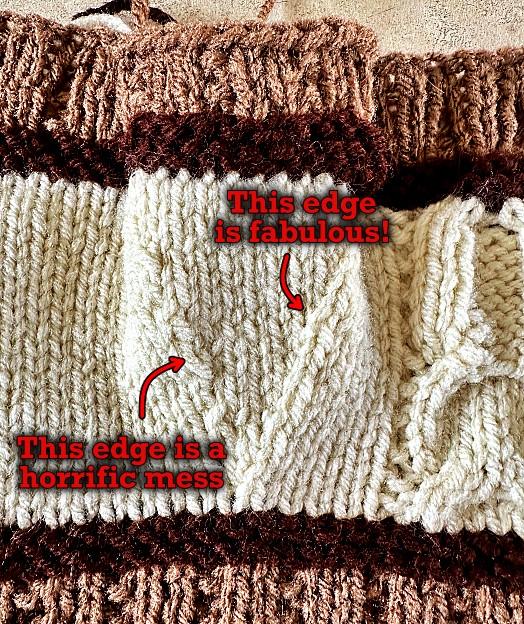
You don’t need to add the extra garter and ribbing for the thumb. It is a finished edge so it won’t come undone. You may want to do a quick single crochet around to give it a bit of a fancy edging.
You can use whatever you like for eyes. Buttons will work. I used 8 mm flat back cabochons. They come in a variety of colours and sizes. I looked for more realistic owl eyes but all I could find were ones for taxidermy and they were too big, and expensive. I also recommend gluing them on as sewing will take a bit of time.
Watch the Helpful Thumb Video
If you need help with casting on the thumb or picking up the stitches to finish the thumb, you can watch the quick how-to video on Youtube here – Basic Fingerless Gloves – How to Make the Thumb The video is for a different fingerless glove style, but is a very similar technique.
Abbreviations
K – knit
P – purl
K2tog – knit 2 together
P2tog – purl 2 together
K3tog – knit 3 stitches together
st – stitch
sts – stitches
Side note: I use both versions of the terminology when it comes to cable stitches. I’ve been corrected that I’m using the wrong one for both occasions so it’s a no win for me. What I mean is that C4F is the same technique as C2F. Just like how C2B is the same as C4B. Do you think of it as the just the stitches you’re pulling or the number of stitches you’re using in total when you do it? It’s a personal choice, I guess.
C4F – Pick up the next 2 stitches with your cable needle. Pull the stitches to the FRONT of your work. Knit the next 2 stitches on your non-working needle. Knit the 2 stitches from the cable needle. Watch this video to see how. How to C4F or Cable 4 Forward.
C4B – Pick up the next 2 stitches with your cable needle. Pull the stitches to the BACK of your work. Knit the next 2 stitches on your non-working needle. Knit the 2 stitches from the cable needle. Watch this video to see how. How to C4B or Cable 4 Back
Like all of my patterns you have my permission to sell and/or give away the physical items that you make using this pattern. You are NOT permitted to reprint this pattern in any form unless you have obtained my written permission to do so.
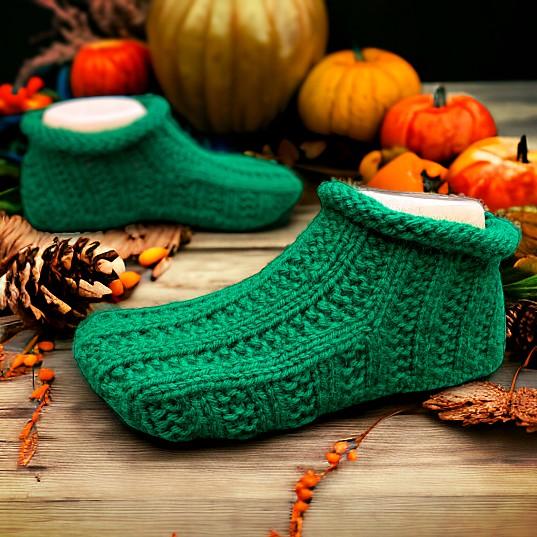
Shocker. Another slipper design 😂 I really do like this style of slipper but after designing the basic moccasin slipper, I was thinking of ways that I can gussy it up a bit if you will. I liked the idea of doing ribbing around it, simply for the additional visual appeal. When I started I didn’t realize how complicated it would be to make the ribbing line up regardless of the sizing. But I gave it some thought, did the math and tahdah! The ribbed moccasins slippers have arrived.
Like the original design, this style of slipper is knit flat on straight needles. The only catch is that it use 2 sets of needles. Don’t worry though. I’ve added a number of photos to help you along. There’s even a few videos for specific stitches and techniques on YouTube if you need extra help.
If you would prefer a printable, ad-avoiding version, you can download the PDF version of this pattern for a small fee/donation. You can download it from a number of places. In particular, my site here – Ribbed Moccasin Bootie Slippers for Adults. You can also get it at a number of other online retailers such as Ravelry, CreativeFabrica, DeviantArt and Etsy. There is also the Kindle and Paperback versions available on Amazon.
Another way to avoid ads and pop-ups, get instant, PRINTABLE downloads of this pattern and others, is by becoming a Member on this website. When you become a Website Supporter for $3/month, you’ll gain access to exclusive member only posts. These posts contain one click downloads of the patterns. Simply click the Download & Print button. The PDF will automatically download to your computer or smart device. You can then read it on your device or print it at your leisure. You can download as many patterns as you like for the same $3 each month. You can go to this page to learn more, become a member and support my work… Exclusive Member Area
If you enjoy this pattern and my other free online knitting patterns, please consider making a small donation or helping me out by visiting my Help Support My Work page. If that’s not possible, that’s totally fine too! Even sharing this page on your social media helps me out immensely. You can use the buttons below to do so easily.
Things You Need
1 ball of worsted weight yarn (average 260 yard, 5 oz or 141 gram ball will be more than enough).
2 sets of size 4 mm (US size 6) single point knitting needles.
Stitch holder
Tapestry needle to sew in ends. You can also use this handy tutorial to show you how to work in the ends while knitting these slippers. (You can watch the embedded video in the Hints and Tips section too).
Gauge
With size 4 mm (US size 6) needles or whatever size you needto obtain the correct number of stitches and rows. Be sure to check your gauge otherwise the sizing won’t be correct.
In garter stitch
4” = 16 sts
4” = 40 rows
Sizes (are written as such)
Women’s 6-7 (8-9, 10-11, 12-13)
Men’s 5-6 (7-8, 9-10, 11-12)
The Pattern
Cast on 42 (46, 46, 50)
♠ Row 1: P across
Row 2: K across ♠ Repeat from ♠ to ♠ for a total of 8 rows
♫ Row 9: K2 (0, 0, 2) ♦ P2, K2 ♦ Repeat from ♦ to ♦ 9 (10, 10, 11) times more. P0 (2, 2, 0).
Row 10: K across ♫ Repeat from ♫ to ♫ for a total of 10 (10, 12, 12) rows.
Next Row: Repeat row 9.
Toe Flap
Next Row: Pass the next 14 (16, 16, 18) sts on to a stitch holder. K1 M1 K12 M1 K1. Leave the remaining sts unworked on your non-working needle. Turn
♣ ☺ Next Row: P3 ◘ K2 P2 ◘ Repeat from ◘ to ◘ two times more. P1
Next Row: K across. ♣ Repeat from ♣ to ♣ 12 (12, 14, 14) times more.
Repeat the row marked with ☺. 28 (28, 36, 36) rows for the toe flap.
Making the Sides
Next Row: Put the sts on the stitch holder back on a knitting needle. With the RIGHT side facing and with your first needle, K14 (16, 16, 18). Pick up 16 (16, 20, 20) sts evenly along the toe flap. Be sure to pick up a st in the first st of the stockinette stripe and in the M1.
Right side of slipper
With your second needle along the sts of the toe flap, K2tog (To make it blend more into the slipper, pick up the first st as if to knit, twist this st and place it back on your non-working needle. Knit this and the next st together going from RIGHT to LEFT. You can also knit the 2 sts together as you normally would if you want.) K12 K2tog (as you normally would).
With your third needle, pick up 16 (16, 20, 20) sts evenly along the toe flap. Be sure to pick up a st in the M1 and the first st of the stockinette stripe. K14 (16, 16, 20).
Left side of the slipper. (I accidentally dropped the next 2 sts when taking the photo)
Your 3 needles will look like this
♥ Next Row: K2 (0, 0, 2) ♦ P2, K2 ♦ Repeat from ♦ to ♦ 17 (18, 20, 21) times more. P0 (2, 2, 0).
Next Row: K across ♥ Repeat from ♥ to ♥ 2 (3, 4, 5).
With the WRONG side facing you, cast off 30 (32, 36, 38) sts. (Maintain the P2 K2 pattern while casting off) P1 ◘ K2 P2 ◘ Repeat from ◘ to ◘ two times more. Cast off the remaining sts maintaining the P2 K2 pattern. Bind off
If you need more help than the photos provide below, you can watch the how-to video embedded here. The video starts in the correct section. No need to find the spot. I already have it cued up for you. The video is for a different style of slipper, but it is made EXACTLY the same way.
Next Row: With the RIGHTside facing, attach yarn and knit the first stitch of the cast off stitches by the toe flap (cast off stitch on the right by the point of the needle).
Your slipper will look like the slipper above. (I’m using a similar design to more clearly show the cast off stitches.)
Pick up this stitch at the start of the row.
K2tog. Knit to the last 2 stitches K2tog. Pick up the cast off stitch by the point of your needle. (14 stitches).
Pick up this stitch at the end of the row.
Quick tip – wrap the yarn counterclockwise around your needle and turn it down to pull the yarn through the cast off stitch on the right. If you have a hard time doing this, you can also use a crochet hook to pull the loop through and place that loop on your working needle.
You now are working back and forth along the bottom of the foot picking up one cast off stitch on each side as you go.
Next Row: Knit across.
ʤNext Row: Pick up the next stitch of the cast off stitches. K2tog. Knit to the last 2 stitches K2tog. Pick up the cast off stitch on the other side of the slipper by the point of your needle. (14 stitches).
Keep working your way down the slipper to make the sole.
Next Row: Knit across ʤ
Repeat from ʤ to ʤ down the entire length of the foot. There are equal number of cast off stitches along each side. How many rows varies depending on the size of slipper you’re making. Be sure to end with a completed knit across row.
Making the Heel
You’re now going to make a small triangle to fit in the back of the heel. You’re going to fill this space in the slipper by working on the 14 sole sts already on your needle, and picking up a st on each side of the needle.
I’ve made a specific video showing how to make the heel. It’s for a number of different styles, but it works the same for all.
Please note: the video decreases every other row. This pattern calls for decreasing EVERY row after the first one or two rows (depending on size). I’ve included photos but if you are still confused, please watch the video embedded below.
♠ Next Row: With the RIGHT side facing, pick up a stitch along the side closest to the sole of the slipper. K2tog. Knit to the last 2 stitches. K2tog. Pick up a stitch on the other side.
Next Row: Knit across. ♠ Repeat from ♠ to ♠ 0 (0, 1, 1) time.
◘ Next row: With the RIGHT side facing, pick up a stitch along the side closest to the sole of the slipper. K2tog twice. Knit to the last 4 stitches. K2tog twice. Pick up a stitch on the other side.
Next row: Knit across. ◘ Repeat from ◘ to ◘ until 6 stitches remain.
Next Row: Pick up a stitch along the side. K2tog 3 times. Pick up a stitch on the other side.
Next Row: Knit across.
Next Row: K2tog, K1, K2tog. Pass the middle stitch on your working needle over the stitch on the left. Pass the stitch on the right over the stitch on the left. (Or you can turn your work and knit the 3 sts together).
Break yarn leaving a length of yarn long enough (8ish inches) to sew up the remaining seam.
Make another slipper.
Hints and Tips
I make my K2tog a little differently at the top of the toe only because how the t looks when you knit the two together can look off. I’m very picky though. It doesn’t really matter.
When picking up the first 2 and last 2 sts along the toe, you don’t have to go through the M1. Once again, I’m just overly particular about what it looks like. What works for you will be fine.
There is a lot of breaking and rejoining of yarn with this pattern. I have made a complete tutorial showing How to Work in the Ends While Knitting. You can watch the video right here.
Abbreviations
k – knit
p – purl
k2tog – knit 2 sts together
st – stitch
sts – stitches
M1 – Make one (knit wise). Increase one stitch between the stitches. Pick up the yarn between the stitches. Twist slightly. Place it on your non-working needle. Knit the stitch. Watch this video to see how.
Like all of my patterns, you have my permission to sell and/or give away the physical items that you make using this pattern. You are NOT permitted to reprint this pattern in any form unless you have obtained my written permission to do so.
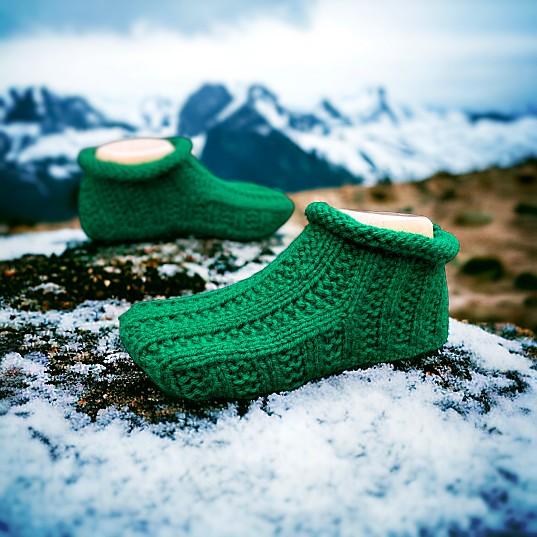
If you have any questions, please feel free to leave a comment or send me your questions at kweenbee_crafts@hotmail.ca.
A great pattern for someone just learning to knit. If you know how to purl, knit, K2tog, M1 and cast on, you will be able to make these slippers. And if you don’t, don’t worry. I’ve included links to the videos that show you exactly how to do the stitches.
These minimal cuff, snug fitting slippers for adults fit folks up to a men’s size 14. Big enough to fit nearly everyone. Knit flat on a pair of straight needles, you don’t need any extra supplies to get these done. If you are an experienced knitter, you’ll be able to whip these up in no time.
Like all my patterns, you have my permission to sell or give away any of the patterns that you make. All I ask that you respect the hard work that goes into designing and publishing a pattern and not violate my copyright.
If you would prefer a printable or ad free version of this pattern, you can get it in all the usual places including this website here – Snug Slip-On Slippers, through myEtsy shop, LoveCrafts, Amazon, Google Books, Patreon, Ravelry, or my newest place Creative Fabrica. If the links aren’t working, I’m in the process formatting and uploading to the retailer.
Another way to avoid ads and pop-ups, get instant, PRINTABLE downloads of this pattern and others, is by becoming a Member on this website. When you become a Website Supporter for $4/month, you’ll gain access to exclusive member only posts. These posts contain one click downloads of the patterns. Simply click the Download & Print button. The PDF will automatically download to your computer or smart device. You can then read it on your device or print it at your leisure. You can download as many patterns as you like for the same $4 each month. You can go to this page to learn more, become a member and support my work… Exclusive Member Area
Love the free patterns? You can say thanks in a couple of ways. You can read more about how you can Support My Work by clicking that link or make a small donation and Buy Me a Coffee. ?? That is a website where you can make a one time donation as a thanks. (FYI I have some great offers if you would like to buy me multiple coffees. You can see those by clicking on the Extras tab or you can click this link Janis Frank Extras).
If you don’t want to or are unable to make a financial donation, sharing this pattern through social media is a great way to help out too! The links below are a super easy way for you to do so.
Things You will Need
7oz (198 g) worsted weight yarn. Any standard ball of yarn you can get at craft or big box stores will be more than enough with yarn to spare.
Set of size 6 US (4 mm) single pointed knitting needles
Tapestry needle – to sew seams and work in ends.
Gauge
In garter stitch
2” (10 cm) – 9 stitches
2” (10 cm) – 18 rows
Sizes are written as such:
Women 6-7 (8-9, 10-11, 12)
Men 6 (7-8, 9-10, 11-12, 13-14)
Abbreviations
If you need help with any of the stitches, you can go to my how-to video page. Here’s the link –Learn to Knit With Videos. A new page will open so you’re sure to not lose this one.
K – knit
P – purl
K2tog – knit 2 together
M1 – Make 1. Increase one stitch between stitches.
st – stitch
sts – stitches
Heel Flap
Cast on 4
K across for 10 (10, 12, 12, 14) rows.
* Next row: K1 M1. K across to last st. M1. K1.
Next 3 rows: K across * Repeat from * to * until there are 14 (14, 14, 16, 16) sts. Make sure to knit the 3 rows after the increase row. Cast on an additional 14 (15, 16, 17, 18) sts. 28 (29, 30, 33, 34) sts total.
Next row: K across. Cast on another 14 (15, 16, 17, 18) sts. 42 (44, 46, 50, 52) sts total.
Next row: K1 (0, 0, 1, 1) K2 tog 4 (5, 5, 5, 5) times, K1, K2tog to last st (if there is one). K1 (0, 0, 0, 0).
Next row: P3 (3, 3, 4, 3) K4 P3 (3, 3, 4, 4).
Break yarn and draw through.
Flip up the triangle-ish shaped flap in the back of the slipper to form the heel. Sew along the sides of the heel flap to form the back of the slipper.
Make another slipper to match.
Hints and Tips
When ending the toe, due to the differing number of stitches for the various sizes, there may or may not be an extra stitch that needs working at the ends. I’ve marked the sizes accordingly.
The heel flap may not match up perfectly with the sides of the slipper but it will be close. Hold the garter edges at the top to make sure it lines up to form the cuff.
Leave a length of yarn when casting on and after you draw the yarn through when forming the toe. You can use it to sew the seams along one of the sides of the heel and along the top of the toe.
After a bit of math and a little tweaking of the results, the child sizes of the FREE Knitted Slipper Pattern is finally available! (You can click that link if you need the adult sizes). Because these are made for little feet, they often don’t need much yarn. This makes them a great way to use up the smaller leftover bits from larger projects. Not to mention, these tend to sell like hotcakes at local farmers’ markets, craft fairs and consignment shops. The smaller pairs are “so cute” making for an easy sale and the return on the investment of your time is great! They’re quick to make and since the yarn has already been bought for a larger project, anything made from the leftovers, like these child shippers, is gravy, baby!
If you enjoy this pattern and my other free online knitting patterns, please consider making a small donation or helping me out by visiting my Help Support My Work page. If you can’t help financially, I totally get it. Sharing on your social media is the next best thing.
And yes, you have my permission to sell or give away anything you make from my patterns. You’re just not allow to redistribute any of the patterns themselves in any form. Linking to and sharing is always welcome though! You can use those buttons ?? to do so easily.
Please note, this isn’t a pattern for beginners, but if you know how to knit a stitch, pick up stitches and knit two stitches together, you should be okay. I used a very different technique involving multiple sets of needles, but no worries! I included photos and now a how-to video demonstrating how I’m using the extra set and it totally works! Trust me.
And if you are concerned with the number of ends you’ll need to weave in when done, I’ve also created a tutorial to help you with that too! It’s so much easier to work the ends in as you go, though there will be a few you’ll have to do (i.e. when you sew up the seam for the heel), but if you are interested in easing your work load, here’s the link showing you How to Weave in the Ends While Knitting. A new window will open so you won’t lose this page ?. There’s also a clickable card in the scrolling free pattern pics running across the top of this website if you need to find the page again.
If you don’t want to read it online and want to print it, this knitting pattern is available in all the usual places including this website – Knitted Moccasin Bootie Slippersfor Children, Ravelry, in my Etsy shop, LoveCrafts, a paperback on Amazon, and as an ePub that you can download on your Kindle. I’ll link to all of them as I get them completed and uploaded to the retailers. If a link isn’t working, it’s on its way. I need to reformat everything to get things on Amazon…
FYI I’m working at uploading my work to a distributor that also works with libraries. I’m publishing paperbacks of the patterns that you’ll be able to borrow! Some are available right now like the slipper and fingerless glove compilations I have. The single pattern paperbacks should be available as I get them uploaded and the distributor gets them out to the libraries. If they aren’t there now, you can always ask them to get it for you ?
The printable version of this pattern will also be in the member section and at Patreon also. Here are the links where you can get it.
If you are uncertain or having trouble finding what you need to make these slippers, clicking any of the links below will show you exactly what you need. And if you decide to order through Amazon, it will be delivered right to your door and help support the hosting costs of the website (I do get a small commission from sales through Amazon).
And because this pattern is so basic with no pattern of any sort, it’s a great knitting pattern to highlight the colour of your yarn. I have a weakness for variegated/shaded yarns. I really enjoying watching how the colours pool on the finished project. Little weird, I know… And In case you were thinking of trying self-striping yarn. Don’t. It looks terrible.
1 ball of worsted weight yarn (average 260 yard, 5 oz or 141 gram ball will be more than enough). I used Red Heart and Bernat worsted weight yarn when designing the pattern but any worsted weight yarn will suffice.
Use this product to help prevent slippers from sliding on slick floors
Gauge
With size 4 mm (US size 6) needles or whatever size you need to obtain the correct number of stitches and rows. Be sure to check your gauge otherwise the sizing won’t be correct.
I’m using a colour code to denote the number of stitches for the various sizes. I hope this helps when making the sizes of slippers.
Size
Length
1-2
4 inches
10 cm
3-4
4.5 inches
11.4 cm
5-6
5 inches
12.5 cm
7-8
5 3/4 inches
14.5 cm
9-10
6 inches
15 cm
11-12
6 3/4 inches
17 cm
13-1
7 1/4 inches
18.5 cm
2-3
8 1/4 inches
21 cm
4-5
8 3/4 inches
22 cm
All measurements are approximate. Knitted slippers are very forgiving for size and foot shape.
To Begin
Cast on 18 (20,22, 24,26,28,30, 32,34)
Knit across for 10 (12,12, 14,14,16,18, 20,20) rows. Break yarn when completed last row.
Toe Flap
Next Row: With RIGHT side facing, transfer the first 6 (7,7, 8,8,9,10, 10,11) stitches to a stitch holder. Reattach the yarn and knit the next 6 (6,8, 8,10,10,10, 12,12) to create the toe flap. Leave the remaining 6 (7,7, 8,8,9,10, 10,11) stitches on the needle unworked.
The following rows are worked back and forth on the 6 (6,8, 8,10,10,10, 12,12) toe flap stitches only!
Knit across for 18 (20,22, 24,26,30,32, 36,40) rows.
Break yarn. You’ll have the 6 (6, 8, 8, 10,10,10, 12, 12) stitches of the toe flap on your needle and the 6 (7, 7, 8, 8,9,10, 10, 11) stitches you left on the needle when you started making the toe flap.
Making the Sides of the Slipper
This is where you’re going to need the extra set of knitting needles. You’ll be knitting back and forth in rows but the turn around the toe is too tight to use circular needles. For this, you’ll put the toe flap stitches on one of your extra needles. It’s a little unconventional, but it works.
Next Row: With the RIGHT side facing, transfer the 6 (7,7, 8,8,9,10, 10,11) stitches from the stitch holder onto one of your needles. Attach your yarn and knit these stitches. Pick up 9 (10,11, 12,13,15,16, 18,20) stitches evenly along the edge of the toe flap. (All of these stitches are now on ONE needle – 15 (17,18, 20,21,24,26, 28,31) stitches
With another needle, knit the 6 (6,8, 8,10,10,10, 12,12) stitches of the toe flap. Leave the remaining 6 (7,7, 8,8,9,10, 10,11) stitches on the other needle unworked for now.
With another needle, pick up 9 (10,11, 12,13,15,16, 18,20) stitches evenly along the side of the toe flap. Knit the remaining 6 (7,7, 8,8,9,10, 10,11) stitches on the next needle. There are now 15 (17,18, 20,21,24,26, 28,31) stitches on this needle.
You should now have 3 needles holding stitches with all the points pointing as shown below when laid flat. You also have one spare needle to knit with. You are now going to knit in rows, back and forth with these three needles. Once you finish knitting all the stitches on one needle, move on to the next needle (the point of the needle is right there) until you complete the row.
I used double pointed needles because they were handy and I don’t like the longer needles flopping and waggling about while I knit. Regular knitting needles work perfectly fine, too!
Another way to say it for the following rows, knit all the stitches forming the side of the slipper, knit the stitches holding the toe flap stitches, then knit the other side of the slipper (counts as one row). Turn. Repeat.
Knit the next 4 (4,6, 6,8,8,8, 10,10) rows.
There are 2 (2,3, 3,4,4,4, 5,5) ridges on the tip of the toe.
The photo below shows the 5 ridges for the sizes 2-3 and 4-5.
These are the ridges picked up along the toe flap
The 2 ridges for small size 1-2 and 3-4.
Next Row: With WRONG side facing. Cast off all the stitches from the first needle loosely. You’ll need to pass the last stitch from the first needle over the first stitch of the toe flap stitches (second needle).
Using the same needle that now has one stitch, knit the remaining 5 (5,7, 7,9,9,9, 11,11) stitches of the toe flap.
Cast off all the stitches from the third needle loosely. Break yarn.
Making the Sole
If you need help with making the sole, picking up stitches along the side etc, you can watch this video. It starts exactly where you need it to.
Next Row: With the RIGHT side facing, attach yarn and knit the first stitch of the cast off stitches by the toe flap (cast off stitch on the right by the point of the needle).
Pick up this stitch at the start of the row.
K2tog. Knit to the last 2 stitches K2tog. Pick up the cast off stitch by the point of your needle. – 6 (6,8, 8,10,10,10, 12,12) stitches
Pick up this stitch at the end of the row.
Quick tip – wrap the yarn counterclockwise around your needle and turn it down to pull the yarn through the cast off stitch on the right. If you have a hard time doing this, you can also use a crochet hook to pull the loop through and place that loop on your working needle.
You now are working back and forth along the bottom of the foot picking up one cast off stitch on each side as you go.
Next Row: Knit across.
? Next Row: Pick up the next stitch of the cast off stitches. K2tog. Knit to the last 2 stitches K2tog. Pick up the cast off stitch on the other side of the slipper by the point of your needle. – 6 (6, 8, 8, 10, 10, 10, 12, 12) stitches
Keep working your way down the slipper to make the sole.
Next Row: Knit across ?
Repeat from ? to ? in every stitch down the entire length of the foot. There are equal number of cast off stitches along each side. How many rows varies depending on the size of slipper you’re making. Be sure to end with a completed knit across row.
Starting the sole. Right side. This is shows the adult size but will have less stitches for child sizes.
Working your way down while making the sole. Wrong side.
Continuing to work down the length of the sole.
Still further down the sole. Note how the cast off edges are being picked up as you go. Keep working your way down the length of the sole until you’ve picked up all the cast off stitches.
If you need help with making the heel, you can watch the video. It starts where you need it to. As mentioned in the video, you’ll need to follow how to decrease with the pattern as written below.
If You Have 6 Stitches
Next Row: With the RIGHT side facing, pick up a stitch in the row closest to the sole of the slipper. Count how many ridges it is for the size you are making. K2tog 3 times. Count down the same number of ridges and pick up a stitch in the space beneath it on the other side.
The photo above shows 9 rows of ridges.
These are rows you knit to form the edges of the slipper.
Stitch picked up on the right edge in the 9th row shown above
After you K2tog at the end of the row, you’ll pick up a stitch here.
Stitch picked up on the left or end of the row.
Next Row: Knit across.
Next Row: K2tog, K1, K2tog. Pass the middle stitch on your working needle over the stitch on the left. Pass the stitch on the right over the stitch on the left. (Or you can turn your work and knit the 3 sts together).
Break yarn leaving a length of yarn long enough (8ish inches) to sew up the remaining seam.
Make another slipper.
If You Have 8 Stitches
Next Row: With the RIGHT side facing, pick up a stitch in the row closest to the sole of the slipper. Count how many ridges it is for the size you are making. K2tog 4 times. Count down the same number of ridges and pick up a stitch in the space beneath it on the other side. (Scroll up to the “If you have 6 stitches” section to see the photos if you need help).
Next Row: Knit across.
Next Row: Pick up a stitch beneath the next ridge. K2tog 3 times. Pick up a stitch in the space beneath the next ridge on the other side.
Next Row: Knit across.
Next Row: K2tog, K1, K2tog. Pass the middle stitch on your working needle over the stitch on the left. Pass the stitch on the right over the stitch on the left. (Or you can turn your work and knit the 3 sts together).
Break yarn leaving a length of yarn long enough (8ish inches) to sew up the remaining seam.
Make another slipper.
If you have 10 or More Stitches
♀️ Next Row: With the RIGHT side facing, pick up a stitch in the row closest to the sole of the slipper. Count how many ridges it is for the size you are making. K2tog twice. Knit to the last 4 stitches. K2tog twice. Count down the same number of ridges on the other side and pick up a stitch in the space beneath it. (Scroll up to the “If you have 6 stitches” section to see the photos if you need help).
Next Row: Knit across.
Next Row: Count down one ridge less than the previous row and pick up a stitch in the space beneath it. K2tog. Knit until the last 2 stitches. K2tog. Count down the same number of ridges and pick up a stitch in the space beneath it on the other side.
Next Row: Knit across. ♀️ Repeat from ♀️ to ♀️ until 6 stitches remain.
Next Row: Pick up a stitch beneath the next ridge. K2tog 3 times. Pick up a stitch in the space beneath the next ridge on the other side.
Next Row: Knit across.
Next Row: K2tog, K1, K2tog. Pass the middle stitch on your working needle over the stitch on the left. Pass the stitch on the right over the stitch on the left. (Or you can turn your work and knit the 3 sts together).
Break yarn leaving a length of yarn long enough (8ish inches) to sew up the remaining seam.
Make another slipper.
Yes, they do look a little boxy when they’re done and not on a foot. The stretch of the garter stitch allows these slippers to stretch around the contours of any foot easily.
Hints and Tips
If you want a longer cuff at the top, work more rows than stated at the beginning when you cast on. Because smaller kid-lettes tend to have chunkier legs (aka – cankles ?), which is so gosh-darn cute btw, don’t go too crazy with the length.
When picking up stitches from the cast off row, be sure you’re really moving on to the next cast off stitch! It’s an easy mistake to pick up a stitch in a stitch you already picked up. If in doubt, give the needle holding the stitches a bit of a tug. You’ll see the yarn move slightly at the very back, closest to the needle. Pick up a stitch at the NEXT cast off stitch.
If you don’t have the same number of stitches on both sides when you are forming the sole, you may have picked up a stitch twice in one stitch or missed one. Don’t worry! This is fixable. You can skip one cast off stitch if you need to make it even, or pick up a cast off stitch twice on the other side. There’s enough stretch in the slipper that any puckering this causes won’t be overly visible if you’re off by a stitch or two.
Picking up the stitches evenly along the toe flap is roughly 1 stitch every ridge.
To speed up finishing the slippers and not have so many ends to sew in, hold the yarn ends to the back of your work as you knit. And yes, this is the third time I’m sharing it, but I made a photo tutorial showing how to do this. You can see it here – How to Work in the Ends as You Knit.
If you have any questions, please feel free to leave a comment below or send me your questions here. If there is a typo or stitch count that’s off, let me know in the comments! I type these out from notes I make when designing the slippers. It’s easy, and embarrassingly common for me to miss something. Especially on the smaller slippers that involve so many different stitch counts for the numerous sizes.
To see how you can keep the free patterns coming, visiting this page – Help Support My Work! A financial donation is always appreciated but a share, like and follow on social media also helps me immensely ?
It wasn’t until this very moment in my life that I realized that naming a knitting pattern for winter headgear was going to be complicated. For those that don’t know about the internet and how information is found, writers have to write around keywords so web crawlers can find the information. I won’t bore you any further with that, but it does cause some, indecision, shall we say, when it comes to naming this knitting pattern. As it so happens, there are at least 3 ways to spell what I know as a touque. I’m Canadian. That’s what we call it and how I have always spelled it. My autocorrect on the other hand, is calling me a doofus and insists that it’s toque. In a state of mild rage I went to the internet to see what’s what in regard to this winter hat dilemma. Turns out there is a third option: tuque. What the actual “f”?!
I do realize that a lot of people generally refer to winter headwear as beanies. TBH that to me is a more tight fitting winter hat that conforms to the shape of your head and NEVER has a pom pom. These are the manly toques worn under hooded things like hoodies and winter jackets, especially when it gets really cold outside.
This pattern is different from most touque patterns I’ve seen and knit up over the years. I’m a little obsessed with short rows this last couple of months. So far I’ve made dishcloths and coasters and slippers using this technique. Instead of casting on all the stitches you’ll need to go around the head, this touque is knit from the forehead to the crown or top of the head. It’s still knit flat, with the shaping of the head being worked as you go. It also gives a neat vertical striping effect if you’re using self striping yarn. And just so you know, the smaller the stripes the narrower the stripes on the toque.
If you would prefer a printed copy of this pattern, there are a couple options for you. No, you don’t need to message me how you’re up in arms that you can’t print this webpage. You can keep scrolling down this page and read the pattern row by row on your phone or tablet in the comfort of your chair as you knit. A printed copy is a preference but not necessary to read and use this pattern.
Another way to avoid ads and pop-ups, get instant, PRINTABLE downloads of this pattern and others, is by becoming a Member. When you become a Website Supporter at $4/month, you’ll gain access to exclusive member only posts on Buy Me A Coffee. You can download as many patterns as you like for the same $4 each month. You can go to this page to learn more, become a member and support my work… Exclusive Member Area
If you like the vertical stripes but have no self striping yarn, I’ve marked in the pattern where to change the colours. This makes this touque a great project to use up all those left over bits of yarn from other projects. I keep them too. I just can’t bring myself to throw out those bits. I always feel I’ll find a use for them.
But enough. You’re here to knit…
Things You Need:
Worsted weight yarn – a standard ball of yarn (215 yards/197 m). It may need to be more if you want a big, dense and fluffy pom pom.
Size 5 mm (size 8 US) knitting needles or whatever you need to acquire the correct gauge.
Tapestry needle to sew the seam and work in the ends
Pom pom maker – or you can use the two pieces of cardboard method. I’m sure there’s a video on YouTube showing how to do this.
Gauge
In stockinette
9 sts – 5 cm (2″)
12 rows – 5 cm (2”)
Sizes are for small, medium and large and are written as such sm (med, lg).
Small – 21 inches
Medium – 22.5 inches
Large – 24 inches
Sizing is always general for knitting as it has a fair amount of stretch to it and tends to contract and expand as needed.
Abbreviations
K – knit
P – purl
st – stitch
sts – stitches
Starting the Toque, Touque, Tuque, Beanie….*Sigh* I give up SMH
Any type of yarn will work for this project. It doesn’t have to be striped just because that’s how I did it. A solid colour would look just as good. Another option it to use the ombre yarns that gently shift from one colour to another. It’s nice to be able to make a beanie that has the colour transition go up and down instead of the usual horizontal way.
Colour changes have to be done in groups of 2 or 7 colours if you want to maintain the proper sequence. For example: black, white, black white, black white, etc. for 2 colours. If you want 7 different colours it would have to be something like: red, orange, yellow, green, blue, purple, black and then repeat those colours again in that order. Of course, it you’re using up leftover yarn and aren’t repeating colours, it doesn’t matter.
Another way to think of it…there are 14 possible colour sections to this winter hat. Any number that fits equally into 14 can be repeated in sequence around the hat.
When making colour changes, you can work in the ends as you go for the first colour change. I show how to do that here – How to Work in the Ends While Knitting. You can also work them in with the tapestry needle when done.
The second colour change occurs at the top of the hat. I tie and knot the ends of the yarn together as I change colour. When done, I thread them up and through the pom pom and cut off the dangly bits so they blend in with it. The knots are above the crown of the head and don’t actually touch the scalp. It’s an easy, time saving short cut.
Like all my patterns, you have my permission to sell, give away or keep any of the physical items you make. You are NOT permitted to reproduced this pattern in any way, including but not limited to, all digital or physical copies.
I’ve been looking to simplify my Adult Moccasin Slippers for some time now. I wanted to design a minimalist style slippers that were knit on a single set of knitting needles, without the sewing of seams (which I try to avoid at all costs, btw). I also wanted to keep any tricky techniques to a minimum. With this pattern, there are no additional sets of needles required, and no knitting in the round on double pointed needles (DPN) to make the edging.
And because there is a bit of starting and stopping when making the sections, this leaves a number of ends to sew in. I strongly recommend working in your ends while you knit. If you don’t know how to do that, you can check out How to Work in the Ends While Knitting on my website. For a quick how to: hold the yarn on the back of your work (the wrong side) and catch the yarn every other stitch. It totally works and in all the slippers I’ve made over the years, I’ve never had a single complaint about it coming undone.
Please note that in some of the photos showing parts of the slipper, I used double pointed needles. These needles are NOT necessary. I just prefer to use shorter needles when knitting narrow pieces. Regular single pointed needles work just as well.
Another way to avoid ads and pop-ups, get instant, PRINTABLE downloads of this pattern and others, is by becoming a Member. When you become a Website Supporter at $4/month, you’ll gain access to exclusive member only posts on Buy Me A Coffee. You can download as many patterns as you like for the same $4 each month. You can go to this page to learn more, become a member and support my work… Exclusive Member Area
If you enjoy this pattern and my other free online knitting patterns, please consider making a small donation or helping me out by visiting my Help Support My Work page. If that’s not possible, that’s totally fine too! Even sharing this page on your social media helps me out immensely. You can use those buttons ?? to do so easily.
Things You Need
Size 6 US (4 mm) knitting needles
Worsted weight yarn – any standard ball of yarn will suffice. (I’m a fan of Red Heart and Bernat worsted weight as it is easy to find and economical.)
Tapestry needle – to work in the ends.
Abbreviations
K – knit
K2tog – knit 2 together
st – stitch
sts – stitches
Gauge
Make sure you match the gauge or sizing will be off.
Stop here for men’s size 11-12. Eighth of a circle completed.
۞ Come here when indicated to stop for the size you are making.
Repeat from ☺ to ☺ once to make another eighth of a circle.
First 1/8th of a circle looks like this.
The second 1/8th looks like this. You now have 1/4th of a circle.
When you have made a quarter circle (1/8 + 1/8 = 1/4), start knitting rows as follows:
Next row: Knit across for 40 (42, 46, 50) rows total.
Starting the back and forth rows.What it looks like finished is below.
Cast off.
With the RIGHT side of your work facing you, pick up 12 (13, 14, 15) sts along the original cast on row.
Side finished (but not cast off. Make sure yours is!!)
Picking up the stitch.
Stitch picked up.
Two stitches picked up.
Stitches picked up along the edge.
Repeat from ☺ to ☺ twice.
First repeat.
Second repeat.
Knit across for 40 (42, 46, 50) rows total.
Starting the back and forth rows.
Done the toe and sides.
Cast off.
Edging (Done before sole)
I know it’s a little unconventional to add an edging at this point. This is usually something you do as a last step. But, to keep this slipper pattern as simple as possible, and to not need any other knitting needles or need to know how to knit in the round, we’ll make the edging now. You can use a complimentary colour or the same colour that you are already using. The choice is yours.
With the RIGHT side of your work facing you, pick up 20 (21, 23, 25) sts along the edge, 7 sts over the curve of the toe and 20 (21, 23, 25) sts along the other edge.
If you spread the rows apart a bit you can see where to pick up the stitch.
First 2 stitches picked up..
Stitches picked up along edge
It doesn’t have to be perfect. As long as the 7 stitches are picked up evenly in this space it’s ok.
Seven stitches picked up.
All stitches picked up.
Knit 2 (4, 4, 4) rows over the picked up stitches. Cast off loosely on the WRONG side.
With the RIGHT side of your work facing you, find the middle seam of the toe. This is the line where you picked up the stitches the first time after making the first quarter section and side strip. Count over 5 (6, 6, 6) ridges. Pick up 11 (13, 13, 13) sts to start the sole. The middle stitch (the 6th (7th, 7th, 7th stitch) should be picked up in the middle seam.
Stitches picked up.This is the smallest size so there are only 11 stitches.
Next row: Knit across.
♥ Next row: With the RIGHT side facing, attach yarn and pick up a stitch in the ridges by the toe flap. K2tog. Knit to the last 2 stitches K2tog. Pick up a stitch in the ridges by the point of your needle. You now have 11 (13, 13, 13) stitches.
Keep picking up a stitch on each side down the entire length to form the sole.
Next row: Knit across. ♥ Repeat from ♥ to ♥ down the length of the slipper until there are no ridges left.
As you pick up stitches along the side, the sole will automatically curve around the toe like this.
Keep working your way down the length of the slipper.
Forming the Heel
I recently made a video showing how to do this. It’s how I make a lot of my slipper heels including this pattern. You can watch the video below to help you if the photos aren’t enough.
◘ Next row: With the RIGHT side facing, pick up a stitch in the cast off stitch closest to the sole of the slipper. K2tog twice. Knit to the last 4 stitches. K2tog twice. Pick up the cast off stitch on the other side.
Next row: Knit across.
Next Row: Pick up a stitch in the next cast off stitch. K2tog. Knit until the last 2 stitches. K2tog. Pick up the cast off stitch on the other side.
Next row: Knit across. ◘ Repeat from ◘ to ◘ until 7 stitches remain.
Working up the back of the heel.
Next row: K2tog, Knit 3 stitches together, K2tog.
Next row: Knit the 3 stitches together.
Break yarn leaving a length of yarn long enough (8ish inches) to sew up the remaining seam.
Make another slipper.
The back of the heel completed.
Heels sewn and complete.
Yes, the toe does look a little boxy when they’re not on a foot. The stretch of the garter stitch allows these slippers to stretch around the contours of any foot easily.
Hints and Tips
If you are up in arms about sewing in the ends when you are done, there is away to avoid it. You can work in the ends on the back side of your work as you are knitting. Not sure how to do that? I have a photo tutorial on my website that will show you how – How to Work in the Ends While Knitting
You can add rows to the edging to make more of a cuff if you like. Or you could also do a K1 P1 ribbing over the stitches. I didn’t like how the slipper fit or looked when it was longer. That’s why I didn’t add any photos of it.
If you have picked up a different number of stitches on each side when making the sole, it’s not a big deal as long as it’s only a row or two. I suggest picking up 2 stitches in one row, rather than skipping a row. It’s less noticeable.
I designed this pattern to have a very minimalist feel to it. Of course, not everyone is into function only wearables. If you want to add pompoms, fancy large buttons or some other decorations, have at it! Be creative and add your personal touch to the design.
Like all of my patterns you have my permission to sell and/or give away the slippers that you make using this pattern. You are NOT permitted to reprint this pattern in any form unless you have obtained my written permission to do so.
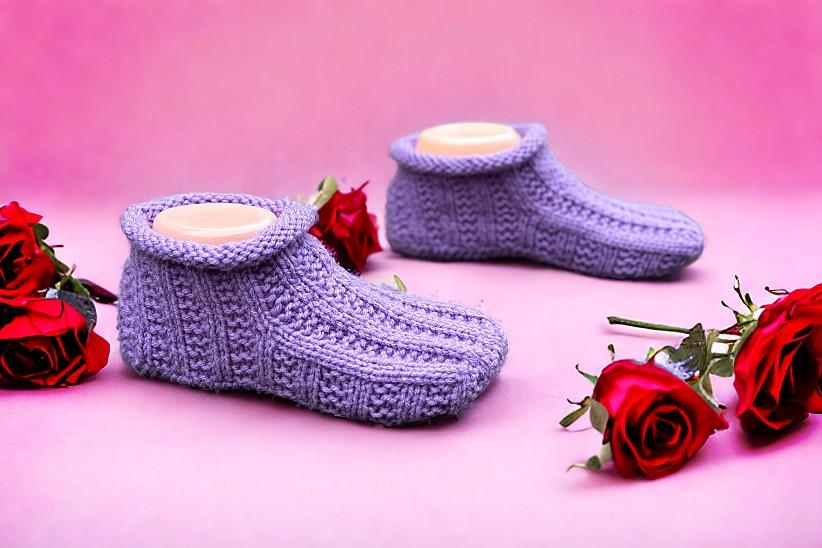
If you have any questions, please feel free to leave a comment or send me your questions at kweenbee_crafts@hotmail.ca.
This knitting pattern is very versatile and can be made to be any size of square. For myself, I like it as a dishcloth. But when I started to knit up samples for the photos I realized that this design could transfer into any thing that can be square. Regardless of the size, because of the method of making it, it will always be square regardless of how many, or few, stitches are cast on at the outset.
And no need to worry about picking up stitches or any other difficult techniques. If you can knit and cast on and cast off, you can make this. It’s not complicated at all.
For myself, I found that 32 stitches made for the perfect size dishcloth and used a little less than one of the smaller balls of cotton yarn. I like mine to be bigger but not unmanageably so. I also found that making a coaster or mini face scrubber, took about 18 stitches. These are just approximate cast on stitch counts. I found that there is some variation in the worsted weight (medium 4) yarn thickness. You may need to add 2 or 3 more cast on stitches if it’s on the thinner side.
I’ve written the pattern to make a dishcloth so started with 32 stitches cast on. A quick tip, if you use a size smaller needle (4 mm or US 6) to cast on, then switch back to the 5 mm (US 8) the starting edge looks a bit more finished and tight.
Another plus about this pattern, I finally designed something that really highlights variegated yarn. I have a great appreciation for the colour changing yarns that are available (I do not have similar feelings towards self striping yarn, but that’s a rant for another time). I found that the variegated yarn did really well with smaller size squares, though I like the pooling of colours when making the larger sized dishcloths as well.
And to sooth my quest for sameness, these washcloths are the same on both sides!! Both sides look pretty much the same. I know in the scheme of things this matters very little, but it somehow screams “correct” to me. I’m weird. I know.
Another way to avoid ads and pop-ups, get instant, PRINTABLE downloads of this pattern and others, is by becoming a Member on this website. When you become a Website Supporter for $3/month, you’ll gain access to exclusive member only posts. These posts contain one click downloads of the patterns. Simply click the Download & Print button. The PDF will automatically download to your computer or smart device. You can then read it on your device or print it at your leisure. You can download as many patterns as you like for the same $3 each month. You can go to this page to learn more, become a member and support my work… Exclusive Member Area
And, yes. I know this pattern becomes very obvious in how to make it once you start knitting. I wrote it out in full regardless, as some people (the few but very vocal) have a tendency to contact me if even the most obvious thing is not mentioned in my patterns. I’m trying to avoid these critical emails, just so you know.
It’s so obvious that you may be able to knit this without the pattern at all. That’s why I made the video. I’m sure some of the more experienced knitters out there will watch the first couple minutes of the video below and be like, “Ya. I got this.”
Things You Need
Size 8 US (5 mm) knitting needles
1 3/4 oz (42g) ball of 100% cotton worsted weight yarn
Large sewing needle (for working in the ends)
Gauge isn’t really important for this project as sizing is approximate.
Abbreviations
K – Knit
st – stitch
That’s it! This is a VERY simple pattern.
The Pattern
Cast on 32 (You will always have 32 stitches on your needle when the right side is facing you)
Row 1 – 2: Knit across
Row 3: K31. Leave the last stitch unworked. Turn.
Back side of work always looks likenormal knitting when the row is completed
Row 4: K31.
Row 5: K30. Leave the last 2 stitches unworked. Turn.
Row 6: K30.
Row 7: K29. Leave the last 3 stitches unworked. Turn.
Row 8: K29.
Row 9: K28. Leave the last 4 stitches unworked. Turn.
Row 10: K28.
Row 11: K27. Leave the last 5 stitches unworked. Turn.
Row 12: K27.
Row 13: K26. Leave the last 6 stitches unworked. Turn.
Row 14: K26.
Row 15: K25. Leave the last 7 stitches unworked. Turn.
Row 16: K25.
Row 17: K24. Leave the last 8 stitches unworked. Turn.
Row 18: K24.
Row 19: K23. Leave the last 9 stitches unworked. Turn.
Row 20: K23.
Row 21: K22. Leave the last 10 stitches unworked. Turn.
Row 22: K22.
Row 23: K21. Leave the last 11 stitches unworked. Turn.
Row 24: K21.
Row 25: K20. Leave the last 12 stitches unworked. Turn.
Row 26: K20.
Row 27: K19. Leave the last 13 stitches unworked. Turn.
Row 28: K19.
Row 29: K18. Leave the last 14 stitches unworked. Turn.
Row 30: K18.
Row 31: K17. Leave the last 15 stitches unworked. Turn.
Row 32: K17.
Row 33: K16. Leave the last 16 stitches unworked. Turn.
Row 34: K16.
Row 35: K15. Leave the last 17 stitches unworked. Turn.
Row 37: K14. Leave the last 18 stitches unworked. Turn.
Row 38: K14.
Row 39: K13. Leave the last 19 stitches unworked. Turn.
Row 40: K13.
Row 41: K12. Leave the last 20 stitches unworked. Turn.
Row 42: K12.
Row 43: K11. Leave the last 21 stitches unworked. Turn.
Row 44: K11.
Row 45: K10. Leave the last 22 stitches unworked. Turn.
Row 46: K10.
Row 47: K9. Leave the last 23 stitches unworked. Turn.
Row 53: K6. Leave the last 26 stitches unworked. Turn.
Row 48: K9.
Row 49: K8. Leave the last 24 stitches unworked. Turn.
Row 50: K8.
Row 51: K7. Leave the last 25 stitches unworked. Turn.
Row 52: K7.
Row 54: K6.
Row 55: K5. Leave the last 27 stitches unworked. Turn.
Row 56: K5.
Row 57: K4. Leave the last 28 stitches unworked. Turn.
Row 58: K4.
Row 59: K3. Leave the last 29 stitches unworked. Turn.
Row 60: K3.
Row 61: K2. Leave the last 30 stitches unworked. Turn.
Row 62: K2.
Row 63: K1. Leave the last 31 stitches unworked. Turn.
Halfway Point
If you would like the other half of your square to use a different colour like shown above, attach it now.
Row 64: K1.
Row 65: K2. Leave the last 30 stitches unworked. Turn.
Row 66: K2.
Row 67: K3. Leave the last 29 stitches unworked. Turn.
Row 68: K3.
Row 69: K4. Leave the last 28 stitches unworked. Turn.
Row 70: K4.
Row 71: K5. Leave the last 27 stitches unworked. Turn.
Row 72: K5.
Row 73: K6. Leave the last 26 stitches unworked. Turn.
Row 74: K6.
Row 75: K7. Leave the last 25 stitches unworked. Turn.
Row 76: K7.
Row 77: K8. Leave the last 24 stitches unworked. Turn.
Row 78: K8.
Row 79: K9. Leave the last 23 stitches unworked. Turn.
Row 80: K9.
Row 81: K10. Leave the last 22 stitches unworked. Turn.
Row 82: K10.
Row 83: K11. Leave the last 21 stitches unworked. Turn.
Row 84: K11.
Row 85: K12. Leave the last 20 stitches unworked. Turn.
Row 86: K12.
Row 87: K13. Leave the last 19 stitches unworked. Turn.
Row 88: K13.
Row 89: K14. Leave the last 18 stitches unworked. Turn.
Row 90: K14.
Row 91: K15. Leave the last 17 stitches unworked. Turn.
Row 92: K15.
Row 93: K16. Leave the last 16 stitches unworked. Turn.
Row 94: K16.
Row 95: K17. Leave the last 15 stitches unworked. Turn.
Row 96: K17.
Row 97: K18. Leave the last 14 stitches unworked. Turn.
Row 98: K18.
Row 99: K19. Leave the last 13 stitches unworked. Turn.
Row 100: K19.
Row 101: K20. Leave the last 12 stitches unworked. Turn.
Row 102: K20.
Row 103: K21. Leave the last 11 stitches unworked. Turn.
Row 104: K21.
Row 105: K22. Leave the last 10 stitches unworked. Turn.
Row 106: K22.
Row 107: K23. Leave the last 9 stitches unworked. Turn.
Row 108: K23.
Row 109: K24. Leave the last 8 stitches unworked. Turn.
Row 110: K24.
Row 111: K25. Leave the last 7 stitches unworked. Turn.
Row 112: K25.
Row 113: K26. Leave the last 6 stitches unworked. Turn.
Row 114: K26.
Row 115: K27. Leave the last 5 stitches unworked. Turn.
Row 116: K27.
Row 117: K28. Leave the last 4 stitches unworked. Turn.
Row 118: K28.
Row 119: K29. Leave the last 3 stitches unworked. Turn.
Row 120: K29.
Row 121: K30. Leave the last 2 stitches unworked. Turn.
Row 122: K30.
Row 123: K31. Leave the last stitch unworked. Turn.
Row 124: K31.
Row 125: K32.
Cast off on the WRONG side.
Hints and Tips
If you would like to make smaller squares for coasters or pot scrubbers, cast on fewer stitches. The basic idea for the pattern is to always leave one less stitch done every other row. Once you’re down to one stitch, knit one extra stitch every other row.
I know I mentioned this in the intro but it deserves repeating. If you use a size smaller needle (4 mm or US 6) to cast on, then switch back to the 5 mm (US 8) the starting edge looks a bit more finished and tight.
You don’t have to use cotton yarn if you’re going to make coasters. An acrylic or wool blend would also work well. And you can also use up some of your yarn stash this way too. Great little things to sell at a garage sale, or craft fair and recoup a little of the money already spent on the yarn.
Use these squares for anything! As long as your yarn is the same thickness and type, all acrylic let’s say, you could easily use up your last little yarn bits to make an afghan or throw blanket. I don’t quilt but I know that triangles and squares make up a good portion of quilt designs. Knitting squares that are two colours along the diagonal put together the solid coloured squares could make some very interesting patterns.
These also make good trivets or pot holders for taking things out of the oven, but only if… they are NOT wet and are made of 100% cotton. Any acrylic or polyester blend will melt to the pot and possible fingers, counter tops or tables. And ain’t nobody got time for that!!
Like all my work, you are permitted to sell, give away or keep whatever physical items you make using this pattern. You do NOT have permission to copy or redistribute this pattern (or any of my patterns) in any form either digitally or physically. That includes printed copies of the pattern either as photos or any file format.
I’ve written a number of slipper patterns over the years with a couple of goals in mind, two goals to be specific. The first is to never have any seams to sew. This pattern didn’t meet this requirement. I offer a heartfelt apology for this.
The other goal is to make them as easy as possible so new knitters or those with not as much experience, can knit something that gives a great final product. This pattern was written specifically to avoid any difficult techniques, specifically, picking up stitches. That is why this pattern is done in one piece; starting at the heel and working towards the toe.
The cuff is made as you knit the piece. Because of the stitches used, it automatically rolls back up on itself giving a nice finished edge without adding any additional stitches or work.
Love the free patterns? You can say thanks in a couple of ways. You can read more about how you can Support My Work by clicking that link or make a small donation and Buy Me a Coffee. ?? That is a website where you can make a one time donation as a thanks. (FYI I have some great offers if you would like to buy me multiple coffees. You can see those by clicking on the Extras tab or you can click this link Janis Frank Extras).
If you don’t want to or are unable to make a financial donation, sharing this pattern through social media is a great way to help out too! The links below are a super easy way for you to do so.
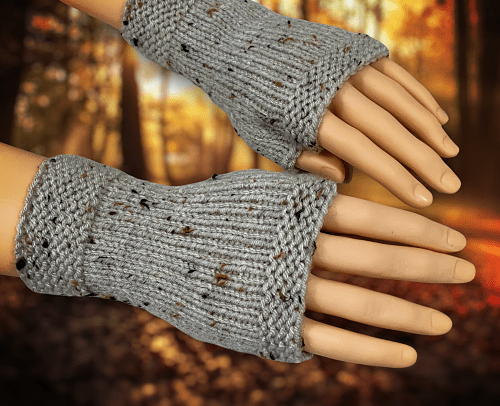
If you would like to avoid the ads on this page or would like to print the pattern, you can purchase the PDF for a small fee from this website atEasy to Knit Rolled Cuff Slippers , through my Etsy shopor on Ravelry.
Another way to avoid ads and pop-ups, get instant, PRINTABLE downloads of this pattern and others, is by becoming a Member on this website. When you become a Website Supporter for $3/month, you’ll gain access to exclusive member only posts. These posts contain one click downloads of the patterns. Simply click the Download & Print button. The PDF will automatically download to your computer or smart device. You can then read it on your device or print it at your leisure. You can download as many patterns as you like for the same $3 each month. You can go to this page to learn more, become a member and support my work… Exclusive Member Area
Yarn (a standard ball of worsted weight yarn will be more than enough)
Size 5 mm (US 8 ) single pointed needles
Tapestry needle to sew seams and work in ends
Gauge(in stockinette)
18 stitches = 4 inches
24 rows = 4 inches
Sizes are written as such:
Women’s 6-7 (8-9, 10-11, 12)
Men’s 6 (7-8, 9-10, 11-12, 13)
Heel Flap
Cast on 2
Row 1: Knit across.
Row 2: Increase in each stitch. (4 sts)
Row 3 – 4 : Knit across.
Row 5: Increase in the first stitch. K until one stitch remains. Increase in this stitch. (6 sts)
Row 6 – 7: Knit across.
Row 8: Increase in the first stitch. K until one stitch remains. Increase in this stitch. (8 sts)
Row 9 – 10: Knit across.
Row 11: Increase in the first stitch. K until one stitch remains. Increase in this stitch. (10 sts)
Row 12 – 13: Knit across.
Row 14: Increase in the first stitch. K until one stitch remains. Increase in this stitch. (12 sts)
Row 15 – 16: Knit across.
PLEASE NOTE:
The following rows are for sizes Women’s 10, 11 and 12 and Men’s sizes 9, 10, 11, 12 and 13 ONLY:
Next row: Increase in the first stitch. K until one stitch remains. Increase in this stitch (14 sts)
Next 2 rows: Knit across.
Continue the pattern for all sizes.
Next row: Cast on 16 stitches. (Yes, you already have 12 (12, 14, 14, 14) stitches on your needle. After casting on, you’ll have 28 (28, 30, 30, 30) sts on your needle). The following is worked over the stitches you just cast on and the stitches from the heel. P4 *K3 P1* Repeat from * to * 2 times more. K12 (12, 14, 14, 14).As you worked those stitches, your work was transferred onto the other needle. Cast on another 16 sts onto this needle. (You now have 44 (44, 46, 46, 46 sts) on your needle)
♥ Next row: Knit across.
Next row: P4 *K3 P1* Repeat from * to * 2 times more. K12 (12, 14, 14, 14).◘ P1 K3 ◘ Repeat from ◘ to ◘ 2 times more. P4. ♥ Repeat from ♥ to ♥ 11 (12, 13, 14, 15) times more for 24, (26, 28, 30, 32) rowstotal.
Shaping Toe
Next row: K2tog K to the last 2 sts K2tog. (42 (42, 44, 44, 44) sts)
Next row: P3 *K3 P1* Repeat from * to * 2 times more. K12 (12, 14, 14, 14).◘ P1 K3 ◘ Repeat from ◘ to ◘ 2 timesmore. P3.
Next row: K2tog K to the last 2 sts K2tog. (40 (40, 42, 42, 42) sts)
Next row: P2 *K3 P1* Repeat from * to * 2 times more. K12 (12, 14, 14, 14).◘ P1 K3 ◘ Repeat from ◘ to ◘ 2 timesmore. P2.
☺ Next row: Knit across.
Next row: P2 *K3 P1* Repeat from * to * 2 times more. K12 (12, 14, 14, 14).◘ P1 K3 ◘ Repeat from ◘ to ◘ 2 timesmore. P2. ☺ Repeat from ☺ to ☺ 12 (13, 14, 15, 16) times more for 26 (28, 30, 32, 34) rows total.
End Toe
Next row: K2tog 10 (10, 11, 11, 11) times. K1 K2tog to last 3 sts. K1 K2tog.
Next row: P1 K2 *P1 K1* Repeat from * to * once P1 K6 (6, 7, 7, 7) *P1 K1* Repeat from * to * 2 time more. P1.
Next row: K1 K2tog 4 (4, 5, 5, 5) times. K1 (1, 0, 0, 0) times. K2tog until last st. K1
Next row: P1 K1 P3 K3 P4.
Break yarn and pull through. Pull tight to draw loops together.
Sew seam on top of toe and the heel flap to the sides of the slipper (the 16 stitches you cast on earlier) and join the edges of the cuff together in the back above the flap.
Hints and Tips
Sew the seam on the top of the toe up to where you K2tog when shaping the toe. If you don’t like what the join looks like, you can always make a pom pom to cover it.
Leave a longer length of yarn when you first start the slipper. You can use this piece to sew one of the seams along the heel flap. When you end the slipper, leave that yarn length longer too. You can use the length to sew the toe seam.
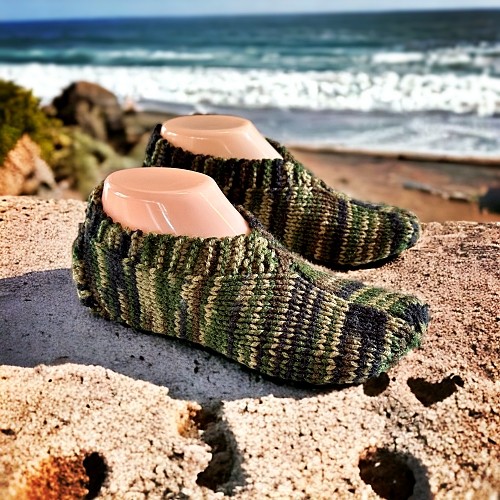
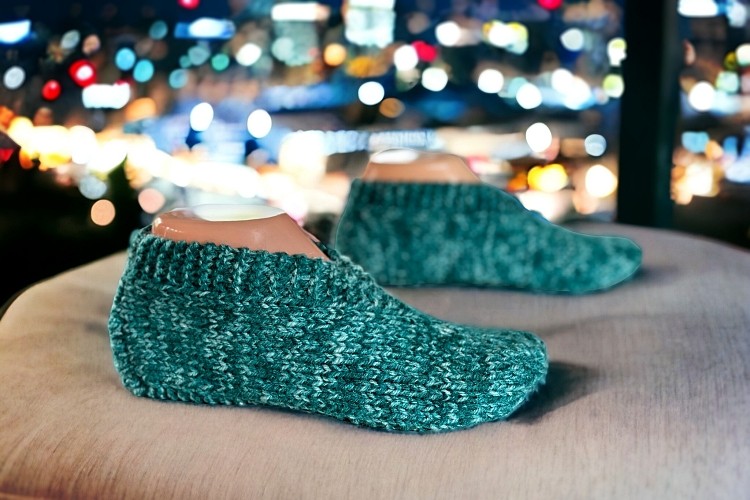
The sizing of these slippers is very forgiving. The garter stitch used throughout helps the slipper to stretch both width and length wise. If your gauge is off by a row or a stitch, you should be able to get the size of slipper you want.
Abbreviations
K – Knit
P – Purl
K2tog – knit 2 together
sts – stitches
st – stitch
The pattern allows you to make, sell or give away any of the slippers that you make. You are NOT permitted to redistribute this pattern in any way. The purchase the PDF is for your PERSONAL USE ONLY! Sharing copies of my patterns robs me of what I financially gain from my hard work and creativity that goes into designing my patterns. Please respect my copyright.
Well, I’m back at it again. Updating my old patterns with new photos and the occasional typo fix. I’m also very pleased to say that I have had enough of rehashing the old and am nearly done. Just a couple more to go.
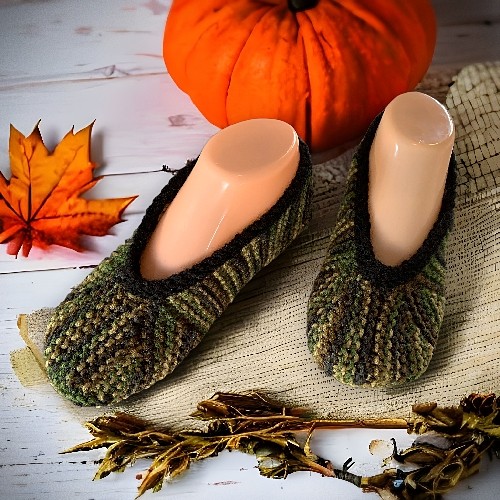
So like always I’ve made this compilation of my original slipper patterns available as a PDF, Kindle and physical book. The book is available only through Amazon at this point. Like my other compilations, please pick the country you’re from so if you are an Amazon Prime member, you’ll get the shipping for free.
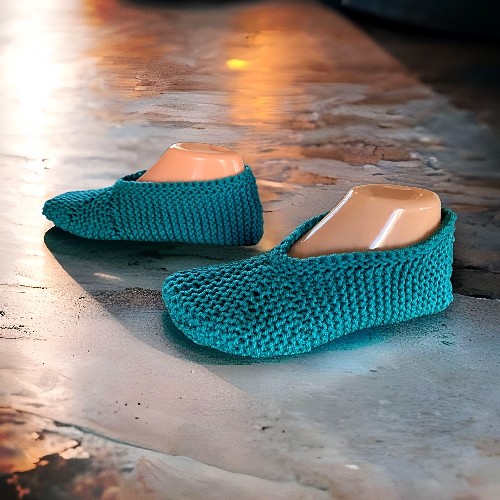
The patterns themselves are still all free to read on the website (the links are listed further down this post). You won’t be able to print them from the site. I lose ad revenue if you do… Betchya didn’t even think of that before ?. I’ve kept the cost for a printable PDF very low so it’s definitely within everyone’s budget. It’s less than a ball of yarn! You can purchase the PDF through this website here – Eight Slipper Styles to Knit or you can get it through my Etsy shop here – Eight Slipper Styles to Knit – Updated and Revised.
For those comfortable with reading patterns online, clicking any of the links below will take you right to it.
And to beat any Karen’s to the punch…if you’re scrolling past everything here to leave a nasty comment that I’m lying about free patterns. Or maybe you feel you need some passive/aggressive, poor you bullish!t that it’s too hard to close an ad to follow a link, please move on and don’t use my patterns. I don’t want my good in the world tarnished by someone as entitled as yourself. And also, learn how to use the internet before you start your self absorbed, unfounded complaints.
Improve your texting in cold climates with these thumbless mittens. More than just a pair of fingerless gloves, these keep your hands warm and only expose your thumbs when needed. The thumb pocket is sewn on and the flap is secured at the base of the palm with Velcro* for easy access. The flap hangs in the back out of the way to enable your texting abilities. Plan on using your thumbs for a while? Then simply tuck the flap into the thumb pocket.
The sizes are each written separately as each size is a bit different in row and stitch counts. Scroll down this post to the size you would like to make. Medium fits the average lady’s hand, large for men, and small for pre-teens.
Don’t forget to share this post!
Don’t want to come back here to read the pattern? You can download the pattern to your tablet, phone or computer from my website at Knit a Pair of Texting Mitts. You can also get it from other ebook retailers such as Ravelry, Etsy, and LoveCrafts. If the link isn’t working, I haven’t uploaded it to the site yet. It will be ASAP.
If you enjoy this and my other free knitting and crochet patterns, please Help Support My Work. It doesn’t have to be financial, though that’s always appreciated. Every like, share and follow also helps me keep this website running.
Another way to get instant, PRINTABLE downloads of this pattern and more, is by becoming a patron and supporting me on Patreon. When you support my work at the $4/month level or higher, the locked posts become visible and you can immediately access the download link. No waiting for an email. Simply click the PDF link at the bottom of the Patreon post and the download is now on your computer, smart phone, tablet or whatever device you’re using. You can then read it on your device or print it at your leisure. You can download as many patterns as you like for the same $4 each month. You can go to this website to become a patron and support my
Round 19: K1, pick up a st (scroll down to the bottom of the page if you want to see photos of how I do this), k1, pick up a stitch. Knit remaining sts.
Round 20 – 21: Knit
Round 22: K1, pick up a st, k3, pick up a stitch. Knit remaining sts.
Round 23 – 24: Knit
Round 25: K1, pick up a st, k5, pick up a stitch. Knit remaining sts.
Round 26 – 27: Knit
Round 28: K1, pick up a st, k7, pick up a stitch. Knit remaining sts.
Round 29 – 30: Knit
Round 31: K1, pick up a st, k9, pick up a stitch. Knit remaining sts.
Round 32 – 33: Knit
Round 34: K1, place next 11 sts onto the stitch holder. Knit the remaining sts.. There should be 31 sts divided on the three needles.
Round 35 and on: Knit in the round on these remaining 31 sts until work measures approximately 3.5 inches from the stitches held back to form the thumb.
Transfer the stitches onto two needles being sure that the stitches held back for the thumb are along the fold.
Break yarn leaving enough to graft the fingertips (if you scroll to the end of the post there are photos showing you how to do this) and sew in ends. 12 inches is plenty.
Finishing the Thumb
Worked over the 11 sts on the stitch holder. Leave the end you attach to complete the thumb longer than you normally would. You can use this to sew the thumb flap onto the mitten.
Pick up and divided the 11 sts on the stitch holder between the 3 double pointed needles. One of the needles will have more sts than the others.
Round 1 – 5: Knit
Bind off loosely.
Thumb Flap
Using 2 of your double pointed needles and working back and forth.
Cast on 3 sts.
Row 1: Knit
Row 2: Purl
Row 3: K1, pick up a st, K1 pick up a st, K1. (5 sts)
Row 4: Purl
Row 5: Knit
Row 6: Purl
Row 7: Knit
Row 8: Purl
Row 9: K1, pick up a st, K3, pick up a st, K1. (7 sts)
Row 10: Purl
Row 11: Knit
Row 12: Purl
Row 13: Knit
Row 14: Purl
Row 15: With the right side of your work facing you, cast on 3 sts. Working over the 3 sts you just cast on, K3. Leave these 3 sts on the needle you used to knit them. With another double pointed needle, knit the 7 sts from the previous row. With the wrong side of you work facing you, cast on 3 sts. Transfer these 3 sts onto another double pointed needle. You will now start knitting in the round.
Round 19: K1, pick up a st (scroll down to the bottom of the page if you want to see photos of how I do this), k1, pick up a stitch. Knit remaining sts.
Round 20 – 21: Knit
Round 22: K1, pick up a st, k3, pick up a stitch. Knit remaining sts.
Round 23 – 24: Knit
Round 25: K1, pick up a st, k5, pick up a stitch. Knit remaining sts.
Round 26 – 27: Knit
Round 28: K1, pick up a st, k7, pick up a stitch. Knit remaining sts.
Round 29 – 30: Knit
Round 31: K1, pick up a st, k9, pick up a stitch. Knit remaining sts.
Round 32 – 33: Knit
Round 34: K1, pick up a st, k11, pick up a stitch. Knit remaining sts.
Round 35 – 36: Knit
Round 37: K1, place next 13 sts onto the stitch holder. Knit the remaining sts. There should be 35 sts divided on the three needles.
Round 38 and on: Knit in the round on these remaining 35 sts until work measures approximately 4 inches from the stitches held back to form the thumb.
Transfer the stitches onto two needles being sure that the stitches held back for the thumb are along the fold.
Break yarn leaving enough to graft the fingertips (scroll to the bottom of the post where there are photos showing you how to do this) and sew in ends. 12 inches is plenty.
Finishing the Thumb
Worked over the 13 sts on the stitch holder. Leave the end you attach to complete the thumb longer than you normally would. You can use this to sew the thumb flap onto the mitten.
Pick up and divided the 13 sts on the stitch holder between the 3 double pointed needles. One of the needles will have more sts than the others.
Round 1 – 5: Knit
Bind off loosely.
Thumb Flap
Using 2 of your double pointed needles and working back and forth.
Cast on 3 sts.
Row 1: Knit
Row 2: Purl
Row 3: K1, pick up a st, K1 pick up a st, K1. (5 sts)
Row 4: Purl
Row 5: Knit
Row 6: Purl
Row 7: Knit
Row 8: Purl
Row 9: K1, pick up a st, K3, pick up a st, K1. (7 sts)
Row 10: Purl
Row 11: Knit
Row 12: Purl
Row 13: Knit
Row 14: Purl
Row 15: With the right side of your work facing you, cast on 5 sts. Working over the 5 sts you just cast on, K5. Leave these 5 sts on the needle you used to knit them. With another double pointed needle, knit the 7 sts from the previous row. With the wrong side of you work facing you, cast on 5 sts. Transfer these 5 sts onto another double pointed needle. You will now start knitting in the round.
With the right side of your work facing you:
Round 16 – 27: Knit
Round 28: K2tog twice, K1, K2 tog 3 times, K1, K2 tog twice, K1.
Round 29: Knit
Round 30: K2tog, K1, K2tog twice, K2tog, K1
Draw loops together and sew in the ends.
Large
The Mitt
Cast on 40 sts (loosely). Divide these evenly as possible on three of the double pointed needles.
Round 19: K1, pick up a st (scroll down to the bottom of the page if you want to see photos of how I do this), k1, pick up a stitch. Knit remaining sts.
Round 20 – 21: Knit
Round 22: K1, pick up a st, k3, pick up a stitch. Knit remaining sts.
Round 23 – 24: Knit
Round 25: K1, pick up a st, k5, pick up a stitch. Knit remaining sts.
Round 26 – 27: Knit
Round 28: K1, pick up a st, k7, pick up a stitch. Knit remaining sts.
Round 29 – 30: Knit
Round 31: K1, pick up a st, k9, pick up a stitch. Knit remaining sts.
Round 32 – 33: Knit
Round 34: K1, pick up a st, k11, pick up a stitch. Knit remaining sts.
Round 35 – 36: Knit
Round 37: K1, pick up a st, k13, pick up a stitch. Knit remaining sts.
Round 38 – 39: Knit
Round 40: K1, place next 15 sts onto the stitch holder. Knit the remaining sts. There should be 39 sts divided on the three needles.
Round 41 and on: Knit in the round on these remaining 39 sts until work measures approximately 5 inches from the stitches held back to form the thumb.
Transfer the stitches onto two needles being sure that the stitches held back for the thumb are along the fold.
Break yarn leaving enough to graft the fingertips (scroll to the bottom of the post where there are photos showing you how to do this) and sew in ends. 12 inches is plenty.
Finishing the Thumb
Worked over the 15 sts on the stitch holder. Leave the end you attach to complete the thumb longer than you normally would. You can use this to sew the thumb flap onto the mitten.
Pick up and divided the 15 sts on the stitch holder between the 3 double pointed needles. One of the needles will have more sts than the others.
Round 1 – 8: Knit
Bind off loosely.
Thumb Flap
Using 2 of your double pointed needles and working back and forth.
Cast on 3 sts.
Row 1: Knit
Row 2: Purl
Row 3: K1, pick up a st, K1 pick up a st, K1. (5 sts)
Row 4: Purl
Row 5: Knit
Row 6: Purl
Row 7: Knit
Row 8: Purl
Row 9: K1, pick up a st, K3, pick up a st, K1. (7 sts)
Row 10: Purl
Row 11: Knit
Row 12: Purl
Row 13: Knit
Row 14: Purl
Row 15: K1, pick up a st, K5, pick up a st, K1. (9 sts)
Row 16: Purl
Row 17: Knit
Row 18: Purl
Row 19: Knit
Row 20: Purl
Row 21: With the right side of your work facing you, cast on 5 sts. Working over the 5 sts you just cast on, K5. Leave these 5 sts on the needle you used to knit them. With another double pointed needle, knit the 9 sts from the previous row. With the wrong side of you work facing you, cast on 5 sts. Transfer these 5 sts onto another double pointed needle. You will now start knitting in the round.
With the right side of your work facing you:
Round 22 – 38: Knit
Round 39: K2tog twice, K1, K2 tog 4 times, K1, K2 tog twice, K1.
Round 40: Knit
Round 41: K2tog, K1, K2tog twice, K1, K2tog, K1
Draw loops together and sew in the ends.If you are unfamiliar with how to end the fingertips on mittens (this works for socks as well), I’ve added a picture tutorial at the end of another pattern. Instead of me adding all the photos and instructions again, here’s the link to learn how – How to Graft Fingertips.
Make another mitten to match.
Attaching the Thumb Flap
With the yarn left from where you continued the thumb, attach the thumb flap to the mitten. Make sure that you attach the thumb flap to the back side of the left and right mittens accordingly. Easiest way is to lay the mitts flat with the thumbs pointing in opposite directions.
Attaching the Velcro
Cut a small piece of Velcro that will fit on the base of the thumb flap. Keeping both halves of the Velcro together, attach it to the THUMB FLAP first. Glue it in place.
Keeping the Velcro pieces together, place some glue on the other half of the Velcro. Pull the thumb flap forward in the toasty warm thumb position. With the Velcro still together, place the Velcro where the bottom of the flap touches the palm of the mitten. Press firmly. DO NOT pull the Velcro apart until ALL the glue has dried completely.Like grafting the fingertips, I’ve also shown how to pick up a stitch without leaving a hole. If you’d like to see how it’s done, here’s the link to learn how – How to Pick up a Stitch.
Abbreviations
K – Knit
P – Purl
K2tog – knit 2 together
sts – stitches
st – stitch
Helpful Hints
Make sure when attaching the Velcro to the thumb flap, that the fuzzy half of the Velcro is what you use for the flap. In other words, which ever side feels less rough. The other pokey side should go on the palm of the mitt. That way the Velcro won’t stick to the inside of the thumb flap when folded back into itself.
When picking up stitches to finish the thumb on the mitt, leave a long piece of yarn to sew on the thumb flap. This saves on the number of ends to sew in when you’re done.
You don’t need a stitch holder. Even a piece of yarn will work.
Instead of glue, you can also sew the Velcro on. I find glue is simpler and quicker.
Inspired by the series Outlander, these gorgeous fingerless gloves are absolutely lovely! Like the designer Louise Bollanos, I too enjoy of the show and have noticed the great hand knit items that Claire wears throughout the series. The Hobbit was also pretty awesome and had knitters right onset knitting stuff. For real. It was in the extended version behind the scenes if you’d like to see for yourself. But I digress…
These fingerless gloves are knit in the round on double point needles (dpn) and the use of a cable needle. If you are comfortable with both techniques, then this pattern should be no problem for you to make.
Valentina shares step by step instructions for knitting this beautiful lace knit shawl. It would look gorgeous made with all of the self-striping yarns that are out there. The triangular shawl shape, with a diamond repeat pattern features a border edge with a series of romantic floral bouquet motifs.
As a blogger and pattern creator myself, I always have a soft spot for my fellow online posters of great patterns. I think there is something to be said for folks that go out of their way to design a pattern, a ton of work btw, and then give it away for free! So here is my latest shoutout to those I’ve found on the “intertubes” that deserve a a few extra page visits, views, likes and shares thrown their way.
These are some super cute slippers! Designed to fit both adults and children, you can read this pattern in full on the blog here. And did I mention, it’s free ?
I’ve always been a fan of crocheted mittens of any style, but I REALLY like the looks of these. I’m a fan of both the design and the colour. Bit of a sucker for the cooler shades… You can read the pattern on the blog here.
I’m always so impressed by the number of patterns available at this site and love these crocheted slippers! You can read the pattern for this lovely design here.
I actually like this purse/basket so much that I’m going to share this one again. I did once with another website I was running, but that’s a story for another day.
The basket is going to turn out based entirely on the yarn colour selections. I know that the yarn cakes are really popular right now but the colour changes may not be short enough to get this fabulous colour transition.
But enough on my views, get to making this now! Read the pattern here.
This is a great project for anyone! If you’re learning how to crochet or even if you’re an experienced crocheter (is that even a word) you’ll find the final product super useful. I have one sitting by my kitchen sink right now. And it was from a fellow crocheter (still not sure if that’s a word ?).
I’m including the how to video and the link where you can read the pattern online – The Best Kitchen Scrubbie
Sometimes it’s nice to have smaller projects that use up our stash ends. Sometimes we want to give something to that favourite child in our lives. Maybe we are sill looking for an excuse to make something a little more on the fun and whimsical side. Whatever the reason, knitting patterns designed for children seem to involve all those factors. Here’s a quick sampling of the few things I’ve found lurking about on the web.
So not necessarily a kid thing, it’s a bit more on the whimsical side by not being your basic square washcloth. It looks like tit’s knitted in the round but in reality, it’s knitted flat on 2 needles. The swooping effect is created by leaving a few stitches on the needle. Very ingenious.
Click here to read the pattern online.
Remember the stacking rings that children played with years ago? MThat was the first thing I thought of when I saw this. The star motif for the pattern is the same regardless of the size. What creates the difference in the sizes of the star is how many repeats you do.
Available as a download only, You can get the pattern through Ravelry here – Stacking Stars
Awesomely super cute! Knit up this toque (I’m Canadian, that’s what we call these here ?) that’s sure to make all the preschoolers a little envious.
You can read the pattern in full online here. There is also a PDF download but there is a fee required for that. The links to the downloads are on the website.
Available as a PDF download from KnitPicks, (tons of patterns there btw), I added this primarily because of the awwwwwww factor.
You can get the pattern here – Bear Washcloth
I didn’t know that a knitted pencil case was a thing until I found this. I have to admit, I like it. Available as a download only, you can find it on Ravelry here – The Toby Case
Knitting patterns that either help raise awareness for a cause or charity or are to give to someone comfort in their time of need. If you can’t directly help the organization that provides the pattern, maybe you can start a similar group to help those that live in your community. Let this page be an inspiration to you.
Knit up this tote bag to help raise cancer awareness. This would make a great gift for someone as a show of support.
Get the pattern here – Tote for a Cause
These “knockers” are useful for ladies as a prosthetic after a mastectomy. These are especially useful if the surgery is recent and the patient is tender.
Just about every country out there has a chapter of this group. A little research will certainly turn up something near you.
The link provided here offers complete step-by-step videos and has both crocheted and knitted versions of the patterns to download for free.
Download the pattern – Knitted Knockers
These are for babies that have been lost due to miscarriage, stillbirth and other complications. There is both a crocheted and knitted version of this pattern.
Click here to get the pattern – Baby Angel Pocket or Blanket
Why you may want to make these for your local hospital (as taken from the page linked to this entry) :
The babies are treated with dignity and respect just as a live baby would be wrapped up when it is born.
The blankets and angel pockets help hospital staff present babies to their family in a respectful way.
The angel pockets allow parents to ‘hold’ their baby without touching their skin, which is very fragile and deteriorates quite quickly.
A dead baby’s body starts to seep fluids shortly after death and the blankets help to ‘soak up’ some of that fluid.
Some parents want to keep the blankets they have bought for their baby so choose to bury or cremate them in the donated blanket.
The blankets may be kept as a keepsake. When there is very little to show for a baby, a pretty angel pocket or blanket will often be treasured forever.
It can get pretty dull for anyone who’s stuck in a hospital for any length of time. It’s even harder if you’re a young child. Why not whip up these cute inner puppets. You probably have enough leftovers in your stash to make them right now (I know I do).
Read the pattern in full here – Five Finger Puppets
Another knitting pattern to help raise awareness of breast cancer and show your support for those who’s lives it touches.
Read the pattern online here – Pink Ribbon Hat
These are perfect for the tiny little newborns in the hospital. They look super cute and help keep these new additions warm. Just about every hospital with babies can use these.
Get the pattern here – Hello Preemie Free Baby Hat
I do like a nice pair of slippers; I certainly do design a lot. But for some reason, maybe because all my spawn are older, I don’t get around to making children’s sizes very often. I actually don’t get around to designing much of anything for kids. Maybe I should… or better yet, I’ll let all the other good people out there design for kids and I’ll share their patterns on my website!
So with that, here is this week’s instalment of some fun, cute and quick to make knitting patterns for children I thought may tickle your fancy. And because I didn’t want anyone to feel left out, there is a treat for you adults in here too. Who doesn’t love Bunny Slippers ??
This is a basic knitted slipper pattern for kids with instructions on how to make cat and the dog head as shown. There are other head patterns that you can buy.
Read the pattern here – Animal Slippers
OMG! How cute are these!! A basic sock design with a few extra embellishments at the end to create some genuine mouse-y goodness. Now I don’t want to toot my own horn too much, but if you want to make something similar for an adult, I have a knitted sock pattern for adults all ready to go on here. Just sayin’ is all…
You can read the pattern for these super cuties here – Knit Mice Socks
Possibly the most fantastic knitted toddler pants to ever be created. And though the original pattern was more like the purple and green ones with the teeth, with a bit of tweaking, you could personalize these to be like the Elmo ones. But of course that would be Elmo inspired or a tribute to Elmo. Not the actual Elmo himself because that would be copyright infringement and we don’t want none of that sorta stuff ’round here.
Read the pattern here – Das Monster
I’ve shared these awesome slippers or socks before because I love them so much! This version is written for toddlers, but you can make them for adults too! Go to Ravelry and you can download the PDF from the same designer.
The pattern is written in full here – Knitted Duck Feet for toddlers and here – Duck Feet for Adults.
Yet another super cute pair of what really are tiny socks with ears and a bit of extra embroidery. But gosh, darn it! Look at what you get! The pattern ranges from 1 month to 4 years. I haven’t tried this pattern yet, but it’s done with very fine yarn and small DPN. If you used a larger gauge of needle and some thicker yarn, it may magically transform into adult sized socks. The number of cast on stitches is the same as my socks, so technically, it should work… let me know if you try.
Read the pattern here – Bunny Toes – Knitted Baby Booties
I’ll be honest, I had no idea what “thrummed” or “thrumming” was (or that it was even a word) until I found this pattern. Thankfully, this pattern not only explains it, but shows you how to do it. In this instance, it makes a cushier, thicker sole. I may need to keep this in mind for future designs…
The pattern is in adult sizes only and can be sans bunny parts to make a more sophisticated slipper for those with discerning tastes.
Read the pattern here – Bunny Hop Thrummed Bunny Slippers